Showing posts with label abuse. Show all posts

Saturday, March 8, 2014

Proposed Downtown Olympia Drug-Free Zone Ordinance Passes Committee


By Janine Unsoeld
To potentially thwart the activity of drug dealers in downtown Olympia, a proposed drug-free zone ordinance passed the city’s Land Use and Environment committee on February 20 and will now go to the full council.
It has not yet been scheduled to be heard by the city council as of this week.
The draft ordinance designates five civic centers located in downtown Olympia and the area within 1000 feet of the perimeter of each civic center as drug-free zones.
These civic centers include the Hands-On Children’s Museum on Adams Street, the Washington Center on Washington Street, the Olympia Center on Columbia Street, Olympia City Hall on Fourth Avenue, and the Olympia Timberland Library on Eighth Avenue. A map indicating the areas shows that the downtown core of Olympia is covered.
The draft ordinance, states, “…there is an increase in the consumption of illegal felony drugs, including methamphetamine and heroin….Drug-free zones will permit a potential enhanced sentence if a person is convicted of a felony drug offense in violation of 59.50.401, 69.50.410, and 69.50.204, excluding marijuana leaves and flowering tops….”
The creation of the draft ordinance was a joint decision made between multiple agencies and departments within the city. 
The police department worked with the city prosecutor, the Thurston County prosecutor, the Thurston County Sheriff, the city manager’s office, the Community Planning & Development department, the Parks department, and the Public Works department.
The top five reasons for arrests downtown in 2013 in descending order, are outstanding warrants, drinking in public, trespassing, assault, and narcotics, says Amy Stull, senior program specialist for police community programs at the Olympia Police Department.
Roberts and Tunheim Address Proposed Ordinance
Olympia Police Chief Ronnie Roberts and Thurston County Prosecutor Jon Tunheim explained the proposed ordinance in a brief presentation to the committee.
“State law allows this designation….It certainly is not the solution. We can’t arrest our way out…but it does allow us to identify those repeat offenders and refer those cases….All these areas are where we’ve had a considerable number of calls,” said Chief Roberts.
The proposed ordinance uses current statute language and does not take the passage of I-522 into consideration. “The marijuana discussion is different,” said Tunheim.
Tunheim said his office would use the designation as a strategy, and is a collaborative effort with other agencies. “It has a valuable role, and is really consistent with the ongoing efforts of the Olympia Police Department and all law enforcement leaders of the community with a more regional approach….I want to stress it’s not our intention to go on an all-out enforcement effort and jail everyone we can….It’s about the prosecution of drug dealers and the ability to address the chronic offenders with some enhanced sentence.”
Tunheim said that with an arrest for a felony drug case, the offender could go to the state prison system if the sentence exceeds one year, or it could get handled on a county level. “The enhanced sentence automatically kicks us into that conversation for treatment options, through the Drug Offender Sentencing Alternative (DOSA) or Drug Court.”
The Thurston County Superior Court Drug Court is a 12 – 18 month treatment program, but not everyone is eligible to participant.
Tunheim said, “Coerced drug treatment can be as effective as voluntary treatment, and that’s a shift of what we’ve known before….The more leverage you put on the table, the greater chance they can get treatment.  Make no mistake - dealers are in it for the money. That’s what they’re motivated by.”
Roberts and Tunheim would like a map of the ordinance area to be part of the ordinance. “Admitting it into evidence makes it easier for us, so we can say, ‘here’s the zone, here’s where the deal happened.’”
Tunheim added that the prosecution doesn’t have to prove that the offender knew it was a drug-free zone and says a dealer is defined as someone who possesses drugs and paraphernalia with intent to deliver. Evidence could include packaging, materials for the purpose of redistribution, scales, notes, records, multiple packages of all the same weight, and the presence of drugs.
“There is no automatic threshold – it’s just the totality of evidence,” said Tunheim.
Tunheim said he plans to ask the court to restrict the offender’s ability to come into downtown. “If the court puts that in place and a law enforcement officer knows they have that order, then they will be in violation of a court order, and the officer can engage that person and make an arrest.”
The specifics of an exclusion order will be addressed at the time the order is issued by the court, said Chief Roberts, when asked later by Little Hollywood.
Asked if there is capacity to hold additional offenders, Tunheim said yes. “Yes, we have capacity. We have for quite awhile. We face this challenge of people not looking at a lengthy sentence for a felony…they serve time, get out, and do it again. It’s tougher for us to push people into treatment….The Drug Court has their own treatment staff. There is capacity. In the county overall, outside the criminal justice system, for detox and drugs, there is a lack of capacity.”
Felony offenses are already illegal in parks so drug-free zone signs will not need to be placed in parks such as Heritage Park or Sylvester Park, which are governed by the state. It is expected one sign per city facility would be sufficient notice.
“The signs will send a message to the community that we’re taking this serious, that we’re cracking down,” said Councilmember Jeannine Roe.
Councilmember Langer said he would like to get the word out to the Tacoma community that dealers are not welcome in Olympia. Roberts and Tunheim said there are already collaborative efforts underway with the City of Tacoma Narcotics Task Force.
Connie Lorenz, executive director of the Olympia Downtown Association, asked about the Olympia Farmer’s Market. Roberts admitted that the market is not included in the zone and is a point of contention in discussions. “I was concerned with going too far. It is city property….the city attorney will have to weigh in.”
Councilmember Steve Langer invited public comment during the meeting, and community member Monica Hoover said that the proposed ordinance criminalizes poverty.
She followed up her comments with a letter to the council, saying in part, “I have no faith that the prison system contains solutions for the vast majority of the problems we are facing in society.  They are mostly part of the problem that drains resources away from what people really need.

“The United States has the highest incarceration rates in the world; many times greater than countries that we might consider our peers.  Longer sentences for drug related crimes are a significant part of this problem.  Please reject this ordinance and work for solutions that don't exacerbate the prison problem.”
Tunheim responded, saying that in the last 25 years, there has been a dramatic shift away from incarceration to treatment. “….Evidence is showing us that criminal justice gets people into treatment and use the system as a way to get into treatment.”

Roberts said that when people complete Drug Court, the charges are dismissed.

Roe said she views the proposed ordinance as a deterrent for hardcore dealers. “It may save some lives, and targets individuals making a business of this.” Langer agreed. “I support this. It deals with drug dealers and not users.”
Exclusion From Downtown Olympia
Later, Tunheim clarified for Little Hollywood that whether a certain offender is excluded from the downtown or not is ultimately a judge's decision and will likely be made on a case by case basis, depending on the circumstances of that case and the offender. 
“Both the state (through the prosecutor) and the defense are allowed opportunities to make recommendations to the court before a judge makes the decision.  My deputy prosecutors will generally recommend a condition like this if they believe the person continues to present a risk of further criminal behavior downtown.  A judge can potentially order someone excluded from downtown at any point in time after they are arrested and charged and, once imposed, a condition like this would likely last until the case is concluded. However, if the defendant is convicted, the same order can also be part of the court's sentence extending the condition up to a couple of years.”
To clarify questions regarding the Drug Court program, Tunheim also said later:
“In almost all cases involving drug related charges, participants who graduate have their charges dismissed.  That is part of the reward for successfully completing the treatment program.  Their “record” (because it does not involve a conviction it is generally only available to law enforcement) shows only that they were arrested and charged, but that the charge was dismissed.  If someone enters drug court but is terminated before they graduate, then the judge decides their guilt or innocence for the original crime based only on the information contained in the police report.  If convicted, then they will have that conviction on their record.”
Upcoming:
A conference, Substance Abuse: A Community Response, will be held Wednesday, April 30, 2014, from 9:00 a.m. to 4:00 p.m. at Great Wolf Lodge Conference Center, 20500 Old Highway 99 SW, Centralia, WA 98531.
Sponsored by the Thurston County Drug Action Team, the conference will provide educational breakout sessions, opportunity for discussion and collaboration, and informative professional keynote speakers.

Prevention leaders, treatment professionals, law enforcement professionals, educators, health professionals, government officials and community members are invited to attend. 

The conference is designed to cover all community sectors and focus on current and emerging issues, latest research findings, best practices, successes, lessons learned, and problems solved. The conference is designed for all levels of experience. 
 
Early-bird registration, on or before March 31, is $35 and includes lunch. Regular price registration, April 1 and later, is $45. Payment for registration must be received on or before March 31 to qualify for the early-bird price.
For more information, contact Tamara Clark, Events Coordinator, TOGETHER!, at tclark@thurstontogether.org or 360-493-2230 ext. 10.

For more information about the proposed ordinance, go to the February 19, 2014 story, “Draft Drug Ordinance Covers All of Downtown Olympia,” at www.janineslittlehollywood.blogspot.com.
The City of Olympia website is www.olympiawa.gov

Friday, January 11, 2013

Hidden In Plain Sight: Elizabeth Smart Speaks About Hope, Survival


Above: Elizabeth Smart

by Janine Unsoeld
www.janineslittlehollywood.blogspot.com

For Elizabeth Smart, the worst happened, but she is a survivor and now provides hope for other families whose lives are forever changed by the loss of a missing child.

Smart spoke Thursday afternoon at St. Martin's University to local Rotary groups and other community members. She was joined by Olympia resident Rani Hong, a United Nations spokesperson against human trafficking, and Thomas Nnour, 20, a student at Olympia High School who escaped war in his native Sudan.

The event was sponsored by the Rotary Clubs of Thurston County and many other local service and community organizations, state agencies, and businesses.

"None of us are perfect or have perfect lives...Many of us say, 'Please, let this day be over.' Every single one of us, we all have our trials in life...No one else can understand exactly how you feel...but no matter how bad life gets, it will get equally as good....The worst time in my life was a story you all know about...." she began.

Smart lead her listeners into the very difficult subject of her kidnapping from the safety of her home in 2002 at age 14. She endured rape and torture for nine months, until she was discovered walking on a street with her captors in Salt Lake City. Her discovery was based on a tip called into 911, and her captors were confronted and arrested by police officers.

"I'll never forget the morning I was kidnapped and taken up into the mountains...I was brought into a tent, and the man followed me inside, and zipped up the tent. I was crying....I screamed out...." The man said he would kill her if she screamed again. She did not scream again. "I knew I wasn't ready to die yet...." Describing what he did and her feelings, she wondered if her parents would want her back.

"I was a 14 year old girl...I didn't watch the news much, but while I was on the floor of the tent I thought of those stories, saying that 'they found her body' and thought, they are the lucky ones, because they don't have to feel like their souls have been crushed...I fell asleep to those thoughts. I was chained up...I felt like my life wasn't worth living anymore. I was sentenced to a life less than an animal....I was a junior high school student about to graduate. I thought about how much I had changed in a day, I thought of family, my mom in particular...I didn't want to forget my mom's voice...."

Smart smiled as she remembered her disgruntlement upon hearing her mother's voice as a child telling her to go practice (harp), and do the dishes. Sometimes her mother gave her a choice - do the dishes or go practice, but her mother also said, "'once you're done with the dishes, you'll still have to practice.'" Of particular irritation to Smart was the sound of her mother singing at the top of her voice, "Oh What A Beautiful Morning!" to wake up her and her siblings at 6:30 a.m. or 7:00 a.m. each morning to get ready for school.

But as Smart lay on the floor of the tent, raped and alone, she thought of her mother, and said, at that time, "I would have given anything to hear her at that moment...."

Her mother also always told her that 'nobody's opinions mattered except for God's and mine.' Her mother always told her that 'He loves you and will never turn your back on you', and 'I will always love you, you will always be my daughter.'"

"Those words stayed with me and I decided I would survive, no matter what. I knew one day I would walk home....That decision was a big turning point for me. The things I was forced to do, no one could make me do now...."

Smart said the first happiest day of her life was when she was married early last year, and the second is when she was reunited with her family. A 911 caller had called to say that she thought she saw Elizabeth Smart on the street with her captors.

Smart had been coached by her captors with a story if there were ever any questions by anyone, and was told that if she didn't stick with the script, she and her family would be killed. Smart stuck to the script even as police questioned her that day. Finally, one police officer decided to separate her from her captors and asked her point-blank, "Are you Elizabeth Smart?"

In her mind, she said 95% of her wanted to say, 'Yes! Save me!' but the other five percent wondered, 'what if they don't believe me?' She said the majority won out, and she admitted that she Elizabeth Smart.

Smart was reunited with her family. "When I saw my mom, if I ever wanted to know what heaven was like, it was seeing her..." Smart said the best advice her mother then gave her was that 'the best punishment you can give that man is to be happy'...so, I knew he would never steal another second from me again."

"We all have trials and rough spots, we can all come up here and tell our stories and we would all be amazed...I am grateful for what happened because of the opportunities and doors it has opened to me and what I'm able to do now - I wouldn't be able to speak for so many who can't speak out - right now there are so many children who are waiting for their miracle...for their chance to come back...people like you made a phone call. If you ever see anything suspicious, make the phone call. You never know whose life you'll be saving - best case scenario, there's nothing wrong. You could make a difference....Never hesitate...That phone call is what brought me home...." Smart concluded.

Rani Hong

Olympia resident Rani Hong spoke about her story of being kidnapped at age seven from her village in southern India. Near death by age eight, she became worthless to her kidnappers, and was illegally sold for international adoption and went to Canada. Eventually, she was brought to Olympia. She attended Garfield Elementary, Roosevelt, Reeves Middle School, and Olympia High School.

"I'm here to prove that, with love, we can heal," said Hong. Hong founded the Tronie Foundation and is a United Nations spokesperson against human trafficking. Another struggle at age 17 tested her emotional strength: her adoptive mother died of cancer when when she was a sophomore at Olympia High School. "I was alone and vulnerable again...at 17 years old I wanted to run away, I didn't know what to do. I didn't want to tell anyone of my circumstances. I was going to drop out...."

Hong said she chose to live for tomorrow and because Rotary gave her a scholarship for her education to South Puget Sound Community College, she felt her community cared about her. Addressing the membership of several South Sound Rotary groups, she said, "It saved my life...never forget that...."

At age 28, in 1999, she was reunited with her birth mother, who had slept with her picture under her pillow every night. "I found her in a tourist hotel in India...my mom cried and cried....don't ever lose hope...."

Thomas Nnour

Hong introduced Thomas Nnour, a 20 year old Olympia High School senior, who addressed the group. Hong said it was his first time speaking publicly about his story as a Sudanese escaping war and his journey to Olympia.

His story, too, was a story of hope and survival.

"I left my homeland, war happened, so when the war starting, shooting, bombing, I see people dying, running around, airplanes bombing. We ran, ran, kept running. We walked nighttime and daytime. During our travel, many people, old people and kids (dying) on the way because they tired, there's no food or water...our enemy keep coming, fighting us. I was going to Ethiopia. On my way, we walk daytime and nighttime. From there, there were sick people who give up. We end up in Ethiopia. From there, we settled down. The Sudanese army coming and collecting little kids, kids. I didn't want to fight. The army came looking for kids. We escaped. I saw them but I ran away from them because I didn't want them to take me....From there, in refugee camp I live there as a minor so I have no mom. The UN (United Nations) - but we in a group - give me food and blanket at nighttime. Three years after what happened...they ask me, they find a better place. They would help me learn and find education. They did - they will take me to U.S. They want me to do interview and medical exam. Finally, they brought me to Washington State, put me in apartment. I learned to read and write and pay the bills every month. A lady comes and helps me. This is what I have...." Nnour continued his story saying he would like to go to college in the future. "It costs a lot...you have to pay for things, books, everything costs money when you go to college."

Matthew Grant, principal of Olympia High School, was clearly proud of Nnour, listening to Nnour and taking pictures of him greeting Smart and other well-wishers. About Nnour, Grant said, "He's one of the most loved students I've ever met at Oly, and he's one of the hardest working on so many levels...He's friendly, he's in tutoring...his work ethic is outstanding. He's a shining star at our school."

Above: Thomas Nnour and Rani Hong
The Kyron Horman and Lindsay Baum Families Wait For Their Miracles

A resource and information fair involving over 40 local organizations and agencies was held throughout the afternoon. Speakers from various groups gave brief presentations about their work.

Grays Harbor Police Chief Rick Scott is involved with the investigation of  Lindsey Baum, last seen June 26, 2009 in McCleary, Washington. He said that almost from the beginning, with his 30 years of law enforcement experience, "this didn't feel like a missing child." His agency quickly mobilized 30 FBI agents and over 100 officers within two days of her disappearance just blocks from home.

"You can never activate enough resources too soon when a child is missing....The case is active. We have investigated 4000 different tips and have continued to maintain a task force with the FBI, the Washington State Patrol, and other law enforcement. We continue to believe in our hearts that we'll bring Lindsay home."

Later, in an interview with Lindsey Baum's mother, Melissa, she said she was overwhelmed by Smart's talk. "The part where she said she wondered if her mother could ever love her again (after being raped), and how worthless she felt, got to me. I don't often cry in public, but that got to me....We're all so worried about minding our own business - I'm guilty of that too - but kids need to know that they will always be loved, no matter what...."

The Grays Harbor police department is currently thinking about issuing an age progression picture of Baum. It's been four years and her appearance has likely changed. Kyron Horman, age seven, disappeared from Skyline Elementary in Portland, Oregon on June 4th, 2010. Oregon authorities have already issued age progression pictures of him, with and without his glasses.

Human Trafficking and the Statistics

Human trafficking is the use of force, fraud, or coercion to compel a person to work. Human trafficking is modern day slavery. According to the National Coalition Against Domestic Violence, 80% involves sexual exploitation, and 19% involves labor exploitation.

Human trafficking has been reported in all 50 states. Eighty percent of trafficking victims are female. Human trafficking is the third most profitable criminal activity, following drugs and arms dealing.

The U.S. Department for Health and Human Services estimate there are 300,000 teenagers who become involved in prostitution across the United States. According to the U.S. Department of State, 50% of trafficking victims internationally are under age 18.

In Washington State, around 80% of trafficked victims are forced into the labor maket. The 2010 Trafficking In Persons Report released by the U.S. Department of State reports that trafficking occurs primarily for labor in construction, manufacturing, health care and elder care, janitorial service, hotel services, domestic servitude, and agriculture. Due to its proximity to the border and waterways, the Seattle area is ranked in the top six places in the world to sexually exploit young boys and girls.


Anyone having information regarding Lindsey Baum's whereabouts are asked to contact 1-866-915-8299 or go to www.FindLindseyBaum.com. Anyone having information regarding Kyron Horman's whereabouts are asked to contact (503) 261-2847 or go to www.BringKyronHome.org.

Established in 2006, the Tronie Foundation creates safe havens for women and children victimized by international slave organizations. For more information about the Tronie Foundation, go to www.TronieFoundation.org.

The Zonta Club of Olympia works to advance the status of women by improving their legal, political, economic, educational, health and professional status. For more information, go to www.zontaolympia.org.

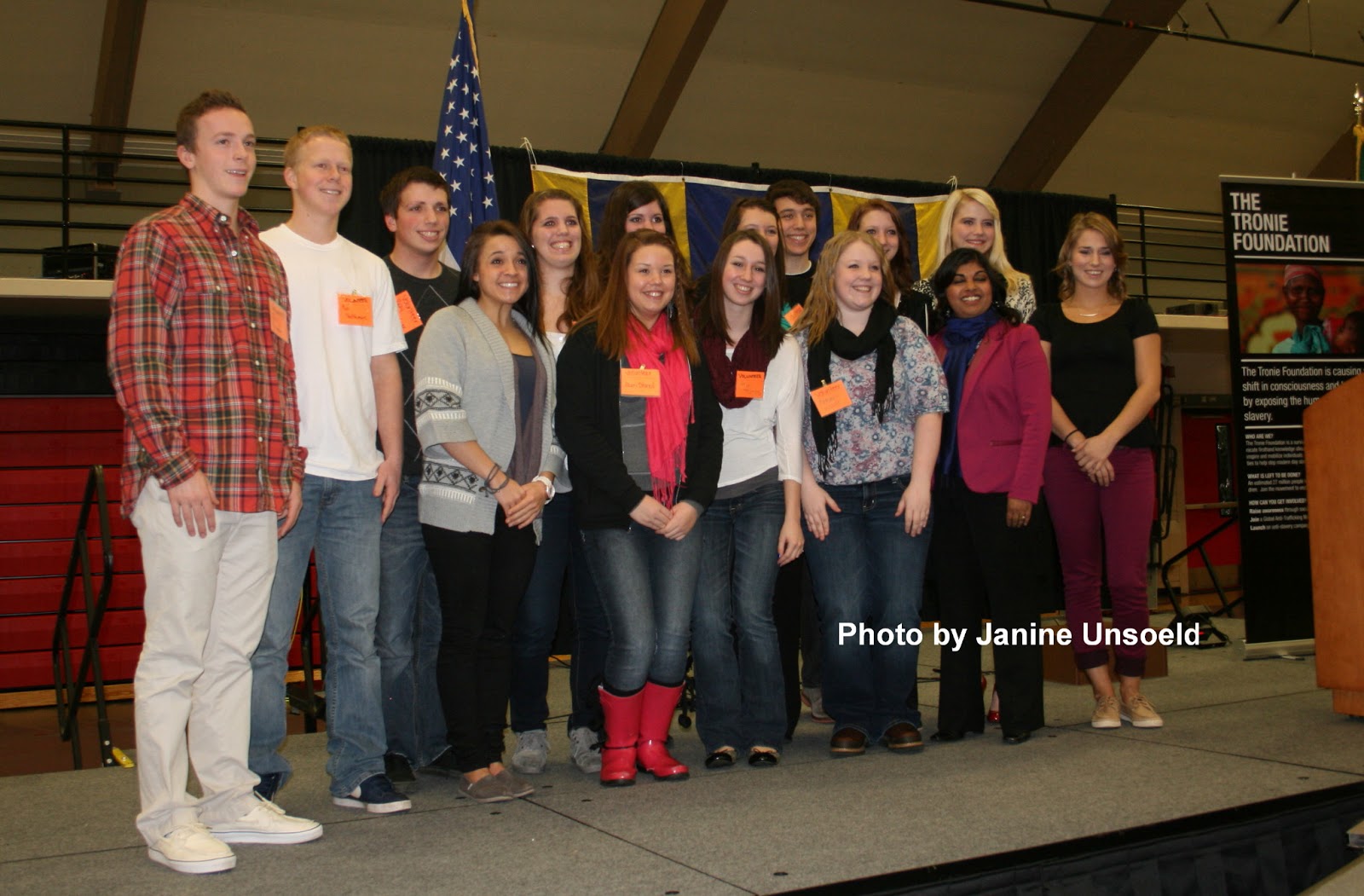
Above: Rotary Interact student club members helped organize the event to bring Elizabeth Smart to the South Sound. Students from Rainier High School, Olympia High School, and Timberline High School pose with Rani Hong, second from right, first row, and Elizabeth Smart, back row, first from right.