Showing posts with label officers. Show all posts

Tuesday, July 12, 2016

Police Use of Deadly Force Study Underway


Legislative Committee Examines Use of Deadly Force Law, Issues

Above: Fe Lopez, representing OneAmerica, an immigrant advocacy organization, speaks at the first meeting of the Joint Legislative Task Force on the Use of Deadly Force in Community Policing in Olympia. She is also the executive director of the Community Police Commission in Seattle. The 26 member legislative task force met for three hours on June 28.

By Janine Gates

“I do believe that this issue is not an either-or…you can be a complete advocate and supporter of law enforcement as I am, and you can also be an advocate for community safety. I think the common ground we all share is to have a safe community. Everyone wants to go home to their families at the end of the day and I think if we keep that in mind as we go through this process, it would be very helpful,” said Gloria Ochoa-Bruck, Washington Commission on Hispanic Affairs.

Ochoa-Bruck’s words at the first meeting of a joint legislative task force on the use of deadly force in community policing on June 28 takes on new meaning as feelings of insecurity, tension, grief and outrage increased and challenged Americans this week.

Later in the meeting, Ochoa-Bruck said, “If you take away the badges, what does that look like? There are apparently two very different standards....

In response to the five police officers killed in Dallas and for the recent police shootings of Alton Sterling in Louisiana and Philando Castile in Minnesota, the work of the joint legislative task force should be made all that much more urgent.

Task Force on Use of Deadly Force in Community Policing

A bill signed into law by Governor Jay Inslee in April, ESHB 2908, created the 26 member task force on the use of deadly force in community policing.

Above: Getting a bill through the Legislature and signed is sometimes only half the battle. Now the real work begins. Governor Jay Inslee signs ESHB 2908, surrounded by prime sponsor Representative Cindy Ryu (D-32) and a few bill advocates in April 2016.

The 26 member task force buckled down June 28 for their first meeting, which lasted three hours without a scheduled break, in a hearing room at the state Capitol Campus in Olympia.

About 35 people observed the proceedings, including members of Olympia area community groups such as the Faith Action Network, Interfaith Works, Unity in the Community, and the League of Women Voters. Local law enforcement observers included Thurston County Prosecutor Jon Tunheim and staff members of the City of Olympia police department.

The task force will review the history of Washington State’s law, best practices used by state and national law enforcement agencies, examine the wide range of reporting requirements, and current training curriculum and practices and use of force policies. 

Staff briefly reviewed ESHB 2908 and explained when police use of deadly force is justifiable under state law.

Goodman confirmed that one of the main reasons the task force convened is to examine the use of deadly force by law enforcement and whether or not the law needs to be changed and to look at ways in which law enforcement establishes relations with communities.

“….I’m here because our community depends on law enforcement and we’re all here interested in keeping the peace. We recognize that police officers have a difficult job and we all have a stake in law and order….This effort here today is not about good cop, bad cop, or placing blame, it’s about coming together to build and strengthen trust within our communities and within the law enforcement community….I’m here to listen and learn and come to a solution that works for everybody,” said Timothy Reynon, a member of the Puyallup Tribal Council, representing the Governor’s Office on Indian Affairs.

Conversation around the issues echoed their representative positions and issues discussed nationwide, leading one task force member, Gabriel Portugal, representing the Latino Civic Alliance, to be ready within an hour’s time to start making motions and move forward.

But task force chair Roger Goodman (D-45) was not to be rushed, wanting to hear thorough introductions and lay the issues on the table, making sure all were heard.

Goodman said the task force will be inclusive, respectful, and deliberate, for “as long as it takes.”

The committee has until December 31 to meet at least four times to discuss a wide range of issues related to the statewide use of deadly force in community policing and produce a report of their findings.

Despite the tight timeline in which to conclude their efforts, the group was not split up into subcommittees, nor expectations provided or requests made to committee members.

Future task force meetings will be held July 26, 9:00 a.m. – 12:00 p.m. and September 13 at 1:00 p.m. – 4:00 p.m. at the Washington State Criminal Justice Training Commission in Burien.  Details for another meeting, scheduled for November, are to be announced. 

“I want Washington State to lead the nation in the process to help build trust and reciprocity between communities that feels underserved and the law enforcement that serves them,” said Goodman.
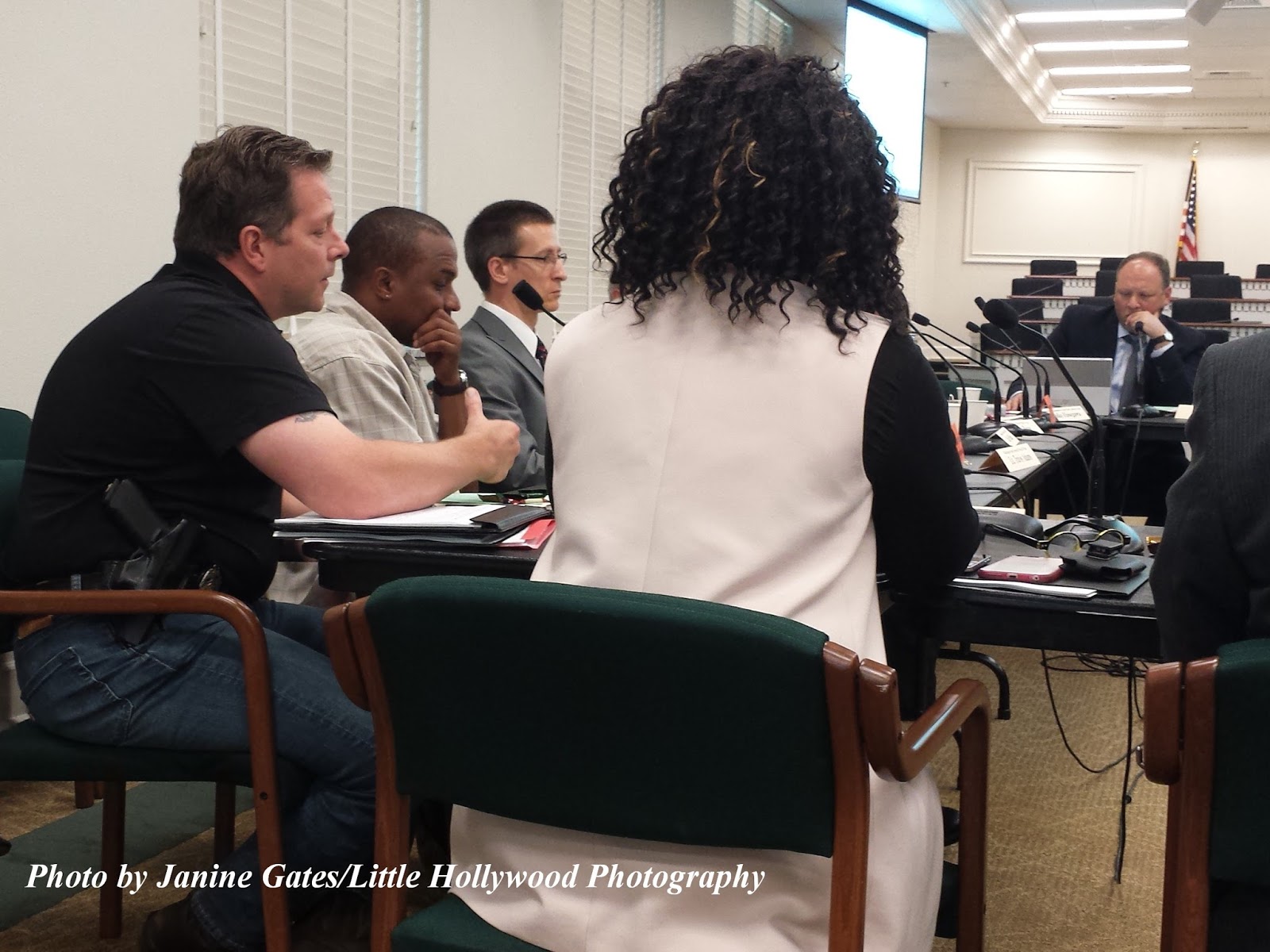
Above: Twenty-six year veteran Seattle police officer Kerry Zieger, representing the Council of Metropolitan Police and Sheriffs, speaks to task force members. Sitting to his left is Gerald Hankerson, representing the National Association for the Advancement of Colored People (NAACP).

Zieger said he was recently involved in an incident on May 1st in Seattle. He and a couple of bicycle officers were surrounded by 50 – 70 individuals wearing masks and throwing objects. He said he was hit by a piece of cement or a rock and injured.

“At the time I was struck, that entire city block was unprotected because now it became a violent situation…all the officers could do was protect themselves and wait for others to come in and rescue the officers. A rock can be a deadly weapon. Another inch lower and I would have lost my eye….”

Zieger said he was out of work for six weeks and still suffers pain and headaches as a result. Use of deadly force against the protesters would have been justified in that incident, he said.

Only Washington State law provides a defense against prosecution when a police officer acts “without malice and with a good faith belief that such act is justifiable.” 
Malice is defined in law as “evil intent.”

Another police related bill heard during the 2016 Legislative Session, HB 2907, would have removed language from RCW 9A.16.040, which states that an officer who acts without malice cannot be held criminally liable. It did not pass out of committee. That bill, sponsored by Representative Luis Moscoso, (D-1) was spearheaded by members of the Black Alliance of Thurston County.

Amnesty International calls Washington State’s law regarding use of deadly force as the “most egregious” in the nation.

The United States has failed to track how many people are killed by law enforcement officers. No one knows exactly how many people are killed each year, but estimates range from 400 to over 1,000.

According to The Counted, an ongoing investigation by the Guardian into the use of deadly force by police, African American males between the ages of 15 and 34 comprised more than 15 percent of all deaths logged this year. Their rate of police-involved deaths was five times higher than for white men of the same age.

Paired with official government mortality data, this new finding indicates that about one in every 65 deaths of a young African American man in the U.S. is a killing by police.

Also according to the Guardian, 12 individuals in Washington State have been killed by law enforcement so far this year.

Task Force Conversations

Representative Goodman encouraged an open, freewheeling conversation between members. Feedback moved swiftly as participants articulated their viewpoints.

While Representative Goodman asked the group several questions that helped frame the conversation, some were quick to not allow him too much freedom in making assumptions.

Starting with law enforcement recruitment, retention, training, and disciplinary methods, and taking a critical look at data collection, Goodman said he wanted to learn more about how Washington State’s statute came about, and that as a result of their conversation, their “to-do” list will get longer.

“….Do law enforcement agencies have the diversity and reflect the community that they serve? You have to collect the dots before you can connect the dots….The use of force reports would help provide that information,” said Goodman. Goodman said that he heard that fewer than two percent of public interactions with law enforcement involve of use of force.

“That’s really a small percentage…they are really very rare,” said Goodman.

“That depends on the validity of the reporting,” responded Laura Daugaard, representing the Public Defender Association of Seattle. Daugaard explained how reporting systems vary widely.

Che Taylor and Zambrano-Montes Cases

Task force members also challenged Goodman’s direction when exploring their scope of work.

After the shooting deaths of Che Taylor of Seattle on February 21  and Antonio Zambrano-Montes of Pasco in February 2015 had been mentioned by committee members several times, Goodman said he didn’t want to hear those cases retried.

Several committee members responded, saying that the lessons of those officer involved killings must be discussed and analyzed and that there is much for the committee to learn by doing just that.

Zambrano-Montes, a farm laborer with a history of mental illness, was shot by police in February 2015.

“….Within five minutes and 15 seconds, he was shot 17 times with 45 caliber bullets. Eight of those bullets killed him. The prosecutor declined to bring charges…it’s real difficult for a prosecutor to take a case like that…Yes, there are times officers need to use deadly force, there’s no question about that. The concern we have as a community is accountability and so prosecutors don’t have their hands tied by language in the statute,” said Gabriel Portugal, Latino Civic Alliance.

Che Taylor was killed by Seattle police in February and the case is still under investigation.

“To the data issue, we have to look at those cases…and the case in Olympia....because that's where we can learn statewide what's going on. We have to look at them critically...to see what's going on within those communities and what happened with those prosecutors and why they made those decisions,” said Fe Lopez, representing OneAmerica, an immigrant advocacy group.

“There’s a lot of passion in this room. If you don’t have a knot in your stomach, we’re not doing it right…I want to use the Che Taylor and Antonio Zambrano-Montes cases as a springboard to learn from each other,” agreed Cynthia Softli of the Black Law Enforcement Association of Washington.

Law enforcement representatives were often coaxed by Goodman to enter the conversation, but when they did, they represented their agencies well.

Snohomish County prosecutor Mark Roe, representing the Washington Association of Prosecuting Attorneys, said he has never felt like his hands were tied to not prosecute an officer if the facts warranted it.

“…I understand angst about “malice.” There is a huge continuum about use of force…between hands on them and everything in between.”

He described the procedures used by a multi-agency response team and their protocol for a major incident. He said a lot of the task force’s work will be about public perception and confidence.

“There have got to be better ways to avoid altercations,” he said.

Mason County Lieutenant Travis Adams, representing the Washington State Fraternal Order of Police, responded that law enforcement is specifically called to go to the incident.

“We are thrust into a situation that a civilian is not….”

Showing that law enforcement protocols have changed, Rich Phillips, representing the Washington Council of Police and Sheriffs, said that the science of memory, recall, action, and reaction is evolving very rapidly.

In the old days, the standard law enforcement reaction after a critical incident was, “no comment.” Now, they are out ahead of the curve to help with perceptions and provide what they know, but it is not an exact science.

Captain Monica Alexander, representing the Washington State Patrol, said it was important to establish trust before an incident happens.

“After an incident, everyone goes to their corners – let’s have that relationship before the incident.”

Jorge Baron of the Northwest Immigrant Rights Project, responded by saying there is a racial disparity as to the subject and use of deadly force.

“How do we avoid those situations?” he asked. Baron said he took a test and discovered that he held an implicit bias against African Americans.

The conversation was flowing at a pretty good clip until a comment by Senator Kirk Pearson (R-39), saying that as a man of faith, he did not have any bias against anyone.

The comment seemed to set the committee back two and a half hours and 200 years, as some members of the committee and many audience members audibly groaned.

Above: Andre Taylor greets members of the task force after the meeting. Left to right, nearest the camera, Gloria Ochoa-Bruck, Washington Commission on Hispanic Affairs, Fe Lopez, OneAmerica, Karen Johnson, Black Alliance of Thurston County, and Taylor. 

I-873 – Not This Time

Andre Taylor, the brother of Che Taylor, the man killed in February by Seattle Police officers, was present in audience, as well as Che Taylor's wife, Brenda. 

Andre Taylor moved to Tacoma four months ago from Los Angeles and is now working on Initiative 873 - Not This Time, which concerns the use of deadly force by law enforcement, public officers, or peace officers.

The initiative petitions to remove the “without malice and with a good faith belief” clause in state statute. Several state legislators have endorsed it and United States Congressman Adam Smith (D-9) endorsed the initiative in June.

After the death of his brother, Taylor said he didn’t believe in shutting down and now has a good relationship with Seattle Police Chief Kathleen O’Toole. Taylor says he thinks it’s a problem if there are those on the committee who don’t think we have a problem.

“….What is our primary intent for being here? I think there is a lack of leadership within our police forces that allow certain things to go on where an officer can treat our citizens worse than a military treats our alleged enemies and that’s power....If we don’t recognize there is an issue in this country as Americans, then we have a problem. We have to fix it…. I believe that we have an opportunity in Seattle, Washington to do something and create a blueprint for the rest of the country…The more we inform people about the way our law is written, they are in shock. My job is to bring the information to the people. And I would hope, as we get this law changed, that this group we have here (the task force) is not being left behind because we’re moving forward and it’s going to get done,” said Taylor.

The 26 member committee is composed of Representative Roger Goodman (D-45) and Senator Kirk Pearson (R-39), who will take turns chairing the meetings, Representative Dave Hayes (R-10) and Senator David Frockt (D-46) and representatives of  the Washington State Fraternal Order of Police, Washington State Patrol, The Tenth Amendment Center, Northwest Immigrant Rights Project, Public Defender Association, National Association for the Advancement of Colored People (NAACP), Association of Washington Cities, Washington State Commission on Asian Pacific American Affairs, Washington Association of Sheriffs and Police Chiefs, Black Alliance of Thurston County, OneAmerica, Disability Rights Washington, Washington Commission on Hispanic Affairs, Washington Council of Police and Sheriffs, Latino Civic Alliance, Washington Commission on African-American Affairs, Criminal Justice Training Commission, Governor's Office on Indian Affairs, Washington Association of Prosecuting Attorneys,  Black Law Enforcement Association of Washington, Washington State Association of Counties, and the Council of Metropolitan Police and Sheriffs.

For more information about the task force, HB 2907, HB 2908, Amnesty International’s report, “Deadly Force: Police Use of Lethal Force in the United States,” City of Olympia police issues, community policing, Karen Johnson, the Black Alliance of Thurston County, race, bias, and related topics, go to Little Hollywood, www.janineslittlehollywood.blogspot.com and type key words into the search engine.

For more about the task force from the Washington State Legislative body, go to http://leg.wa.gov/JointCommittees/DFTF/Pages/Members.aspx

The event was taped by TVW and can be viewed at http://www.tvw.org/watch/?eventID=2016061155

Editor's Note, July 13: Caption for top photo is now correct. The person speaking is Fe Lopez, not Gloria Ochoa-Bruck. I also straightened out a couple quote attributions. Thank you TVW.

Thursday, February 4, 2016

Black Alliance Packs Hearing for Police Deadly Force Bill, HB 2907


Above: Dr. Karen Johnson, Black Alliance of Thurston County, testifies in support of HB 2907 before the House Public Safety committee chaired by Representative Roger Goodman (D-45) on Wednesday. 

Senator Fraser Sponsors SB 6621 Calling for Policing Task Force, Hearing Also on Wednesday

By Janine Gates

The room was packed for a public hearing on Wednesday for HB 2907, which seeks to clarify state law governing the use of deadly force by police officers. The bill, spearheaded by the Black Alliance of Thurston County, was sponsored by Representative Luis Moscoso (D-1).

Washington State House Public Safety Committee Committee chair Representative Roger Goodman (D-45) said that 65 people signed up to testify. Only a handful was able to give their testimony, although he allowed the meeting to go 20 minutes longer than expected.

Most testified in support of the bill, with some, including the Washington Association of Prosecuting Attorneys, Washington Association of Sheriffs and Police Chiefs, and Concerns of Police Survivors, opposing or expressing concerns.

Dr. Karen Johnson, chair of the Black Alliance of Thurston County, presented an overview of how the group began its efforts just a few short months ago, and described her organization’s efforts to build a relationship with Olympia Police Chief Ronnie Roberts after the officer involved shooting of two African American young men in Olympia.

Johnson promoted the police department’s mission and strategic plan, and said the Black Alliance is eager to help the department garner the respect and trust of Olympia residents, and to make sure police get the training they need to begin changing the culture within the department.

Encouraged by her story, Representative Goodman praised Johnson’s efforts.

“...We have a lack of trust between communities and law enforcement, but it seems you’ve done a lot of work on a local level to bring people together….Who did you bring to the table and is there a template for what we could do on a state level?” he asked.

Johnson responded that it’s about communication and having courageous community conversations about racial bias and institutional racism with the police department, and exploring the experiences and questions around those themes.

She said Olympia’s next community conversation with the Olympia Police Department is scheduled for March 2.

“I think we’ve been doing an awful lot of talking to them, and it’s time we start listening to what they need from us,” said Johnson.

“I agree, I think we need to listen to the police,” responded Goodman.

Jamira Burley, with Amnesty International’s campaign on criminal justice and gun violence, spoke in support of the bill, saying that HB 2907 takes significant steps to provide needed clarity and accountability in regards to the use of lethal force by officers.

Burley said that the use of lethal force by police in the February 2015 case involving Antonio Zambrano-Montes, a farm laborer with a history of mental health issues who was shot and killed by police in Pasco, was inconsistent with international law and standards on the use of lethal force.

Lisa Daugaard, director of the Public Defender Association in Seattle, also spoke in support of the bill and described the 2010 killing of Seattle Native American woodcarver John T. Williams by a Seattle police officer.

“The Seattle Police Department itself concluded that the killing violated policy on use of force, the first time that had happened in decades. This was not a reasonable mistake – it was an unreasonable mistake, at best. Officer Birk was not reasonable in thinking he was under attack, and he was not reasonable in thinking deadly force was necessary to forestall any attack. This was widely accepted. If ever a killing by a police officer might be prosecuted as a crime under the current law, it seemed to most observers that it would be this one. And yet Ian Birk was not prosecuted…..”

“…For those who are uncomfortable with the approach taken in this bill: it’s time to offer an alternative solution that would have allowed a prosecution in Mr. Williams’ death. A group of concerned community leaders has done its best to propose a solution that is fair to officers and community members alike. If you are uncomfortable with this solution, please, identify another that will change outcomes in the most egregious of these cases,” said Daugaard.

Noah Seidel of Lacey who represents Self-Advocates in Leadership, a group of over 200 people with developmental disabilities, also spoke in support of the bill.

“Mental health problems is not the only kind of disability that people have had when killed by police officers. John T. Williams…was also partially deaf. When he was killed, the officer was behind him telling him to stop. Disability was a factor....We need to do a better job holding law enforcement accountable to keep people safe,” said Seidel.

Seidel said that, according to a 2013 report by the Treatment Advocacy Center and National Sheriffs’ Association, at least half of the people shot and killed by police between 1980 and 2008 in the United States had mental health problems.

Rick Williams, the older brother of John T. Williams, also spoke.

“For five years all this talking and no action…He (Officer Birk) gets a free pass. Why is this guy still walking free? It’s not right…I can’t get my brother back but I can help people stand up for him. Somebody has got to it do because this is all wrong,” said Williams.

The committee also heard testimony about HB 2908, which creates a 13 member joint legislative task force on community policing standards. The bill’s prime sponsor, Representative Cindy Ryu, (D-32), spoke to her bill.

James McMahon, policy director with the Washington Association of Sheriffs and Police Chiefs, did not necessarily oppose the bill, but suggested that more data be gathered first before a task force begins to discuss the issue.

Senator Fraser Sponsors SB 6621 Calling for Policing Task Force, Hearing Also on Wednesday

Above: Rick Williams, seated, Jay Westwind Wolf, a Mohegan Tribal member who is also on the Seattle Community Police Commission, Karen Johnson of the Black Alliance of Thurston County, and Thelma Jackson, also of the Black Alliance of Thurston County, gather just before the Senate Law and Justice Committee heard SB 6621, sponsored by Senator Karen Fraser (D-22).

Later on Wednesday, SB 6621 was heard by the Senate Law and Justice Committee, chaired by Senator Mike Padden (R-4).

SB 6621, sponsored by Senator Karen Fraser (D-22), creates a 22 member task force on policing and the use of deadly force convened by the Washington State Institute for Public Policy. It contains several directives and would provide recommendations to the Legislature related to statute changes related to the use of deadly force by an officer. The task force would report its findings and provide recommendations to the governor by December 1, 2016.

Fraser spoke to her bill and said it was written in cooperation with the Black Alliance of Thurston County.

Acknowledging the task force proposed in HB 2908, Fraser said, “I’m not wedded to how we structure the task force…but the core idea is to bring the relevant people together to talk about this and how we want to move ahead in the future….We need all the right people involved in this,” she said.

Similar to his testimony for HB 2908, James McMahon, policy director, Washington Association of Sheriffs and Police Chiefs, expressed concerns about the bill and would like data to be collected on the use of force before a task force is formed.

Craig Bulkley, president of the Washington Council of Police and Sheriffs, also expressed concerns, saying that a problem has not been identified with the current statute, data needs to be collected, and the bill does not have a means to do that. He said that according to the FBI, 107 officers have been killed nationally in the line of duty, and 49,851 were assaulted in 2013.

In Washington State, 16 people were shot and killed by law enforcement in 2015. According to research by The Seattle Times, there were 213 Washington State police related fatalities between 2004 – 2014.

In 2015, the Guardian newspaper tracked the number of deaths in the United States due to interactions with law enforcement, documenting 1,015 people killed by police using firearms. Of that total, 25.6% of those killed were African American and 17.5% were Latino. More than 10% - 107 individuals - were unarmed when they were shot and killed by police.


For more information about the HB 2907, Amnesty International's Report on Deadly Force, the Black Alliance of Thurston County, Karen Johnson, the City of Olympia’s Ad Hoc Committee on Police and Community Relations, body cameras, and other police related issues in Olympia, go to Little Hollywood, www.janineslittlehollywood.blogspot.com, and type key words into the search button. 

Wednesday, January 27, 2016

Police Deadly Force Bill Has Number, Community Policing Bill Also Introduced


Two bills were introduced to the Washington State Legislature on Wednesday. One would amend Washington State law governing the use of deadly force by law enforcement, and the other would establish a joint legislative task force on community policing standards.

Above: Artwork made of welded metal and found objects by John Vanek entitled Justice For All was gifted to the City of Olympia and is installed at the Lee Creighton Justice Center, the site of Olympia's former city hall. 

By Janine Gates

Proposed legislation to amend Washington State law governing the use of deadly force by law enforcement was introduced Wednesday morning to the Washington State Legislature as HB 2907.

The bill is prime sponsored by Representative Luis Moscoso (D-1), and co-sponsored by five others, including Olympia area Representatives Sam Hunt and Chris Reykdal (D-22).

The bill has been referred to the House Public Safety Committee for a hearing and can be read here:  http://lawfilesext.leg.wa.gov/biennium/2015-16/Pdf/Bills/House%20Bills/2907.pdf

Community Policing Standards Legislation Introduced

Another bill on Wednesday was introduced, HB 2908, that establishes a 13 member joint legislative task force on community policing standards. Representative Cindy Ryu (pronounced Ree-oo), (D- 32), is the prime sponsor.

The bill has been referred to the House Public Safety Committee and can be read here: http://app.leg.wa.gov/billinfo/summary.aspx?bill=2908&year=2015.

In part, HB 2908 reads, “The legislature acknowledges that officers are often placed in harm’s way and must make decisions quickly while under extreme stress. Although regrettable in every case, the use of deadly force may sometimes be necessary to protect the safety of others. The legislature also recognizes that both the people of this state and law enforcement officers themselves rely on and expect accountability, the failure of which damages the public trust in those who serve the public honorably and with compassion.

“The legislature finds that the law of deadly force in Washington provides absolute protection for law enforcement in virtually all instances, above and beyond that which is reasonable and justifiable....It is the intent of the legislature to improve our deadly force law….”

The bill proposes to create the joint legislative task force to review known data regarding the use of deadly force by officers, review proposals and modifications to RCW 9A.16.040, evaluate the availability of body cameras and similar tools, review current police training curriculum and practices, evaluate public confidence in community policing practices and use of force policies in Washington and produce a preliminary report on its findings to Governor Jay Inslee by December 1, 2016.

Karen Johnson, chair of the Black Alliance of Thurston County, was pleased today about the introduction of the two bills.

“The Black Alliance of Thurston County sees supporting both bills as an opportunity because, as we know, changing the use of deadly force law is the strong foundation upon which all of the other systemic changes (data collection when civilians die at the hand of police officers, body cameras, implict/explicit bias, de-escalation training and the like) is built,” said Johnson.

“Let us build a strong foundation. We believe the more strategic, intentional, and collaborative we can be, the better. Please endorse HB 2907 and HB 2908. As Dr. King said, “the time is always ripe to do right,” she said.

According to a press release by the Black Alliance, thirty two local, regional, and statewide organizations to date have endorsed HB 2907: 

A. Philip Randolph Institute, Seattle Chapter, Art Forces, Behavioral Health and Wellness, the Black Student Union of The Evergreen State College (Tacoma Campus), Center for Justice, Church Council of Greater Seattle, Faith Action Network, Families United Against Hate, Interfaith Works, John T. Williams Organizing Coalition, Justice Not Jails, Latino Civic Alliance, League of Women Voters - Thurston County, Mothers for Police Accountability, Olympia Chapter of the Japanese American Citizens League, Olympia Coalition to Reform Deadly Force, Peace and Justice Action League of Spokane, Point Defiance Aids Projects/North American Syringe Exchange Network, Risen Faith Fellowship, Seattle Chapter of the National Association for the Advancement of Colored People (NAACP), Self Advocates in Leadership, Spokane NAACP, Standing Up to Racism, Tacoma-Pierce County Black Collective, The Arc of Washington State, The Justice Coalition of the Olympia Unitarian Universalist Congregation, The United Churches of Olympia, Washington State Commission on African American Affairs, Washington State Commission on Hispanic Affairs, Washington State Independent Living Council, Washington State National Organization for Women, and the YWCA Olympia.

Editor's Note, January 28: HB 2907 was going to the Judiciary Committee as originally stated in this article. It was then referred to the House Public Safety Committee. For up to date information and to track all bills, go to www.leg.wa.gov

For more information about the journey to this proposed legislation, the Black Alliance of Thurston County, the City of Olympia’s Ad Hoc Committee on Police and Community Relations, body cameras, and other police related issues in Olympia, go to Little Hollywood, www.janineslittlehollywood.blogspot.com, and type key words into the search engine.

For more information about the Black Alliance of Thurston County, contact Dr. Karen Johnson at blackalliancethurstoncounty@gmail.com.

Thursday, May 21, 2015

Olympia Police Shoot Two African American Men

 
Above: Olympia Police Chief Ronnie Roberts answers questions from the media and the community at a press conference in Olympia City Hall this morning about a police shooting of two African-American men early this morning in Olympia. Mayor Stephen Buxbaum, to his left, also addressed questions.


By Janine Unsoeld
Thurston County Critical Incident Team Investigating
A formal Olympia Police press release, below, was issued shortly after 7:00 a.m.:
“At about 1am this morning, Olympia Police responded to a call from the Westside Safeway store at 3215 Harrison Avenue West.  Store employees reported that two black men had attempted to steal beer and, when confronted by employees, threw the stolen items at them then fled.  As police investigated the matter, an officer found two men matching the suspect descriptions a short distance away.  A few minutes later, the officer notified dispatch that he had been involved in a shooting.  Two men were shot by the officer.  Preliminary reports indicate the men were both shot in the chest.  Both men were transported to St. Peter’s Hospital in critical condition.  Both men are in their twenties and believed to be from the Thurston County area.
The officer, who has been an officer for 3 years, has been put on administrative leave while the incident is investigated, following Olympia Police Department policy.  The Thurston County Critical Incident Team is investigating the shooting.  The Critical Incident Team is composed of detectives from five local agencies.
More details will be released as they are available.  An initial briefing for the media will be at 6am at the Olympia City Hall Council Chambers, 601 4th Ave E.  A second briefing is anticipated at 10am this morning.”
For more information, contact Paul Lower, Public Information Officer, 360.753.8410, plower@ci.olympia.wa.us

Press Conference
The 10:00 a.m. press conference in Olympia City Hall lasted about 40 minutes. Several regional television stations and reporters were present, as well as many city staff, Councilmember Cheryl Selby, and members of the public.
Mayor Stephen Buxbaum, City Manager Steve Hall, and Olympia Police Chief Ronnie Roberts answered questions.
Mayor Buxbaum, when asked by a reporter why he was present, and whether or not he thinks this incident is going to “blow up,” responded:
“We don’t experience this every day. Unfortunately, what’s happening across the nation makes these kinds of incidents compelling, to meet in an honest, direct, and forthright way. Olympia is a community that cares deeply about social justice and I think that it’s important that anytime there’s a dramatic incident like this – and I call this a dramatic incident – that we stand together as a community and model respectful, thoughtful, inclusive dialogue, so I’m standing here because I want to represent those values and I think our community, I believe can, learn from events like this and become stronger as a result, so I’m here to support the young men that are in the hospital, to support the police officers involved, and I’m here to support the families that are involved, both directly and indirectly, and I’m here to support our community at large. I think that’s the role of the mayor….”
Buxbaum continued:
“I believe Olympia is going to heed this – honoring the values and principals we hold dear as a community – nonviolence, inclusive dialog, and good, solid relationship building. I believe in this community. We have had challenging times, and certainly this is one of those times. Being proactive in these situations, I think is another way of representing our values as community. I think it’s my responsibility to be here. And I do want to emphasize talking with Interfaith Works and members of our clergy that we are committed to open dialog where people can gather and share their perspectives, feelings, show their compassion and stand up for what I think, again, represents our values, is learning from things that are challenging.”
Copies of CDs of the initial 911 call were made available, as well as copies of the Olympia Police Department policies on use of force, equipment and proficiency, and the Washington State Legislature statute, RCW 9A.16.040, on Justifiable homicide or use of deadly force by public officer, peace officer, person aiding, and RCW 9A.16.020 Use of force - when lawful.
More will be added to this story by Little Hollywood as time allows. For past stories on the Olympia Police Department, go to Little Hollywood at www.janineslittlehollywood.blogspot.com and use the search button to type in key words.