
Legislative Committee Examines Use of Deadly Force Law, Issues

Above: Fe Lopez, representing OneAmerica, an immigrant advocacy organization, speaks at the first meeting of the Joint Legislative Task Force on the Use of
Deadly Force in Community Policing in Olympia. She is also the executive director of the Community Police Commission in Seattle. The 26 member legislative task force met for three hours on June 28.
By Janine Gates
“I do believe that this issue is not an either-or…you
can be a complete advocate and supporter of law enforcement as I am, and you
can also be an advocate for community safety. I think the common ground we all
share is to have a safe community. Everyone wants to go home to their families
at the end of the day and I think if we keep that in mind as we go through this
process, it would be very helpful,” said Gloria Ochoa-Bruck, Washington Commission on Hispanic Affairs.
Ochoa-Bruck’s words at the first meeting of a joint legislative task force on the use of deadly force in community policing on June 28 takes on new meaning as
feelings of insecurity, tension, grief and outrage increased and challenged
Americans this week.
Later in the meeting, Ochoa-Bruck said, “If you take away the badges, what does that look like? There are apparently two very different standards....”
Later in the meeting, Ochoa-Bruck said, “If you take away the badges, what does that look like? There are apparently two very different standards....”
In response to the five police officers killed in Dallas and for the recent police shootings of Alton Sterling in Louisiana and Philando Castile in Minnesota, the work of the joint legislative task
force should be made all that much more urgent.
Task
Force on Use of Deadly Force in Community Policing
A bill signed into law by Governor Jay Inslee in April, ESHB 2908, created the 26 member task force on the
use of deadly force in community policing.

Above: Getting a bill through the Legislature and signed is sometimes only half the battle. Now the real work begins. Governor Jay Inslee signs ESHB 2908, surrounded by
prime sponsor Representative Cindy Ryu (D-32) and a few bill advocates in April 2016.
The 26 member task force buckled down June 28 for
their first meeting, which lasted three hours without a scheduled break, in a
hearing room at the state Capitol Campus in Olympia.
About 35 people observed the proceedings, including
members of Olympia area community groups such as the Faith Action Network,
Interfaith Works, Unity in the Community, and the League of Women Voters. Local law
enforcement observers included Thurston County Prosecutor Jon Tunheim and staff
members of the City of Olympia police department.
The task force will review the history of Washington State’s law, best practices used by state and national law enforcement agencies, examine the wide range of reporting requirements, and current training curriculum and practices and use of force policies.
Staff briefly reviewed ESHB 2908 and explained when police use of deadly force is justifiable under state law.
Goodman confirmed that one of the main reasons the task force convened is to examine the use of deadly force by law enforcement and whether or not the law needs to be changed and to look at ways in which law enforcement establishes relations with communities.
“….I’m here because our community depends on law enforcement and we’re all here interested in keeping the peace. We recognize that police officers have a difficult job and we all have a stake in law and order….This effort here today is not about good cop, bad cop, or placing blame, it’s about coming together to build and strengthen trust within our communities and within the law enforcement community….I’m here to listen and learn and come to a solution that works for everybody,” said Timothy Reynon, a member of the Puyallup Tribal Council, representing the Governor’s Office on Indian Affairs.
Conversation around the issues echoed their
representative positions and issues discussed nationwide, leading one
task force member, Gabriel Portugal, representing the Latino Civic Alliance, to be ready within an hour’s time to start making motions and move forward.
But task force chair Roger Goodman (D-45) was not to
be rushed, wanting to hear thorough introductions and lay the issues on the
table, making sure all were heard.
Goodman said the task force will be inclusive, respectful, and deliberate, for “as long as it takes.”
The committee has until December 31 to meet at least four times to discuss a wide range of issues related to the statewide use of deadly force in community policing and produce a report of their findings.
Despite the tight timeline in which to conclude their efforts, the group was not split up into subcommittees, nor expectations provided or requests made to committee members.
Future task force meetings will be held July 26, 9:00 a.m. – 12:00 p.m. and September 13 at 1:00 p.m. – 4:00 p.m. at the Washington State Criminal Justice Training Commission in Burien. Details for another meeting, scheduled for November, are to be announced.
“I want Washington State to lead the nation in the
process to help build trust and reciprocity between communities that feels
underserved and the law enforcement that serves them,” said Goodman.
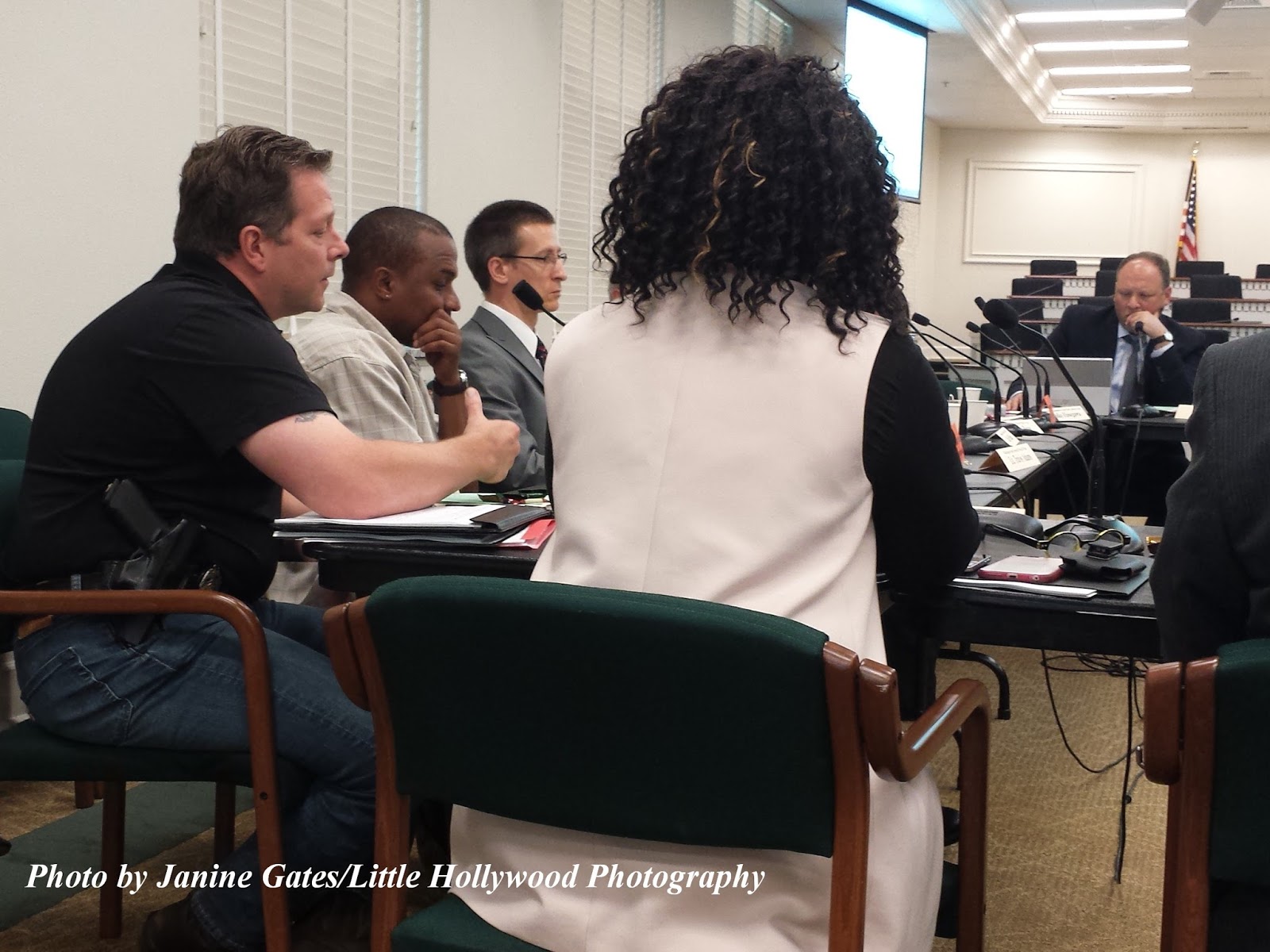
Above:
Twenty-six year veteran Seattle police officer Kerry Zieger, representing the
Council of Metropolitan Police and Sheriffs, speaks to task force members. Sitting to his left is Gerald
Hankerson, representing the National Association for the Advancement of Colored
People (NAACP).
Zieger
said he was recently involved in an incident on May 1st in Seattle. He and a couple of bicycle officers were surrounded by 50 – 70 individuals wearing masks and throwing objects. He said he was hit by a piece of cement or a rock
and injured.
“At
the time I was struck, that entire city block was unprotected because now it
became a violent situation…all the officers could do was protect themselves and
wait for others to come in and rescue the officers. A rock can be a deadly
weapon. Another inch lower and I would have lost my eye….”
Zieger
said he was out of work for six weeks and still suffers pain and headaches as a
result. Use of deadly force against the protesters would have been justified in that incident, he
said.
Only Washington State law provides a defense against
prosecution when a police officer acts “without malice and with a good faith
belief that such act is justifiable.”
Malice is defined in law as “evil intent.”
Another police related bill heard during the 2016
Legislative Session, HB 2907, would have removed language from RCW 9A.16.040,
which states that an officer who acts without malice cannot be held criminally
liable. It did not pass out of committee. That bill, sponsored by Representative
Luis Moscoso, (D-1) was spearheaded by members of the Black Alliance of
Thurston County.
Amnesty International calls Washington State’s law
regarding use of deadly force as the “most egregious” in the nation.
The United States has failed to track how many
people are killed by law enforcement officers. No one knows exactly how many
people are killed each year, but estimates range from 400 to over 1,000.
According to The
Counted, an ongoing investigation by the Guardian into the use of deadly force by police, African American males
between the ages of 15 and 34 comprised more than 15 percent of all deaths
logged this year. Their rate of police-involved deaths was five times higher
than for white men of the same age.
Paired with official government mortality data, this
new finding indicates that about one in every 65 deaths of a young African
American man in the U.S. is a killing by police.
Also according to the Guardian, 12 individuals in
Washington State have been killed by law enforcement so far this year.
Task Force Conversations
Representative Goodman encouraged an open,
freewheeling conversation between members. Feedback moved
swiftly as participants articulated their viewpoints.
While Representative Goodman asked the group several
questions that helped frame the conversation, some were quick to not allow him
too much freedom in making assumptions.
Starting with law enforcement
recruitment, retention, training, and disciplinary methods, and taking a critical
look at data collection, Goodman said he wanted to learn more about how
Washington State’s statute came about, and that as a result of their
conversation, their “to-do” list will get longer.
“….Do law enforcement agencies have the diversity and
reflect the community that they serve? You have to collect the dots before you
can connect the dots….The use of force reports would help provide that
information,” said Goodman. Goodman said that he heard that fewer than two
percent of public interactions with law enforcement involve of use of force.
“That’s really a small percentage…they are really
very rare,” said Goodman.
“That depends on the validity of the reporting,” responded
Laura Daugaard, representing the Public Defender Association of Seattle. Daugaard
explained how reporting systems vary widely.
Che
Taylor and Zambrano-Montes Cases
Task force members also challenged Goodman’s
direction when exploring their scope of work.
After the shooting deaths of Che Taylor of Seattle
on February 21 and Antonio Zambrano-Montes
of Pasco in February 2015 had been mentioned by committee members several
times, Goodman said he didn’t want to hear those cases retried.
Several committee members responded, saying that the
lessons of those officer involved killings must be discussed and analyzed and
that there is much for the committee to learn by doing just that.
Zambrano-Montes, a farm laborer with a history of
mental illness, was shot by police in February 2015.
“….Within five minutes and 15 seconds, he was shot
17 times with 45 caliber bullets. Eight of those bullets killed him. The
prosecutor declined to bring charges…it’s real difficult for a prosecutor to
take a case like that…Yes, there are times officers need to use deadly force, there’s
no question about that. The concern we have as a community is accountability
and so prosecutors don’t have their hands tied by language in the statute,” said
Gabriel Portugal, Latino Civic Alliance.
Che Taylor was killed by Seattle police in February
and the case is still under investigation.
“To the data issue, we have to look at those cases…and the case in Olympia....because that's where we can learn statewide what's going on. We have to look at them critically...to see what's going on within those communities and what happened with those prosecutors and why they made those decisions,”
said Fe Lopez, representing OneAmerica, an immigrant advocacy group.
“There’s a lot of passion in this room. If you don’t
have a knot in your stomach, we’re not doing it right…I want to use the Che
Taylor and Antonio Zambrano-Montes cases as a springboard to learn from each
other,” agreed Cynthia Softli of the Black Law Enforcement Association of
Washington.
Law enforcement representatives were often coaxed by
Goodman to enter the conversation, but when they did, they represented their
agencies well.
Snohomish County prosecutor Mark Roe, representing
the Washington Association of Prosecuting Attorneys, said he has never felt
like his hands were tied to not prosecute an officer if the facts warranted it.
“…I understand angst about “malice.” There is a huge
continuum about use of force…between hands on them and everything in between.”
He described the procedures used by a multi-agency
response team and their protocol for a major incident. He said a lot of the
task force’s work will be about public perception and confidence.
“There have got to be better ways to avoid
altercations,” he said.
Mason County Lieutenant Travis Adams, representing
the Washington State Fraternal Order of Police, responded that law enforcement
is specifically called to go to the incident.
“We are thrust into a situation that a civilian is
not….”
Showing that law enforcement protocols have changed,
Rich Phillips, representing the Washington Council of Police and Sheriffs, said
that the science of memory, recall, action, and reaction is evolving very
rapidly.
In the old days, the standard law enforcement
reaction after a critical incident was, “no comment.” Now, they are out ahead
of the curve to help with perceptions and provide what they know, but it is not
an exact science.
Captain Monica Alexander, representing the
Washington State Patrol, said it was important to establish trust before an
incident happens.
“After an incident, everyone goes to their corners –
let’s have that relationship before the incident.”
Jorge Baron of the Northwest Immigrant Rights
Project, responded by saying there is a racial disparity as to the subject and
use of deadly force.
“How do we avoid those situations?” he asked. Baron
said he took a test and discovered that he held an implicit bias against
African Americans.
The conversation was flowing at a pretty good clip
until a comment by Senator Kirk Pearson (R-39), saying that as a man of faith, he did not have any bias against anyone.
The comment seemed to set the committee back two and a
half hours and 200 years, as some members of the committee and many audience members audibly groaned.

Above:
Andre Taylor greets members of the task force after the meeting. Left to right, nearest the camera, Gloria Ochoa-Bruck, Washington Commission on Hispanic Affairs, Fe Lopez, OneAmerica, Karen Johnson, Black Alliance of Thurston County, and Taylor.
I-873
– Not This Time
Andre Taylor, the brother of Che Taylor, the man
killed in February by Seattle Police officers, was present in audience, as well
as Che Taylor's wife, Brenda.
Andre Taylor moved to Tacoma four months ago from
Los Angeles and is now working on Initiative 873 - Not This Time, which
concerns the use of deadly force by law enforcement, public officers, or peace officers.
The initiative petitions to remove the “without malice
and with a good faith belief” clause in state statute. Several state
legislators have endorsed it and United States Congressman Adam Smith (D-9) endorsed
the initiative in June.
After the death of his brother, Taylor said he
didn’t believe in shutting down and now has a good relationship with Seattle
Police Chief Kathleen O’Toole. Taylor says he thinks it’s a
problem if there are those on the committee who don’t think we have a problem.
“….What is our primary intent for being here? I
think there is a lack of leadership within our police forces that allow certain
things to go on where an officer can treat our citizens worse than a military
treats our alleged enemies and that’s power....If we don’t recognize there is
an issue in this country as Americans, then we have a problem. We have to fix
it…. I believe that we have an opportunity in Seattle, Washington to do
something and create a blueprint for the rest of the country…The more we inform
people about the way our law is written, they are in shock. My job is to bring
the information to the people. And I would hope, as we get this law changed,
that this group we have here (the task force) is not being left behind because
we’re moving forward and it’s going to get done,” said Taylor.
The 26 member committee is composed of
Representative Roger Goodman (D-45) and Senator Kirk Pearson (R-39), who will
take turns chairing the meetings, Representative Dave Hayes (R-10) and Senator
David Frockt (D-46) and representatives of
the Washington State Fraternal Order of Police, Washington State Patrol,
The Tenth Amendment Center, Northwest Immigrant Rights Project, Public Defender
Association, National Association for the Advancement of Colored People
(NAACP), Association of Washington Cities, Washington State Commission on Asian
Pacific American Affairs, Washington Association of Sheriffs and Police Chiefs,
Black Alliance of Thurston County, OneAmerica, Disability Rights Washington,
Washington Commission on Hispanic Affairs, Washington Council of Police and
Sheriffs, Latino Civic Alliance, Washington Commission on African-American
Affairs, Criminal Justice Training Commission, Governor's Office on Indian
Affairs, Washington Association of Prosecuting Attorneys, Black Law Enforcement Association of
Washington, Washington State Association of Counties, and the Council of
Metropolitan Police and Sheriffs.
For
more information about the task force, HB 2907, HB 2908, Amnesty
International’s report, “Deadly Force: Police Use of Lethal Force in the United
States,” City of Olympia police issues, community policing, Karen Johnson, the
Black Alliance of Thurston County, race, bias, and related topics, go to Little
Hollywood, www.janineslittlehollywood.blogspot.com and type key words into the search
engine.
For
more about the task force from the Washington State Legislative body, go to http://leg.wa.gov/JointCommittees/DFTF/Pages/Members.aspx
The
event was taped by TVW and can be viewed at http://www.tvw.org/watch/?eventID=2016061155
Editor's Note, July 13: Caption for top photo is now correct. The person speaking is Fe Lopez, not Gloria Ochoa-Bruck. I also straightened out a couple quote attributions. Thank you TVW.
Editor's Note, July 13: Caption for top photo is now correct. The person speaking is Fe Lopez, not Gloria Ochoa-Bruck. I also straightened out a couple quote attributions. Thank you TVW.


