Showing posts with label drinking. Show all posts

Saturday, October 4, 2014

City, Tribal Partnership Creates a New Water Source for Olympia


Above: Tribal elder Bob Sison holds a commemorative glass given to participants of today’s dedication of the McAllister Wellfield, the site of Olympia's new water supply.
 
By Janine Unsoeld
www.janineslittlehollywood.blogspot.com

“This is the beginning of a new journey. Father, Grandfather, hear me, Spirit of our People, hear me. We thank you, thank you for joining hands with another world. We thank you for the mountain, for it brings us the water, the water that we will share. May the mountain never run dry, or if it does, so will our lands, so will our people. Watch over and guide and protect everyone who is here. Give them your physical, mental and spiritual strength…show them the way….You’ve brought our people a long ways, you’ve left us the gift of water. Let the rivers never run dry…the pumps…keep them strong. Keep the water flowing, for this is an honor to join hands with Olympia, their people. We pray that the water will give them strength, especially to the children. Help them to remember, teach them, teach them the way, the way it was. The pure of the water, the pure of the land. We ask this, we thank you Grandfather, Creator of Heaven and Earth….Masi…masi…” Tribal Elder, chaplain Bob Sison, offering the blessing at today’s dedication of the McAllister Wellfield.

And so began an emotional ceremony today as local city and state officials and tribal representatives spoke at the dedication ceremony of Olympia's new water source at the McAllister Wellfield today.
Words such as ‘commitment,’ ‘visionary,’ and ‘challenging,’ were also used to describe the efforts that led to today’s event, which marked a unique partnership between the City of Olympia and the Nisqually Tribe.

The city’s new wellfield replaces McAllister Springs, which is located on Nisqually tribal land, as the city’s primary water source. Located about a mile away from the Springs on 20 acres of city-owned property on St. Claire Cut Off Road SE, the new site includes over 160 surrounding acres that are protected from future development.
The McAllister Wellfield water supply will provide high quality, protected drinking water to the regional community over the next 50 years and beyond.

Putting that figure into perspective, the Nisqually Tribe has been using McAllister Springs, which they call Medicine Springs, for 10,000 years.
Living in peace and prosperity in their original homeland of over two million acres, Nisqually land encompassed the present towns of Olympia, Tenino, Dupont, Yelm, Roy, and Eatonville, and extended to the top of Mount Rainier.
In her remarks, Nisqually Tribal Chairperson Cynthia Iyall said, “….Looking around, you see fir trees, you see cedar, you see cottonwoods, you see oak trees…all these different trees are living together, harmoniously, and they share the same water. I was told when I was younger that cedar loves to be near the water, near the river because they loved to dig their roots in, to get their toes wet. And that was so important to the Nisqually tribe because it was such a mainstay in our lives. It’s used for clothing, for protection, for housing, all kinds of things, so we’re glad to be a part of your forest, and you’re a part of our forest and we are so glad that all these seedlings…coming up for the next generation will have safe water….”

Iyall thanked her mentor, tribal elder and former Nisqually tribal councilmember, Larry Sanchez, for creating much of the early framework and shared vision for the project.
She later said that the Nisqually Tribe will develop a water supply at the wellfield in a future phase.
Above: Lacey Mayor Andy Ryder and Lacey Mayor Pro-Tem Cynthia Pratt cautiously peer into the drain after the Wellhouse 1 pump is turned on for show and tell. The pump uses a 700 horsepower motor, the same as a NASCAR race engine, and pumps 6,000 gallons of water per minute. The well is at a depth of 425 feet.


Rich Hoey, public works director for the City of Olympia, explained the project as a steady stream of elected officials, city staff, and those associated with the project walked through Wellhouse 1.

Seeing the infrastructure first-hand helped to visualize the process of how water from the ground manages to travel the eight and a half miles to the city of Olympia.

There are three wells, each ranging from 370 to 425 feet deep, with an initial pumping capacity of 15 million gallons of water per day. The wellfield project cost $13.7 million to design and construct, paid largely with low-interest loans from the Washington Drinking Water State Revolving Fund.
Partnerships  
Aside from physical pipes and plumbing, today’s ceremony was also about partnerships. In a process that began nearly 22 years ago, the Olympia-Yelm-Lacey water supply project has involved a collaborative effort assisted by the state Department of Ecology, the state Department of Health, the cities, and the Nisqually Indian Tribe.

“It’s a spectacular piece of property,” said Hoey before the ceremony. “It’s an amazing accomplishment, knowing it’s high quality water – we’re in good shape. It’s a remarkable thing to have this level of confidence in our water….”
Ecology Water Resources Program Manager Tom Loranger was the most specific in detailing the lengthy legal process it took to get this point.

“It took persistence and partnerships and risk taking. There were discussions about mitigation and offsets. What does the law say? How do we develop projects? There were tough times and discussions….There was no template for doing it. New court decisions changed what we had to do….” Loranger credited the Smith Farm acquisition several years ago as a critical piece of the project.
According to City of Olympia records, the cities of Olympia, Lacey and Yelm jointly purchased about 200 acres of the farm because it was a critical cold water spring source. Ceasing intensive agricultural activities on the land combined with habitat restoration directly improved the summer flows to large portions of the Deschutes River.

“….It was huge…a mile of riparian habitat restored gave it the final legs that could get it done. We have not seen anything like this. I talk about it all the time around the state. There were so many partners, and a number of pieces in play. It’s the gold standard of mitigation to improve the environment….(The state department of) Fish and Wildlife has testified to that…the amount of persistence…you made the choice to take some risks and get this done.”
After the ceremony, Lacey Mayor Andy Ryder said, “The fact that all these communities came together is historic and something to be proud of…it should be used as a model for more accomplishments, like clean air. This project was a new trail, it took time. It was true regionalism.”

Andy Haub, public works planning and engineering manager for the City of Olympia, said that the city will start tapping the McAllister Wellfield in about a month.
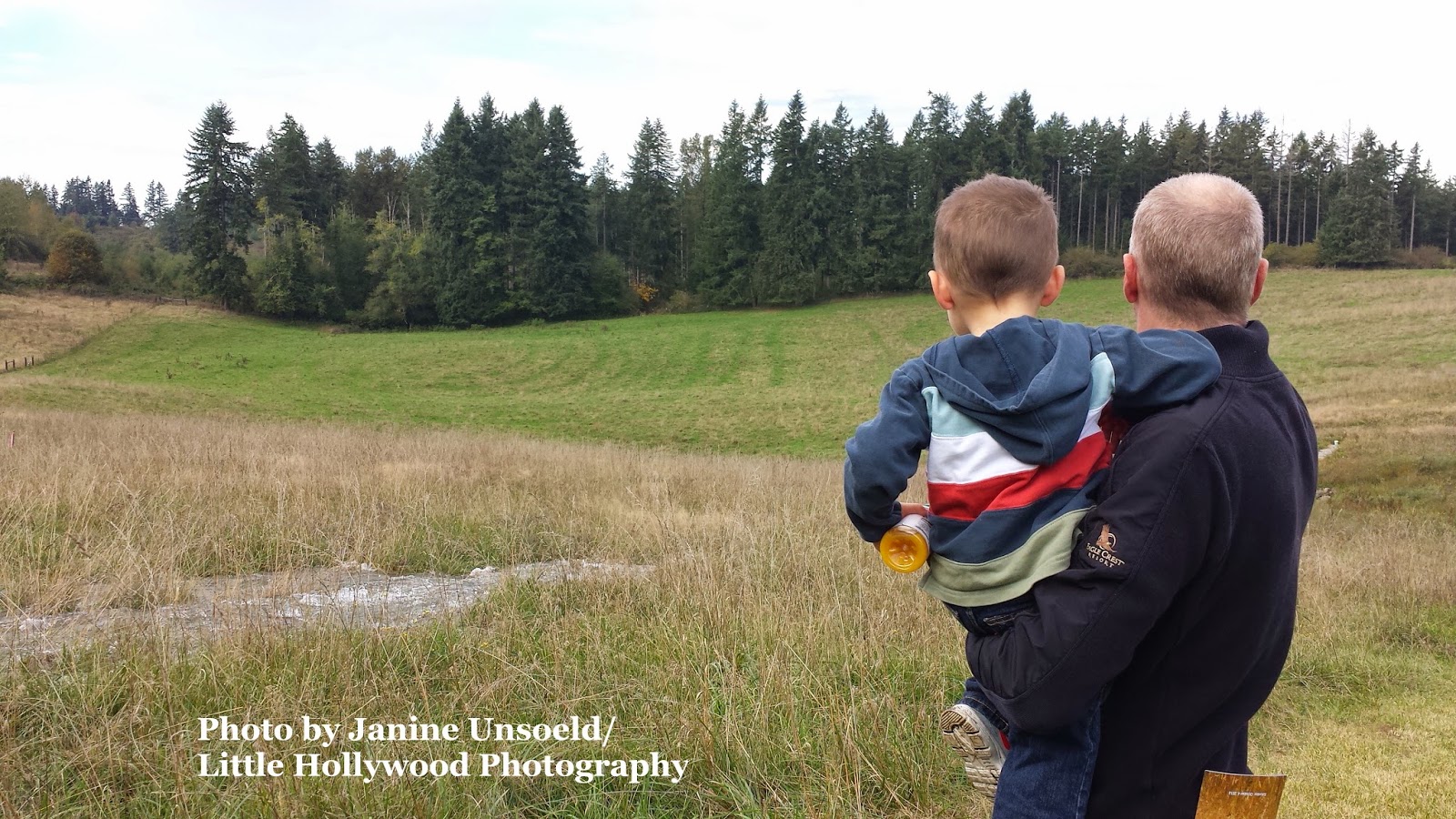
 Above: Reese Gaer,3, and his father Ken Gaer, look over the McAllister Wellfield area after today’s ceremony. Reese's mother, Shari Gaer, is employed with the wellfield 's design consultant, Gray & Osborne, Inc.
Editor’s Note: Several Native words were used in the remarks by tribal elder Bob Sison and Nisqually Chair Cynthia Iyall. Little Hollywood apologizes for not knowing how to write those words. Asked later what “….Masi…masi….” meant, Sison said, “It means thank you. It’s a very thankful word….”
A Brief History
McAllister Springs has supplied most of Olympia’s drinking water since 1949. Studies indicated that the springs are susceptible to land use impacts, which could diminish water quality during periods of heavy demand and drought. To address these concerns, the City of Olympia decided to replace its supply source with high-capacity wells.

In the 1990s, the city identified and purchased 20 acres for a wellfield. Studies of the site showed that the wellfield site taps a large sustainable aquifer with high quality water.
In May 2008, the City of Olympia and the Nisqually Indian Tribe entered into a historic agreement - the first such agreement between a tribe and a municipality in the country - to jointly develop the new regional water source at McAllister Wellfield.

In 2012, after working together for many years to gather data, refine computer models and predict potential impacts, the state Department of Ecology presented the Olympia City Council with the final approval for transferring water rights to the new wellfield.
Subsequent construction projects included a nearly one mile of 36-inch diameter pipeline to connect the new wellfield to the city’s existing water transmission main at McAllister Springs.

Above: Participants of today’s celebration and dedication of the McAllister Wellfield include, left, public works director for the City of Olympia, Rich Hoey, local elected officials including Olympia and Lacey city council members, Nisqually Tribal members and staff, and members of the public. Olympia Mayor Stephen Buxbaum, in brown suit with blue shirt, is standing next to Nisqually Tribal Council Chairperson Cynthia Iyall.
 

Sunday, December 8, 2013

LOTT Groundwater Study: Public Meeting on Dec. 9


by Janine Unsoeld
www.janineslittlehollywood.blogspot.com

 
Above: Karen Janowitz staffs an information station on October 23 about the LOTT Reclaimed Water Infiltration Study. Janowitz is one of 13 members of a citizen advisory group to the newly renamed, multi-year study conducted by the LOTT Clean Water Alliance.

Previously known as the Groundwater Recharge Scientific Study, the study is examining the quality and use of reclaimed water in our groundwater. The Monday, December 9 public workshop will be held from 6:30 p.m. - 8:30 p.m. at 500 Adams Street NE, Olympia.

Like the session in October, the event will provide the community an opportunity to learn more about the study's analysis of the current quality of our local waters, treatment methods, risks of replenishing groundwater with reclaimed water, and the costs of various treatment methods.  

At a meeting of the study's citizen advisory committee on Wednesday, group members heard a report by consultants about the role of temperature in soil aquifer treatment effectiveness.

LOTT staff also reported that the study's peer review panel will begin their work and produce a team report in the third week of January 2014. They will be examining the study's scope of work, make sure the study is scientifically valid and its methodology sound, and provide feedback on the work of the study thus far.

For more information about LOTT and the study, go to past articles at www.janineslittlehollywood.blogspot.com and type key words into the search button.

To learn more about the meeting and the study's draft scope of work, contact Lisa Dennis-Perez, LOTT Public Communications Manager at (360) 528-5719 or lisadennis-perez@lottcleanwater.org or go to www.lottcleanwater.org.
 

Thursday, October 10, 2013

LOTT Groundwater Recharge Study - Public Workshop October 23


Above: This orb spider, who was not paid for his opinion today, does not think the topic of water is boring.

LOTT Focus Group Members Think Study Title, Topic Is Boring - Groundwater Study Name Changed, Goal Refined

By Janine Unsoeld
www.janineslittlehollywood.blogspot.com

The LOTT Clean Water Alliance (LOTT) will host a public workshop about its multi-year groundwater recharge scientific study on Wednesday, October 23, 6:30 - 9:00 p.m., in the LOTT Board Room at 500 Adams Street NE in downtown Olympia.
The LOTT Clean Water Alliance is designing a study to answer questions about chemicals in our water, what happens to them in the environment, and risks they may pose to our drinking water and other water resources. LOTT staff and groundwater study group citizen advisory group members will be available to answer questions.

The evening format is scheduled as follows:
6:30 p.m. Open House with Information Stations
7:00 p.m. Presentations about the Study Design
7:45 p.m. Discussion Sessions
8:30 p.m. Open House


For more information, call Lisa Dennis-Perez, LOTT public communications manager at (360) 528-5719 or lisadennis-perez@lottcleanwater.org.
LOTT staff has acknowledged they are late in launching a public awareness campaign for its first public workshop on October 23. A second public workshop will be held in December.

A direct mailing about the October 23 workshop will go out this week to those who have previously expressed interest in the study, as well as radio, email and social media announcements, and advertisements in The Olympian newspaper.
Above: LOTT board members and staff at yesterday's work session meeting.
 
LOTT Board Changes Groundwater Study Name, Goal
The LOTT Clean Alliance is a regional water and wastewater treatment facility representing the cities of Lacey, Olympia, and Tumwater and Thurston County.
The LOTT Board of Directors is composed of Cynthia Pratt, chair and Lacey councilmember, Steve Langer, Olympia councilmember, Tom Oliva, Tumwater councilmember, and Sandra Romero, Thurston County commissioner.
At its work session on October 9, LOTT board members agreed by consensus to change the name of the study from the LOTT Groundwater Recharge Scientific Study to its new name, the LOTT Reclaimed Water Infiltration Study.

The reason for the name change came from a recommendation by LOTT staff after they met with three focus groups in late September. The groups were made up of 34 self-selected individuals who were paid to provide LOTT staff their feedback on a series of questions and pictures related to the study.

These participants were paid $75 each at the end of the two hour session held in the LOTT board room. They were asked a series of questions about the study title and terminology such as “compounds of emerging concern” and “reclaimed water” vs. “recharged water.”
Among other comments, they felt the study title was boring, and the term "scientific" was disingenuous. Although some felt an alternative word for "recharge" could be "infiltration," some felt this sounded too militaristic. Others liked the word.
In general, LOTT staff reported that participants felt the topic was not sexy enough to get people's attention, and needed a subtitle and graphic to illustrate its purpose.
Participants were also shown images of household products and asked what words they would use to describe the process of introducing into the region’s groundwater aquifers treated water contaminated with products most of us use everyday, such as shampoo and medicines.
LOTT board member Tom Oliva questioned the new title of the study, and the makeup of the focus groups, saying that the participants did not necessarily align with the demographics of the study. He was also concerned that the words “groundwater” and “scientific” were taken out.
 
After a robust one and a half hour discussion, which included a review of a draft flyer about the upcoming public workshop, the board agreed to the new name change and made minor changes to the flyer.

LOTT board member Sandra Romero said she wanted the flyer to convey to the public that some chemicals that remain in the water may require a higher level of treatment.
"We are not stuck – we’re trying to find the safest level – and way - to infiltrate treated water into our aquifers," she said. She also suggested that the context for why we need to do this be included on the flyer and in workshop presentations.

New Study Goal and Question

In response to a request by LOTT board members to come up with a one-line study goal and a one-line primary study question, the following was offered, and agreed upon:

Goal: Provide local scientific data and community perspectives to help policymakers make informed decisions about future reclaimed water treatment uses.
Primary Study Question: What are the risks from infiltrating reclaimed water into groundwater because of chemicals that may remain in the water from products people use every day, and what can be done to reduce those risks?


Groundwater Peer Review Panel Selected

Ben McConkey, LOTT groundwater study project manager, also presented to the LOTT board members during their work session a near-final list of panelists who are interested and available in serving as peer review panel members to the LOTT Reclaimed Water Infiltration Study.
 
LOTT board members agreed to accept the members, who will be paid a $750 stipend per day of work, with travel and hotel expenses paid by LOTT. McConkey says the panelists will meet about five to seven times over the next three years, and will work about a week before each meeting, attend meetings, and assist with follow-up.

LOTT staff and board members made suggestions to the list for consideration. McConkey worked with the National Water Research Institute to provide a balance of disciplines needed to oversee the study. The Institute made the final selections. The finalists are:

Water Reuse and Public Health/Criteria: Dr. James Crook, Ph.D. Environmental Engineering Consultant, Boston;

Chemistry: Dr. Jennifer Field, Ph.D., professor, Oregon State University

Water Treatment: Dr. David Stensel, Ph.D., P.E., professor, University of Washington, Seattle

Hydrogeology: Dr. Roy Haggerty, Ph.D., retired, Oregon State University

Public Health and Toxicology: Dr. Richard Bull, MoBull Consulting, Richland, Washington.

Full biographies will be posted on the LOTT website.
 
A sixth member of the panel is still being sought to represent a local perspective. Several area tribal representatives have been approached to participate, but no one has come forth.
 
Commissioner Romero urged that the person have experience with the study of compounds of emerging concern, now being called residual chemicals by the study, on fish populations.
 
 Above: Salmon at Tumwater Falls Park agree:
Water is not a boring topic.
 
 
Group Advisory Committee, Public Questions Study Purpose, Data

As the study enters Phase II, the framework of the study is falling into four main areas: water quality characterization, treatment effectiveness, risk assessment, and cost/benefit analysis.

The community advisory committee, now composed of 13 members, met again in late July and October 8.  Members continue to receive LOTT and consultant information, and ask questions.
At the Study’s groundwater citizen advisory group meeting on October 8, group members heard more reports about how risk assessments define acceptable levels of exposure to chemicals in the water, and what levels of treatment are used for groundwater recharge in other areas such as the southwest and western states.

Despite the deluge of technical materials provided by LOTT staff and consultants, many members still struggled to define their role - since LOTT has existing and proposed groundwater infiltration projects currently underway - and repeatedly returned to the purpose of the study.
When LOTT staff and consultants showed the group a series of draft workshop posters and asked for feedback, citizen advisory group member and former Olympia mayor Holly Gadbaw was surprised to learn that several properties around the county have already been purchased by LOTT for the purpose of infiltrating treated water into the aquifer.

The potential infiltration sites are: Henderson (12 acres), Rixie Road (32 acres), South Deschutes (49 acres), East Mullen (five acres), and the existing Hawks Prairie infiltration site of 41 acres. The water sampling plan is to study what’s in the groundwater at 20 - 30 domestic wells, and 10 city and community wells in each area.

The Woodland Creek infiltration site in Lacey off Pacific Avenue, currently under construction, is not operated by LOTT – it is an agreement between the cities of Olympia and Lacey. Groundwater monitoring of current conditions at this site has been going on there for about six months.

“This raises a whole bunch of questions…how were these sites chosen?” asked Gadbaw.

Citizen advisory group member Maureen Canny expressed great concern about living in the Hawks Prairie area and wondered if any epidemiological studies are planned for the area. The answer from LOTT staff and consultants was that no epidemiological studies are planned, just toxicological and put it in a risk assessment framework.

The Hawks Prairie recharge site began operations in 2006, and enough time has passed that there would now be interaction with groundwater. Canny took a quick poll of group members and asked if anyone else lived in the Hawks Prairie area, and none did.

“I hope people start thinking about it….If this is the plan, what’s going to happen? Let’s start figuring out the questions,” she asked. She expressed concern that by the time this study is complete, the Hawks Prairie facility will have been in operation for 12 years, and said that should be long enough to determine if there are any concerns, such as an increase in cancer rates.

Citizen advisory group member Lyle Fogg asked staff when people near the proposed infiltration sites will be informed of their locations.

“In my opinion, it should be sooner than later….We should inform them that we’ve already gone down the road this far….” he said.

Karla Fowler, LOTT community relations and environmental policy director, responded that that will be done through a direct mailing in the future, and that the Henderson site is planned to begin operating in 2018.

Citizen advisory group member Ruth Shearer, a retired toxicologist, questioned information provided to the group by Jeff Hansen, lead consultant of HDR Engineering, as she has also expressed at past meetings.
 
The risk assessment to human health that defines an acceptable daily intake level, compared to a maximum contaminant level of exposure, she said, is “based on grossly inadequate testing…these levels are not safe for populations of children with diarrhea, which is quite common, and pregnant women….The acceptable levels of exposure are not the same for all….”

She said that the acceptable daily intake level numbers, as provided, are politically edited, derived from the Environmental Protection Agency’s Reagan administration-era threshold numbers that purposely set the maximum contaminant levels too low due to the cost of treatment.
 
Referring to another piece of literature distributed to the group produced by the WaterReuse Research Foundation, Shearer said the information provided about therapeutic doses were all about skin absorption, not oral intake.

“It was irrelevant propaganda – there are different degrees of skin absorption for each chemical, and it did not address drinking water that may have reclaimed water introduced into it.

“These numbers make me very suspicious of the other numbers….As a toxicologist, I object to ever using the therapeutic dose in risk assessment – that’s why they’re prescription drugs – the therapeutic dose applies to them, but (the study should examine) the effect on normal people….”

There are thousands of unregulated contaminants, but the study plans to study 97 unregulated compounds of emerging concern, or residual chemicals, that are often found in reclaimed water and known to persist in the environment. Contaminants include medicines, personal care products, foods, hormones, and household chemicals.

Dennis Burke, a water system civil engineer based in Olympia, has attended most study committee group meetings and has offered information to committee members during public comment period. He has frequently been critical of the information provided to committee members.

On Wednesday, Burke said he has started a website at www.SaveOurDrinkingWater.org to provide the community alternative information about LOTT and study omissions. He said he'll be adding to it over the next few weeks to feature articles from scientific journals regarding viruses, genetic material, and antibiotics. He said the website will have a comment section and invite contributions.
 
Did You Know?
 
The following questions were offered by LOTT's focus group participants to provide attention-grabbing information about the LOTT groundwater study:

Did you know…
  • Some of the water you use and wash down the drain is treated and cleaned so it can be used again as reclaimed water?
  • Some of the medicines and chemicals from products you use every day may remain in reclaimed water?
  • Some reclaimed water is infiltrated into groundwater, our region’s source of drinking water?
For more articles and information about the LOTT Clean Water Alliance’s groundwater recharge study, now called the LOTT Reclaimed Water Infiltration Study, go to www.janineslittlehollywood.blogspot.com and type key words into the search button and/or go to www.lottcleanwater.org.
 

Monday, December 3, 2012

LOTT Groundwater Study Group - Community Advisory Members To Meet Next Week


LOTT Groundwater Study Group - Community Advisory Members To Meet Next Week

by Janine Unsoeld
www.janineslittlehollywood.blogspot.com

The first meeting of the LOTT Clean Water Alliance Groundwater Recharge Scientific Study community advisory group is scheduled for Tuesday, December 11, 2012, from 6:00 to 9:00 p.m. at the LOTT Regional Services Center, 500 Adams Street NE in Olympia. Meetings of the advisory group are open to the public. 

The agenda will include several background presentations on the Groundwater Recharge Scientific Study, LOTT’s Reclaimed Water Program, and the quality of reclaimed water in general. The group will also discuss their initial perspectives and questions regarding reclaimed water and groundwater recharge.

Members of the community advisory group are: Maureen Canny, John Cusick, Marissa Dallaire, Lyle Fogg, Holly Gadbaw, William Gill, Pixie Needham, Tina Peterson, Ruth Shearer, Edward Steinweg, Richard Wallace, Azeem Hoosein, Karen Janowitz, Emily Lardner, Bill Liechty and Scott Morgan.

LOTT public communications manager Lisa Dennis-Perez said that she will be issuing a formal announcement about the meeting, with an agenda, sometime later this week. There will be time on the agenda at the end of the meeting for public comment, she added.

For more information about the Community Advisory Group, contact Lisa Dennis-Perez, LOTT Public Communications Manager, at (360) 528-5719 or lisadennis-perez@lottcleanwater.org or go to www.lottcleanwater.org.

More articles by Little Hollywood about LOTT, the groundwater study, and interviews with community advisory group members can be read using the search button and keywords at www.janineslittlehollywood.blogspot.com