Showing posts with label environment. Show all posts

Monday, October 27, 2025

Little Hollywood is Back: Saving the Nisqually Delta and Other Updates!


by Janine Gates

Little Hollywood

https://janineslittlehollywood.blogspot.com

After a six year hiatus, Little Hollywood is back! Not a month goes by that I don't hear from community members who have missed my photography and reporting on local issues. Thank you all so much for your love and support. What have I been doing all this time? In part, writing! 

Published in August 2025 by Little Hollywood Media, Saving the Nisqually Delta by Janine Gates chronicles the historic pressures to develop the Nisqually Delta into something that would have looked very different from what we see today. 

Located eight miles northeast of Olympia, Washington, the Nisqually Delta is one of the country's last unspoiled estuaries, a place where the fresh water of the Nisqually Delta meets the salt water of Puget Sound. The Nisqually Delta is home to the Billy Frank Jr. Nisqually National Wildlife Refuge, however, the Refuge is only a small part of the Nisqually Delta. 

Saving the Nisqually Delta is an inspiring drama that captures the voices and efforts of environmentalists who fought proposals by ports, counties, cities, and corporations to industrialize the delta. It also recognizes those who are currently caring for the Nisqually River watershed, from its headwaters at Mount Rainier National Park to the Nisqually Reach. 

Significant threats to industrialize the Nisqually Delta were thwarted by effective citizen activism, but today, the Nisqually Delta is still at risk. The cumulative impact of urban and industrial encroachment still threatens the Nisqually Delta and its ecosystem.

Since publication, I have been busy giving slide show presentations throughout the Nisqually watershed and beyond. I have lots of stories to share, and I am grateful to all the organizations and local businesses who have hosted me. I'm booked at events through February 2026! 

For more information, go to my Saving the Nisqually Delta website, https://savingnisquallydelta.com, Instagram: @Ja9Olympia, or Facebook: Saving the Nisqually Delta. 

This blog, however, will return to covering issues in the public interest as the need arises. I may not have the time to devote to it as I did in the past, but it will be, again, just another source of information for your consideration. Please feel free to contact me at Ja9gates@aol.com with your news tips.

Janine Gates

Janine Gates speaks about her book, Saving the Nisqually Delta 
DuPont Historical Museum, October 12, 2025. 
Photo by Zac Lyday, DuPont Historical Museum


Tuesday, October 16, 2018

Sequalitchew Warehouse Public Hearing on Hold


Above: A red-tailed hawk soars above the trailhead of Sequalitchew Creek in DuPont earlier this month. A public hearing tentatively scheduled for October 24 regarding the proposed development of two large warehouses near the creek has been cancelled.

Project Applicant Meets with Interested Parties

By Janine Gates
Little Hollywood

A public hearing for the proposed development of two large warehouses in the City of DuPont near a historically and environmentally sensitive area near Sequalitchew Creek has been cancelled.

The hearing in front of a hearing examiner had been tentatively set for October 24 but an environmental determination for the property has not yet been reached.

Once the city gathers more information, an environmental decision about the project will be issued by the city and a hearing date will be set.

The project applicant, DuPont Industrial Partners LLC, represented by Barghausen Consulting Engineers of Kent, is learning more about the concerns of those interested in the area’s environmental and historic significance.

Known as Lot Y, the 21 acre wooded site where the proposed warehouses would be located is on the northeast side of Sequalitchew Creek off Center Drive behind a residential community. 

According to the application, warehouse operations would generate significant traffic and other operational activity 24 hours a day, seven days a week.

The peaceful 1.5 mile trail follows the creek near City of DuPont city hall and ends at the mouth of Sequalitchew Creek and Puget Sound, just north of the Billy Frank Jr. Nisqually National Wildlife Refuge. 

The area is abundant with wildlife and is a favorite destination for families, bird watchers, and photographers.

The Sequalitchew area was the site of a year round village for the Sequalitchew-Nisqually Indians over 5,700 years ago. 

The land for the proposed warehouses is also the site of the historic Methodist Episcopal Mission, the first non-permanent, Euro-American settlement on Puget Sound. Built in 1839, the Mission burned down in 1842.

The site is also the area where approximately 4,000 Buffalo Soldiers of the 9th Cavalry camped and held several military maneuvers from 1904 to 1912.

A discussion among representatives of invited organizations was held at City of DuPont city hall on October 10th. The meeting was held at the request of the property owner and project applicant. 

Invited interest groups included the Nisqually Indian Tribe, Washington State Department of Archeology and Historic Preservation, DuPont Historical Society, United Methodist Church Commission, the Nisqually Delta Association, and the Ninth and Tenth Cavalry Buffalo Soldiers Museum in Tacoma.

The applicant sought input from the groups to help identify the cultural and historic features on the site and seek input on how to preserve and tell the history of the site. These and other entities have long worked to create a National Historic District in the project area.

The applicant invited the stakeholders back for a follow-up discussion sometime during the last week of October, City of DuPont community development director Jeff Wilson told Little Hollywood.

Little Hollywood has written several stories about the proposed project. For photos and more information, go to Little Hollywood at www.janineslittlehollywood.blogspot.com and type key words into the search button.

For more information about the property and to stay up to date on future public hearings and meetings, contact Jeff Wilson, City of DuPont Community Development Director and City SEPA Official, at jwilson@dupontwa.gov or (253) 912-5393, or go to www.dupontwa.gov.

Above: The Sequalitchew Creek Trail in Pierce County is a favorite with families. Two warehouses totaling 258,400 square feet, or over five acres, are proposed to be built 100 feet from the creek.

Sunday, September 23, 2018

Sequalitchew Warehouse Public Hearing Set


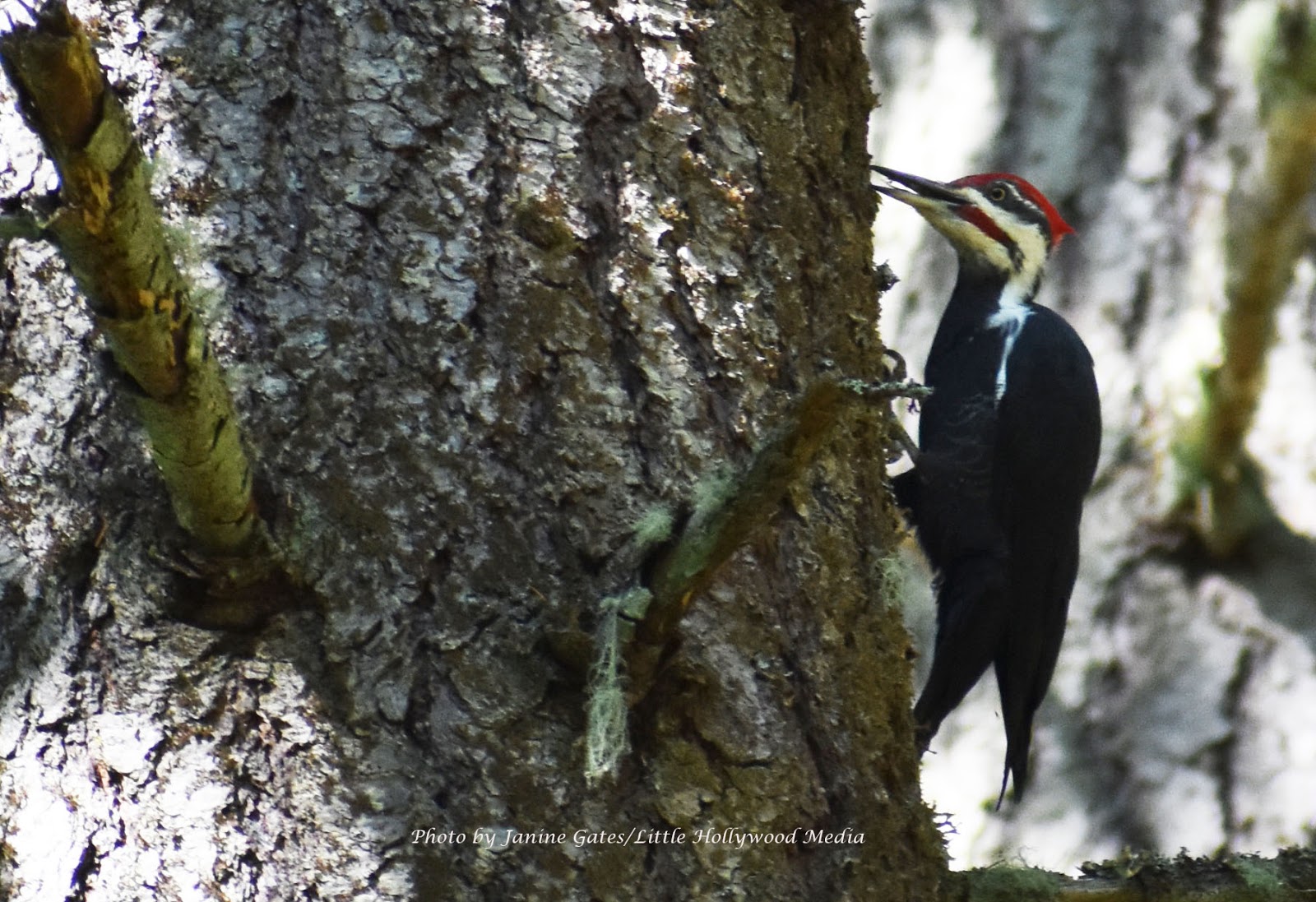
Above: Several pileated woodpeckers were heard boring into snags and trees well before they were seen along the peaceful Sequalitchew Creek trail in DuPont last week. Two industrial warehouses and related facilities are proposed to be built 100 feet from the creek.

Public Hearing Tentatively Set for October 24


Public Comments Highlight Area’s Historic Significance, 9th Cavalry Buffalo Soldiers Held Maneuvers, Camped at Sequalitchew

By Janine Gates
Little Hollywood

A public hearing for an industrial development proposal near Sequalitchew Creek in the City of DuPont, Pierce County, is tentatively set for October 24, 1:00 p.m., at DuPont City Hall, 1700 Civic Drive, DuPont.

The public is invited to attend and present oral and written testimony to a city hearing examiner on the proposed project.

DuPont Industrial Partners, LLC is proposing to build two warehouses totaling 258,400 square feet on a vacant, 21 acre wooded parcel near Sequalitchew Creek and the Sequalitchew Creek trail in DuPont.

Based on the applicant’s materials:

·      The buffer between the proposed project and Sequalitchew Creek is 100 feet.

·      Nearly 400 healthy trees will be removed from the site, called “Lot Y.” Of that number, 76 landmark trees are in the area, 49 of which will be removed. Landmark trees are described in ordinances as significant. One of the 49 landmark trees is a large Oregon white oak tree.

·      Over 70 percent of the property is expected to become impervious surface.

·      Approximately 444 total daily trips are expected to be generated on a typical weekday. Noise from vehicular traffic to and from the site would be present with possible operating hours of 24 hours a day, seven days a week.

·      The current comprehensive plan designation for the area is Sequalitchew Village Planning Area. The current zoning designation for the site is Manufacturing Research Park (MRP) and buildings on site may be as high as 70 feet.

The first comment deadline for state agencies, tribes, and the public to weigh in on the project was September 12. 

Jeff Wilson, community development director for the City of DuPont, has compiled the comments and will likely issue a Mitigated Determination of Non-Significance (MDNS) for the project. 

Above: Mothers and children walk along the Sequalitchew Creek trail. The trail leads directly to Puget Sound and is popular with families, photographers, and bird watchers.

History of Buffalo Soldiers at Sequalitchew, American Lake

Earlier this week, Little Hollywood reviewed the City of DuPonts two inch thick file of community comments and concerns regarding the proposed project. 

Most letters highlighted the historic significance of the area and called for its preservation. Others requested increased buffers from the creek and noted other environmental considerations.

Jackie Jones-Hook, executive director of the non-profit Buffalo Soldiers Museum in Tacoma, is opposed to the proposed development. 

She provided the City of DuPont historical information about the Buffalo Soldiers and intends to testify at the public hearing on October 24.

In an interview with Little Hollywood, Jones-Hook says the area is part of a proposed Nisqually-Sequalitchew Historic District and lies in the cradle of U.S. military history in the Puget Sound region.

In 1866, Congress established six all-black regiments, each with about 1,000 soldiers.

Known as “Buffalo Soldiers,” the regiments were comprised of former slaves, free men and Civil War soldiers. They helped rebuild the country, patrolled the remote western frontier, protected settlers, built forts and roads, and mapped the wilderness in the West.

The first stewards of our national parks were these Army cavalry troops before there was a National Park Service. The last Buffalo Soldier units were disbanded in 1944.

Of local significance, over 4,000 troops from the regular U.S. Army and National Guard units from Washington, Oregon, and Idaho were organized into opposing armies around American Lake and engaged in mock battles and skirmishes.

Members of the 9th U.S. Cavalry Regiment served in the 1904 maneuvers at American Lake, the first in a series of large scale military maneuvers. The success of those maneuvers led to additional maneuvers in 1906, 1908, 1910, and 1912.

Jones-Hook said she is in the process of implementing a federal grant her museum just received to educate at-risk, under-served and under-represented children about the Buffalo Soldiers.  

Field trips for the children will include the areas of Fort Lawton, now Discovery Park, in Seattle and Sequalitchew Creek, where the soldiers camped. Stables for the horses were also located there.

Our curriculum will talk about the Buffalo Soldiers lifestyles and survival skills, and how they were able to live off the land by eating berries and drinking water out of the creek. It will also provide the children an opportunity to visit the actual sites where the Buffalo Soldiers served. You can talk about it, but actually being there puts you in a totally different mindset. 

“For so long we were denied the ability to read and write, so its a story thats not well told, but the story of the Buffalo Soldiers is the greatest tribute in the world to the dedication, strength, and pride of black men,” she said.


Above: A display at the Buffalo Soldiers Museum in Tacoma describes the 9th and 10th Cavalry also known as the Buffalo Soldiers, and their military maneuvers at American Lake in 1904, 1908, 1910 and 1912.

Archaeological Investigations

Although artifacts have been found on the site proposed to be developed, the area has been extensively disturbed over the years.

In its comment letter, the state Department of Historical Preservation inquired about the relocation of the Methodist Mission marker and possible interpretive signs explaining the history of the temporary encampment of the Buffalo Soldiers.  

There is currently no marker or mention of the Buffalo Soldiers anywhere along Sequalitchew Creek. 

The agency also wondered if the project proponent has plans to retain the section of narrow gauge railroad that was recorded during a cultural resource survey a few years ago.

Operation of the DuPont Powder Works in the early to mid-1900s included use of part of the property as a burning ground dump from the 1930s until 1945. 

More disturbances occurred during archaeological investigations and related artifact collection between 1989 and 2005, and environmental remediation activities in 1999 and 2000.

Regarding the 9th U.S. Cavalry site archaeological investigations in 1989 and 1991, archaeologist Guy Moura and his team recovered over 800 artifacts.

Washington State archaeologist Robert Whitlam indicated in a 1998 letter to noted archaeologist Richard Daugherty that the site was potentially eligible for listing on the National Register of Historic Places. He also recommended further work to define the boundaries of the Native American and Buffalo Soldier occupations.

The Nisqually Indian Tribe expressed no concerns about the development except in the event human remains or cultural and historic resources were found.

Above: A marker indicates the likely location of the Methodist Episcopal Mission, the first non-permanent, Euro-American settlement on Puget Sound. Built in 1839, the Mission burned down in 1842. The location lies in the location of Warehouse B of the proposed project.

A September 5 story by Little Hollywood, Sequalitchew Threatened by DuPont Warehouses, is at http://janineslittlehollywood.blogspot.com/2018/09/sequalitchew-threatened-by-dupont.html 

For more information about the property and to stay up to date on possible public hearing meeting changes, contact Jeff Wilson, City of DuPont Community Development Director and City SEPA Official, at jwilson@dupontwa.gov or (253) 912-5393, or go to www.dupontwa.gov.

For more information about the Ninth and Tenth Cavalry Buffalo Soldiers Museum in Tacoma, go to www.buffalosoldierstacoma.org or email soldiersmuseum@aol.com. The museum is located at 1940 South Wilkeson Street, Tacoma, Washington 98405.

Wednesday, September 19, 2018

Olympia Attorney Fights for His Life, Nature


Above: Darren Nienaber, former deputy city of Olympia attorney and father of three young children, is looking at the big picture as he battles class 4 glioblastoma brain cancer. He has started an environment and land use education non-profit called People and Otters.

By Janine Gates
Little Hollywood

Characteristically, Darren Nienaber, 47, has always spoken slowly and quietly, choosing his words carefully.

For 18 years, the former deputy city of Olympia attorney has worked as an attorney for both city and county government, specializing in land use and environmental law.

Now, Nienaber (pronounced nee-neighbor) is on a mission to use his legal expertise to protect nature in the Pacific Northwest, especially in Western Washington and Oregon.

His goal is to educate decision makers and the public about federal, state and local environmental codes and regulations. While assisting community members with advice and potential litigation, Nienaber is also fighting for his life.

A father of three young children, Nienaber has class 4 glioblastoma, a rare, aggressive type of brain cancer with a low rate of survival.

In December 2015, Nienaber had brain surgery to remove the cancer. All was well for a while, but then it came back.

He had a second surgery in January of this year and is now undergoing chemotherapy and other treatments. In May, he left his position at the city.

“I hope this does the trick. I’m doing all I can do to fight it,” says Nienaber, who talked about his outlook on life and new endeavors with Little Hollywood last week

Chuckling at the irony, Nienaber said he had just paid off his law school debt when he found out he had cancer.

To further his environmental interests, Nienaber recently created a new non-profit called People and Otters. Asked about the name, he laughed and said, “I picked otters as a representative of nature out of total cuteness.” 

The idea is working. On his website, his creative writing oozes his upbeat personality and passion for conservation issues.

The purpose for the organization came to him after his first brain surgery, when he realized his sense of smell was more acute. 

“I could smell so-called odorless paint for months,” he said. His sense of hearing also improved. That led him to think about the animals in nature.

“It’s not surprising that some animals want to avoid state and federal logging roads. The roads are noisy and generate a lot of dust that damages streams….Then it occurred to me: can there be more places without roads and areas set aside just for nature?”

Above: The distinctive, loud drumming of several pileated woodpeckers boring into trees could be heard well before they could be seen along Sequalitchew Creek in DuPont on Tuesday.

With deep family roots in Whatcom County, Nienaber was born and raised in Bellingham. He grew up playing in nearby forests, building forts, hiking trails, and having Douglas fir cone fights with his buddies.

Well into his 20s, his days were also filled with lying on the beach and playing in tide pools, observing barnacles and crabs.

He started his college education taking classes in finance but ended up graduating in environmental analysis from Huxley College of the Environment at Western Washington University.

He was the editor of an award-winning environmental magazine called The Planet and appreciated his time with faculty member Michael Frome, a nationally known environmental journalist.

“He said to me, ‘You have to talk to the other side to understand what they are saying. Don’t just get mad and angry from a distance,’” Nienaber remembers. 

Wanting to help the environment from within the system, Nienaber received his law degree in 2000 from Lewis and Clark College in Portland, Oregon. He had legal stints in King and Mason counties before landing at the City of Olympia in 2005.

True to his temperament, Nienaber has a unique approach to adversarial situations.

“I am not afraid to take a strong stance for my client, but that doesn’t mean I have to be mad while doing it,” he said.

Above: In January, 2010, then deputy city attorney Darren Nienaber spoke before the city’s Design Review Board. The contentious issue was Triway Enterprises’ plan to build a massive housing and mixed-use office building project on the isthmus in downtown Olympia. Going against a city staff recommendation to approve the project, the Board recommended denial of the applicant’s plan.

State, County, and City Reforms Needed

Nienaber is enjoying his ability to be outspoken as a private citizen and says anyone can be a city planner or an activist if they get involved in the process. 

Optimistically, Nienaber is taking the long view on state, county, and city level environmental reforms.

On the state level, his interests include improving federal and state land management and logging practices. He wants to stop outright clear cutting and limit the harsh impacts of extensive road systems within the forests.

“There should be more all-natural nature than there is,” he says.

On the local level, he has voiced his desire for city and county officials to take themselves out of all levels of permit processes in land use decision-making.

Out of respect for his former employer, Nienaber demurred when asked about examples specific to Olympia, but referred to last months Washington State Supreme Court decision against the county, Maytown Sand and Gravel, LLC v Thurston County. 

The case involved a 20-year special use permit to mine gravel in Thurston County. The Maytown Sand and Gravel Company and the Port of Tacoma claimed the county’s board of commissioners imposed unnecessary procedural hurdles on the process, and had personal communications with others about the permit that were not disclosed during a permit review hearing.

“Regardless of political party or what may or may not have not been discussed, private conversations in quasi-judicial, administrative and appeal processes are bad. A lot of land use decisions go to the county commissioners that shouldn’t. In this case, millions were paid out by the taxpayers and the county’s insurance company, eight million to the Port of Tacoma and four million to Maytown Sand and Gravel.

“Unfortunately, there was an appearance of corruption. Land use cases should be handled by hearing examiners who have the knowledge and expertise to deal with cases on a local level. If there are specific concerns about the local environment, the hearing examiner needs to be made aware of them,” he said.

Referring to the Appearance of Fairness Doctrine, he said the City of Olympia is a good model for this process.

About growth issues, Nienaber has seen first-hand how city councils need more options to attract infilling of their downtown and neighborhood centers.

“All too often, these areas are too risky to invest in because of legacy pollution,” he said.

Nienaber recently wrote a letter to Washington State Governor Jay Inslee regarding the state Department of Ecology’s Toxics Cleanup Program, which is responsible for the Model Toxics Control Accounts (MTCA).

“It is an underfunded program,” he wrote the governor last month.

“This is a problem that I think both conservation/ environmental groups and the development/construction side can agree. People and Otters strongly supports both a significant increase in funding, in the short term to take care of a back log, as well as funding to increase the number of (Ecology) employees that review MTCA cases.”

Referring to the Washington State Growth Management Act and local project review requirements, Nienaber says increased funding will move projects forward more quickly so small and medium sized cities can rebuild and reinvent.

If all this seems like Nienaber has a lot on his plate, he does, but he’s also taking time to enjoy the nature he loves so much. He recently took a trip to Alaska with his children, and often takes day trips to local destinations.

“I had thought I would be able to protect nature when I retired. Now, I don’t know how much time I have left.

“I must first and foremost fight the cancer and also love my loved ones. With whatever time I have after that, and fun time too, I want to fight for nature. That’s my mission. I don’t know where this will go, but I have lots of hopes and dreams of a better day for nature.”

For more information about People and Otters, go to https://www.peopleandotters.org or on Facebook, go to https://facebook.com/peopleandotters.

Saturday, February 24, 2018

‘Oly Mountain Boy’ Attorney Announces Race for County Commission


Above: Tye Menser is a candidate for Thurston County Commission District 3. Little Hollywood interviewed Menser and covered law and justice issues, growth and the environment, county public health issues, and the need for a new county courthouse complex.

The county has to be right there knee-deep with the cities in solving the county’s problems,” said Menser.

By Janine Gates
Little Hollywood
https://janineslittlehollywood.blogspot.com

Tye Menser announced his candidacy for Thurston County Commission District 3 on Saturday.

Menser, 47, is a bluegrass, banjo-playing member of the acclaimed Oly Mountain Boys and a Harvard and University of California-Berkeley educated public defense and criminal law attorney.

Menser made his announcement at the Thurston County Democrats’ annual Champagne Brunch at the Rivers Edge Restaurant in Tumwater.

The seat is currently held by Commissioner Bud Blake, a self-described independent. Blake unseated Karen Valenzuela, a Democrat, in 2014.

Menser says he is running to improve the county’s financial management and partner with cities to work on solutions to regional problems such as affordable housing, poverty, addiction and mental health services. 

He also wants this partnership to create sustainable land use policies.

Interview with Little Hollywood

Menser sat down with Little Hollywood earlier this week to discuss his journey to Thurston County and approach to the issues.

We covered a lot of ground: the budget, growth, housing, environmental issues, the proposed new county courthouse, the proposed expansion of the county jail, and law and restorative justice issues.

Born in Southern California and raised by public school teachers, Menser is married to a public school teacher and father of two children. 

While a law student, he studied in Mexico, Argentina and Chile, learned Spanish, and served three years in large law firms. He traveled around the world in between jobs and met his wife while traveling in Bulgaria.

Menser is a ten-year singing and songwriting member of the Oly Mountain Boys. In a Northwest Music Scene reader poll, the band’s album, “White Horse” was voted as one of the top ten Pacific Northwest albums of 2014.

Set in Grays Harbor, the album, written by Menser, tells a life story from beginning to end, centering on Washington’s frontier past. One song is called, “They Cut Down the Trees.”

Menser first discovered his appreciation for environmental issues while living in Alaska nearly 15 years ago. 

“I went to Alaska in 2001, after three years in big-law firm private practice. Those three years showed me that I would only survive as a lawyer if I was in a more public service type of practice. At the same time, I became interested in environmental issues….I combined the two goals and joined the Alaska Public Defender Agency, representing the interests of indigenous peoples living above the Arctic Circle and throughout interior Alaska. I stayed for nearly seven years.

“I traveled all over the Alaskan wilderness, and developed an abiding appreciation for wild places and a deep understanding the value of pristine natural landscapes,” he said.

Coming to Olympia in 2007, Menser served on Thurston County’s Water Conservancy Board from 2010 to 2013. He has extensive training in Washington State’s complex water law.

With that knowledge, Menser pledges to enhance Thurston County’s unique features and preserve water quality, county farmlands and open spaces.

“I appreciate how smart, sustainable land use planning provides security for people and our irreplaceable lands as we continue to grow. We must provide for both prosperity and preservation. We have to be mindful of how we grow, and our current commissioners are trying to roll back protections for our prairies, groundwater and shorelines. We’re in a sweet spot here and need to retain its character. We need county commissioners who are going to fiercely protect that character,” he said.

Digging deep into the details of the county’s Habitat Conservation Plan currently under review, Menser wants to remind voters that all three current commissioners ran their election campaigns saying the Plan was unnecessary.

“The Habitat Conservation Plan is a way to help our landowners and property owners not run afoul of the law…Now the commissioners realize it’s needed, but they are questioning the science behind the need to protect endangered species and questioning the acreage for mitigation, so we’re pretty far back in the process. They have taken an obstructionist approach and I don’t think that is responsible leadership for the county. They are not asking the right questions.

“They are also looking at a reduction of protections in low impact development standards and the critical areas ordinance and considering the reduction of buffers,” he said.

Highlighting the interconnectedness of the county’s challenges, Menser says the county budget is in trouble and “it is time for the county to take a stronger role in joining the cities to work on regional issues.”

The county’s criminal justice system, including the courts, prosecution and defense, policing and the jail, currently consumes 76 percent of the county’s general fund.

“The commission has squandered two-thirds of our budget reserve with no plan to replenish it –that’s not responsible financial planning. We’re one emergency away from financial insolvency. A long term financial plan is key,” he said.

“Thurston County faces increasingly complicated problems with fewer and fewer financial resources to solve them. The anticipated population growth that we can see all around us is only going to further strain our ability to provide services and protect natural resources. The voters need someone who can safely lead the county through these challenges and I believe I’m the person for the job.”

With the commissioners also acting as the Board of Health, Menser says he will provide greater county leadership on issues on issues such as affordable housing and homelessness.

“The recent Point-in-Time count indicates that the number of unsheltered homeless on the street has spiked. Partnerships with the cities on these issues with a collaborative approach may be slow, but produces more solid, long-term solutions. Nearly a third of people in the county are under rent pressure, struggling to just meet their basic housing costs. The county has to be right there knee-deep with the cities in solving the county’s problems,” said Menser.

Menser’s practice includes court-appointed work with Thurston County Public Defense.

Despite the drop in crime, the population in the county jail is increasing, particularly those with special needs.

“We have 45 percent of the people in our jail with diagnosed mental health issues and 75-80 percent with addiction and substance abuse, so, to me, that statistic jumps off the page. If we’re concerned about why our jail is full and we’re housing people believing there’s going to be some rehabilitation, we are accomplishing a lot less incarcerating someone when they really are in need of mental health and addiction treatment.

“So, if we’re looking at the gap between revenue cap and the rising cost of government, we have to look at these issues. I’m well positioned to do that with my background. The plan to expand the jail is not the best use of our money….We could be looking at investing in other parts of the system that will have a better effect,” said Menser.

“The interconnectedness of these issues is one of my themes….You have to think of all our main issues - economic development, the environment, the budget, and law and justice. You have to see the whole system in terms of how to spend your money. I will work to implement reforms, find efficiencies and cost savings, reduce criminal recidivism, and make our communities safer and healthier,” said Menser.

Regarding the needs of the current county courthouse complex which was built in 1978, Menser agrees it needs to be replaced and says all the reasons presented are valid.

“The case that the courthouse is in disrepair is pretty clear. To me, the space concerns are the tipping factor. Three times the amount of space is needed to deal with the anticipated population growth. The space issue is acute. We have to figure out as a community how to make this project work. The judges have given a number of presentations. They are mindful of the fact that this very large expenditure needs to have corollary benefits to the community. That’s why the thought of having it downtown could be another way to revitalize our community.

“The downtown concept is good but the financial possibilities that have been presented are going to eat up capital expenditures. Whether it can it be done on a smaller scale is the challenge. Even the current commissioners are acknowledging the need. The location is the next big decision that needs to be made,” said Menser.

After covering a lot of ground on serious issues, it was time for Little Hollywood to ask Menser if he would be offended by me closing out the interview with a carefully chosen banjo joke. Menser laughed and braced himself.

Little Hollywood: So why is banjo playing like a courtroom trial?

Menser put his head in his hands, and thought for what seemed like half a minute. He was stumped. What? Had he not heard this one? He gave up.

Answer: Everyone is relieved when the case is finally closed.

But Menser was quick with a challenge:

Menser: Why do some people hate banjo players instantly?

Answer: It saves time.

Menser is hoping voters will like this one.