Showing posts with label history. Show all posts

Monday, October 27, 2025

Little Hollywood is Back: Saving the Nisqually Delta and Other Updates!


by Janine Gates

Little Hollywood

https://janineslittlehollywood.blogspot.com

After a six year hiatus, Little Hollywood is back! Not a month goes by that I don't hear from community members who have missed my photography and reporting on local issues. Thank you all so much for your love and support. What have I been doing all this time? In part, writing! 

Published in August 2025 by Little Hollywood Media, Saving the Nisqually Delta by Janine Gates chronicles the historic pressures to develop the Nisqually Delta into something that would have looked very different from what we see today. 

Located eight miles northeast of Olympia, Washington, the Nisqually Delta is one of the country's last unspoiled estuaries, a place where the fresh water of the Nisqually Delta meets the salt water of Puget Sound. The Nisqually Delta is home to the Billy Frank Jr. Nisqually National Wildlife Refuge, however, the Refuge is only a small part of the Nisqually Delta. 

Saving the Nisqually Delta is an inspiring drama that captures the voices and efforts of environmentalists who fought proposals by ports, counties, cities, and corporations to industrialize the delta. It also recognizes those who are currently caring for the Nisqually River watershed, from its headwaters at Mount Rainier National Park to the Nisqually Reach. 

Significant threats to industrialize the Nisqually Delta were thwarted by effective citizen activism, but today, the Nisqually Delta is still at risk. The cumulative impact of urban and industrial encroachment still threatens the Nisqually Delta and its ecosystem.

Since publication, I have been busy giving slide show presentations throughout the Nisqually watershed and beyond. I have lots of stories to share, and I am grateful to all the organizations and local businesses who have hosted me. I'm booked at events through February 2026! 

For more information, go to my Saving the Nisqually Delta website, https://savingnisquallydelta.com, Instagram: @Ja9Olympia, or Facebook: Saving the Nisqually Delta. 

This blog, however, will return to covering issues in the public interest as the need arises. I may not have the time to devote to it as I did in the past, but it will be, again, just another source of information for your consideration. Please feel free to contact me at Ja9gates@aol.com with your news tips.

Janine Gates

Janine Gates speaks about her book, Saving the Nisqually Delta 
DuPont Historical Museum, October 12, 2025. 
Photo by Zac Lyday, DuPont Historical Museum


Tuesday, September 25, 2018

Grange Starbucks Expected to Open This Week


Above: The former Chambers Prairie Grange #191 has come back to life and now bears a Starbucks logo. Pending final inspections, the store at 1301 Yelm Highway in Tumwater is expected to open on Thursday.

Chambers Prairie Grange #191 Sign Comes Home

By Janine Gates
Little Hollywood
https://janineslittlehollywood.blogspot.com

Pending final inspections, a new Starbucks at the former Chambers Prairie Grange at 1301 Yelm Highway in Tumwater will open on Thursday.

The coffee shop is inside the 108 year old building, one of the first granges built in Thurston County, located on the corner of Yelm Highway and Henderson Boulevard. 

In recent decades, the former grange hosted a variety of memorable events, community fundraisers, and dances, but had sat neglected for years by the time developer Tom Schrader bought it in 2015 from the Washington State Grange. 

Still, the building retained its historic character and structural integrity.

Starbucks is leasing the upstairs portion of the building from Schrader, and on Tuesday, he was on site juggling a myriad of last minute details. 

Above: Inside the former Chambers Prairie Grange #191 in Tumwater on Tuesday.

Inside, a dozen or so Starbucks employees frantically unpacked boxes full of displays, supplies and equipment which had just been delivered that morning. 

Starbucks construction manager Cheryl Nicholson managed to keep the chaos organized while setting up tables and chairs out on the deck.

The inside features exposed original beams and skylights to allow in natural light. The original glass in the windows was retained. The maple floor was taken off, exposing the original Douglas fir flooring underneath. The stage is gone, but the dark-colored wood that surrounded the stage was repurposed in portions of the floor.

Historically, granges served as the community center for social, agricultural, educational, and political activities. Many artifacts were found in the grange when Schrader purchased the building including ledgers, ribbons, and songbooks. 

For a wall display, Schrader reproduced a list written in calligraphy of grange masters dating from 1908, which features many familiar last names.  

Above: The original Chambers Prairie Grange #191 sign has come home. It will be on display inside the former grange, which has been transformed into a Starbucks.

The land use process for getting the project to this point has been a multi-year roller coaster ride, chronicled by Little Hollywood since 2015. 

But perhaps the most emotionally rewarding achievement for Schrader was his recent procurement of the large, wooden, painted chipped Chamber Prairie Grange #191 sign that hung on the outside of the building for so many years.

Schrader declined to say who had the sign, but he has worked hard to get it. After he learned who had it, he found that she was unwilling to part with it for sentimental reasons.

Two Sundays ago, Schrader said, the woman contacted him. She saw that his dream to open a community space in the former grange was finally becoming a reality and told him it was time for her to let the sign go. 

Schrader purchased it from her, and just yesterday, brought it back to the grange. To protect it from the weather, it will be hung on an inside wall.

“The sign needed to come home,” he said.

Above: Ashley Buller of Tenino, center, is the new Starbucks store manager at the former Chambers Prairie Grange on Yelm Highway. She is excited to open the store and appreciated the reuse of materials throughout the building. 

A grand opening will be scheduled in the near future. 

Store hours will be Monday through Friday, 4:30 a.m. – 9:00 p.m., Saturday, 5:00 a.m. – 9:00 p.m., and Sunday, 5:00 a.m. – 8:00 p.m.

For more photos and information about the history of the Chambers Prairie Grange, the building’s purchase by Tom Schrader, and property rezones, negotiations and compromises between the City of Tumwater and Schrader, go to Little Hollywood at www.janineslittlehollywood.blogspot.com and type key words into the search button.

Sunday, September 23, 2018

Sequalitchew Warehouse Public Hearing Set


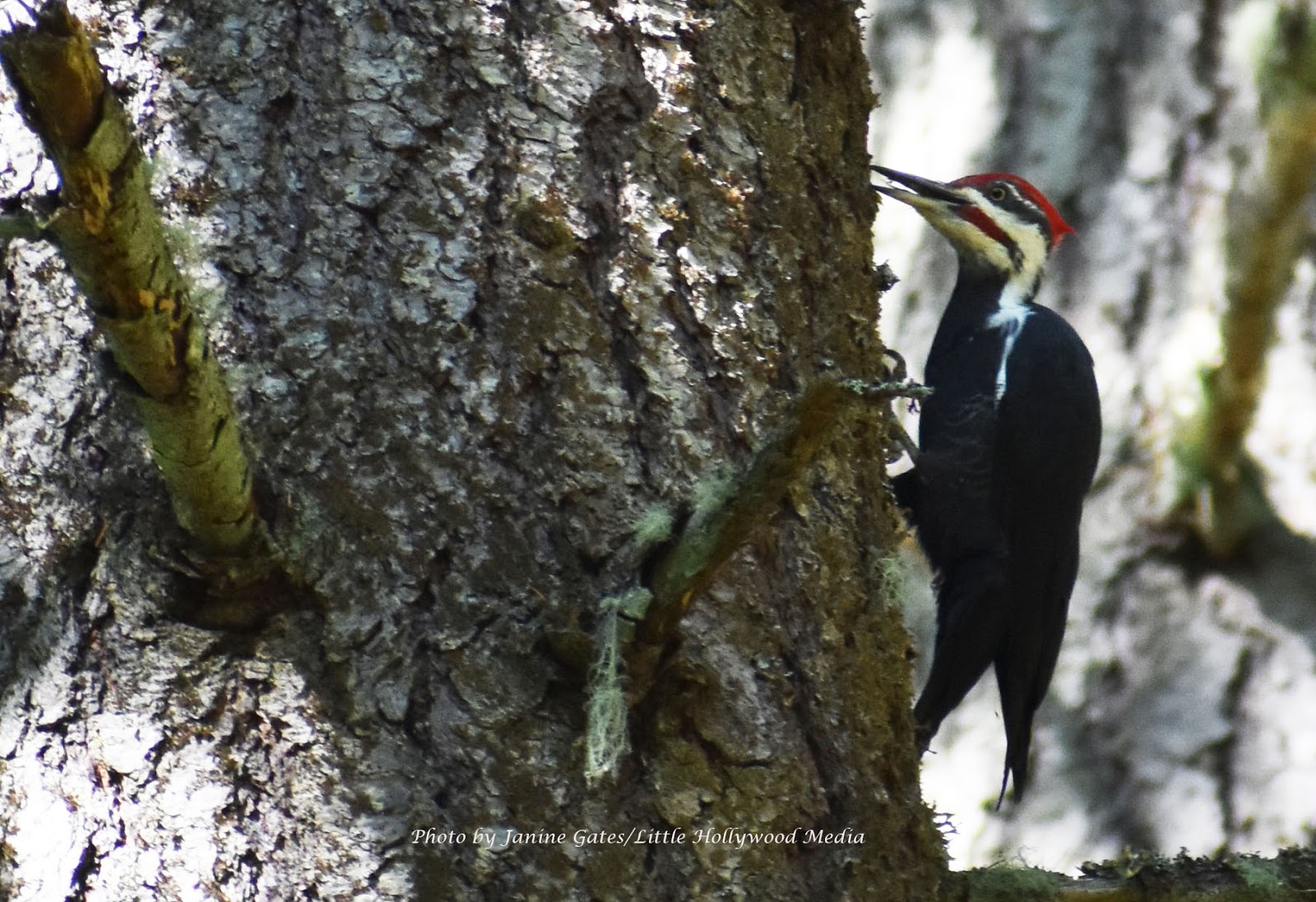
Above: Several pileated woodpeckers were heard boring into snags and trees well before they were seen along the peaceful Sequalitchew Creek trail in DuPont last week. Two industrial warehouses and related facilities are proposed to be built 100 feet from the creek.

Public Hearing Tentatively Set for October 24


Public Comments Highlight Area’s Historic Significance, 9th Cavalry Buffalo Soldiers Held Maneuvers, Camped at Sequalitchew

By Janine Gates
Little Hollywood

A public hearing for an industrial development proposal near Sequalitchew Creek in the City of DuPont, Pierce County, is tentatively set for October 24, 1:00 p.m., at DuPont City Hall, 1700 Civic Drive, DuPont.

The public is invited to attend and present oral and written testimony to a city hearing examiner on the proposed project.

DuPont Industrial Partners, LLC is proposing to build two warehouses totaling 258,400 square feet on a vacant, 21 acre wooded parcel near Sequalitchew Creek and the Sequalitchew Creek trail in DuPont.

Based on the applicant’s materials:

·      The buffer between the proposed project and Sequalitchew Creek is 100 feet.

·      Nearly 400 healthy trees will be removed from the site, called “Lot Y.” Of that number, 76 landmark trees are in the area, 49 of which will be removed. Landmark trees are described in ordinances as significant. One of the 49 landmark trees is a large Oregon white oak tree.

·      Over 70 percent of the property is expected to become impervious surface.

·      Approximately 444 total daily trips are expected to be generated on a typical weekday. Noise from vehicular traffic to and from the site would be present with possible operating hours of 24 hours a day, seven days a week.

·      The current comprehensive plan designation for the area is Sequalitchew Village Planning Area. The current zoning designation for the site is Manufacturing Research Park (MRP) and buildings on site may be as high as 70 feet.

The first comment deadline for state agencies, tribes, and the public to weigh in on the project was September 12. 

Jeff Wilson, community development director for the City of DuPont, has compiled the comments and will likely issue a Mitigated Determination of Non-Significance (MDNS) for the project. 

Above: Mothers and children walk along the Sequalitchew Creek trail. The trail leads directly to Puget Sound and is popular with families, photographers, and bird watchers.

History of Buffalo Soldiers at Sequalitchew, American Lake

Earlier this week, Little Hollywood reviewed the City of DuPont’s two inch thick file of community comments and concerns regarding the proposed project. 

Most letters highlighted the historic significance of the area and called for its preservation. Others requested increased buffers from the creek and noted other environmental considerations.

Jackie Jones-Hook, executive director of the non-profit Buffalo Soldiers Museum in Tacoma, is opposed to the proposed development. 

She provided the City of DuPont historical information about the Buffalo Soldiers and intends to testify at the public hearing on October 24.

In an interview with Little Hollywood, Jones-Hook says the area is part of a proposed Nisqually-Sequalitchew Historic District and lies in the cradle of U.S. military history in the Puget Sound region.

In 1866, Congress established six all-black regiments, each with about 1,000 soldiers.

Known as “Buffalo Soldiers,” the regiments were comprised of former slaves, free men and Civil War soldiers. They helped rebuild the country, patrolled the remote western frontier, protected settlers, built forts and roads, and mapped the wilderness in the West.

The first stewards of our national parks were these Army cavalry troops before there was a National Park Service. The last Buffalo Soldier units were disbanded in 1944.

Of local significance, over 4,000 troops from the regular U.S. Army and National Guard units from Washington, Oregon, and Idaho were organized into opposing armies around American Lake and engaged in mock battles and skirmishes.

Members of the 9th U.S. Cavalry Regiment served in the 1904 maneuvers at American Lake, the first in a series of large scale military maneuvers. The success of those maneuvers led to additional maneuvers in 1906, 1908, 1910, and 1912.

Jones-Hook said she is in the process of implementing a federal grant her museum just received to educate at-risk, under-served and under-represented children about the Buffalo Soldiers.  

Field trips for the children will include the areas of Fort Lawton, now Discovery Park, in Seattle and Sequalitchew Creek, where the soldiers camped. Stables for the horses were also located there.

“Our curriculum will talk about the Buffalo Soldiers’ lifestyles and survival skills, and how they were able to live off the land by eating berries and drinking water out of the creek. It will also provide the children an opportunity to visit the actual sites where the Buffalo Soldiers served. You can talk about it, but actually being there puts you in a totally different mindset. 

“For so long we were denied the ability to read and write, so it’s a story that’s not well told, but the story of the Buffalo Soldiers is the greatest tribute in the world to the dedication, strength, and pride of black men,” she said.


Above: A display at the Buffalo Soldiers Museum in Tacoma describes the 9th and 10th Cavalry also known as the Buffalo Soldiers, and their military maneuvers at American Lake in 1904, 1908, 1910 and 1912.

Archaeological Investigations

Although artifacts have been found on the site proposed to be developed, the area has been extensively disturbed over the years.

In its comment letter, the state Department of Historical Preservation inquired about the relocation of the Methodist Mission marker and possible interpretive signs explaining the history of the temporary encampment of the Buffalo Soldiers.  

There is currently no marker or mention of the Buffalo Soldiers anywhere along Sequalitchew Creek. 

The agency also wondered if the project proponent has plans to retain the section of narrow gauge railroad that was recorded during a cultural resource survey a few years ago.

Operation of the DuPont Powder Works in the early to mid-1900s included use of part of the property as a burning ground dump from the 1930s until 1945. 

More disturbances occurred during archaeological investigations and related artifact collection between 1989 and 2005, and environmental remediation activities in 1999 and 2000.

Regarding the 9th U.S. Cavalry site archaeological investigations in 1989 and 1991, archaeologist Guy Moura and his team recovered over 800 artifacts.

Washington State archaeologist Robert Whitlam indicated in a 1998 letter to noted archaeologist Richard Daugherty that the site was potentially eligible for listing on the National Register of Historic Places. He also recommended further work to define the boundaries of the Native American and Buffalo Soldier occupations.

The Nisqually Indian Tribe expressed no concerns about the development except in the event human remains or cultural and historic resources were found.

Above: A marker indicates the likely location of the Methodist Episcopal Mission, the first non-permanent, Euro-American settlement on Puget Sound. Built in 1839, the Mission burned down in 1842. The location lies in the location of Warehouse B of the proposed project.

A September 5 story by Little Hollywood, “Sequalitchew Threatened by DuPont Warehouses,” is at http://janineslittlehollywood.blogspot.com/2018/09/sequalitchew-threatened-by-dupont.html 

For more information about the property and to stay up to date on possible public hearing meeting changes, contact Jeff Wilson, City of DuPont Community Development Director and City SEPA Official, at jwilson@dupontwa.gov or (253) 912-5393, or go to www.dupontwa.gov.

For more information about the Ninth and Tenth Cavalry Buffalo Soldiers Museum in Tacoma, go to www.buffalosoldierstacoma.org or email soldiersmuseum@aol.com. The museum is located at 1940 South Wilkeson Street, Tacoma, Washington 98405.

Monday, March 26, 2018

Trails End Horse Arena, Stables to Be Demolished


Above: The long vacant Trails End horse arena is facing demolition by the City of Tumwater. The city proposes to use the 22.4 acres it owns near the Olympia Airport for its new operations and maintenance facility.

- The Gopher in the Room
- Large Garry Oak Could Be Removed

By Janine Gates
Little Hollywood

In its heyday, there was no place like the Trails End arena and event center for horse shows, rodeos, 4-H activities, country western concerts, dancing, fine dining and good times.

Located in Tumwater near the Olympia Airport off Old Highway 99, the long vacant site is an integral piece of priceless memories for generations of South Sounders.

Horse culture runs deep in Thurston County and many children grew up there, riding and showing their animals and yes, mucking out horse stalls. Tens of horses were boarded there year round, and for many adults too, it was home away from home.

Now, as local 4-H groups and equestrian clubs struggle to find open space to meet and practice, the site that used to foster so much community is now covered with blackberry brambles.

The boarded-up building fronts look like a ghost town set in an old western, but you can almost smell sawdust and hear horses snort and whinny.

Above: The Trails End in Tumwater near the Olympia Airport.

Community Meeting

The long vacant Trails End horse arena is facing demolition by the City of Tumwater. The city proposes to use the 22.4 acres it owns near the Olympia Airport for its new operations and maintenance facility.

Nearly 40 community members attended a meeting about the plan on Thursday evening in Tumwater’s new Warehouse District, an area near the Trails End that caters to small, startup craft brewing, distilling and cider industries.

Jay Eaton, Tumwater public works director, fielded questions and addressed the proposed project’s impacts on the environment and surrounding neighborhoods. Joining him were representatives of TCF Architecture who planned and designed Tumwater’s new Peter G. Schmidt Elementary School.

The city first put the new operations and maintenance facility into its capital facility plan in 2012. The city’s current facilities, which include 100 vehicles, are crammed into two locations: one behind city hall and the other at the corner of Israel Road and Capitol Boulevard in the old fire station.

Taking into consideration the future expansion of city hall, additional staff and parking and more urban amenities, city staff began looking for properties that would accommodate growth of the city and their needs.

Built in pieces between the 1960s and the 1990s, the Trails End property had fallen out of the bankrupt hands of housing developer Tri Vo and his company, Triway Enterprises.

In 2014, the City of Tumwater purchased the property for the purpose of creating a new operations and maintenance facility. The property is zoned light commercial. 

Eaton said vandals have stripped the property clean of plumbing, electrical wiring and other features of value. Structurally, he said the beams in the arena are failing.

“It’s kind of sad. It used to be a happening place and now it’s in poor condition. It’s not suitable for any purpose. It’s much easier to build new space much more efficiently than (keep) the existing buildings. If we were to bring it back…it really doesn’t function for the intended use we have,” he said.


Above: City of Tumwater Mayor Pete Kmet welcomed community members to a meeting about the future of the Trails End property on Thursday evening. Many questions were asked and the meeting lasted over two hours.

Site Alternatives

The city presented a series of site alternatives, all ranging in cost from $30 to $46 million.

Trails End Road divides the former Trails End property between two parcels. Options include the possibility of realigning 79th Avenue around the entire property.

The road now leads to a housing development called Sterling Crossing. Increased Old Highway 99 traffic at 79th Avenue SE comes from new developments with streets named after equestrian terminology like Stable Court, Arab Drive, and Derby Lane and subdivisions like Bridlewood. 

The city also wants to designate an area that could be used for a permanent park. That aspect of the plan would be handled by the city’s parks and recreation staff.

Some community members of nearby subdivisions are eager to have the property cleaned up and used by the city. Others are concerned about noise associated with operations.

Dan Venable said he frequented Trails End for about 20 years and once operated the restaurant and lounge. Venable, owner of a residential demolition firm, agreed the city needed a new facility but wondered if the site was the most cost effective place to put it. Eaton said the city looked at different properties but preferred to have property that was in city ownership.

Doug Woolen asked about the liability of a fuel facility near a residential community. Eaton said that the city did examine that, but felt the city needed access to immediate fuel in order to respond to emergencies. He said the facilities would be state-of-the-art.

The Gopher in the Room

Addressing the gopher in the room, Eaton acknowledged that the site will be subject to environmental review as it is home to the federally protected and endangered Mazama pocket gopher.

Eaton said the city has built up “credits” to mitigate the impact of destroying the Mazama pocket gopher habitat, but will still have to address it in a habitat conservation plan.

“The gopher issue will be an issue no matter what happens on this property…it still doesn’t make it easy to get through the process.”

A large Garry Oak tree is also on the property. Garry Oaks, also known as Oregon white oaks, and its related prairie ecosystems are vanishing rapidly in the South Sound due to development pressure.

Asked later about the future of the oak, Eaton says it depends which site alternative is selected.

“Alternative A, with the development on the west parcel, wouldn’t impact the tree.  Alternative B, in its current configuration with the development on the east parcel, would impact the tree unless the site could be rearranged to avoid it, which would appear to be difficult. As the project progresses the alternatives could change.  The demolition project wouldn’t include removal of the tree,” he told Little Hollywood.

“It is still our intent to move forward with demolition this summer and construction a couple years from now… with the caveat that we’ll be dealing with the gopher and related environmental issues,” said Eaton.

Alicia Phillips boarded her horses there, participated with cattle events, and briefly ran a cafe at Trails End during weekend events.

Phillips attended the City of Tumwater’s council meeting on Tuesday evening to express her passionate feelings about the Trails End complex. She also attended Thursday night’s meeting.

“Why is there no consideration for the spirit for what this place has been? There is history here. The city is missing out on a huge opportunity to preserve history. When you say none of it is salvageable, I don’t believe it,” she said at Thursday's meeting.

Later, she spoke with Mayor Pete Kmet, who stayed for the entire meeting. She asked him to find a way for the existence of the Trails End to somehow be commemorated.

“I was more than a bit disheartened by everyone’s willingness to demolish and pave over its history. This site has a rich history and has housed thousands of events,” she told Little Hollywood.

Above: A tiny green space for the Sterling Crossing subdivision consists of a single piece of plastic playground equipment. It sits in stark contrast to the 22 acres of adjacent open space. A large outbuilding that used to board horses sits on the other side of the subdivision’s fence on the Trails End west parcel.

Sunday, August 27, 2017

Thurston County Fire Destroys Historic Home, Habitat


Above: Looking north over 183rd Street in Rochester, a DC-10 drops red colored flame retardant to help stop the Scatter Creek area fire in south Thurston County on August 22. The historic Miller-Brewer House and barn were destroyed in the fire. Photo courtesy George Ormrod.

By Janine Gates
Little Hollywood

The Scatter Creek area fire near Rochester in south Thurston County burned 485 total acres on August 22, prompting the temporary evacuation of about 100 residents. It also destroyed several homes.

In the Scatter Creek Wildlife Area, the historic Miller-Brewer homestead, built in 1860, and a barn were also destroyed. The homesite was listed on the National Historic Register.

Fire crews from several neighboring counties helped to control the blaze, as did the Washington State Department of Natural Resources, which is leading an investigation of the fire.

Rochester resident George Ormrod became aware of the Rochester – Grand Mound area fire when he heard a DC-10 fly low over his home near 183rd Street. He went out and saw the plane dropping red colored flame retardant.

Hopping on a scooter, he weaved around back roads until stopped by a road block near the Grand Mound cemetery where he spoke with an emergency management official. She informed him that the fire was four miles from his home and he did not need to evacuate the area.

A press release issued on Friday by the Washington Department of Fish and Wildlife (WDFW) says state wildlife managers are assessing the damage caused by the fire. The south side of the Scatter Creek Wildlife Area in Thurston County is closed until further notice.

Owned and managed by WDFW, 345 acres of the Scatter Creek Wildlife Area was burned, and provides a sanctuary for several threatened and endangered wildlife species, including Taylor's checkerspot and mardon skipper butterflies and the Mazama pocket gopher.

The wildlife area is a popular destination for hiking, birdwatching, dog training and upland bird hunting in the south Puget Sound area, said Brian Calkins, regional WDFW wildlife manager.

“This fire is truly a tragedy,” Calkins said. “We put our heart and soul into restoring this remaining piece of rare native prairie, and we know a lot of people are going to feel this loss as much as we do.”

Calkins said fire damage will likely affect some activities scheduled in the burned, southern unit of the wildlife area, including upland bird hunting this fall. However, the 435 acre section of the wildlife area on the north side of Scatter Creek was largely unscathed by the wildfire and remains open to the public.

The WDFW will immediately begin work to restore the burnt landscape south of Scatter Creek. Based on a preliminary estimate, that work will cost more than $1 million.

“We're invested in the future of this area, and we're already starting to plan recovery efforts to protect the prairie for use by animals and people,” Calkins said. “We will be putting a lot of effort into weed control and replanting.”

Scatter Creek is one of 33 state wildlife areas managed by WDFW to provide habitat for fish and wildlife as well as land for outdoor recreation.

Above: The historic Miller-Brewer House and a nearby barn were destroyed in the fire on August 22. Photo Courtesy Hans Littooy.

Miller-Brewer House Historic Site

Hans Littooy, of Olympia, offered Little Hollywood pictures he took on August 16 of the Miller-Brewer House, the oldest home in Thurston County at the Scatter Creek Prairie. 

“I often go to the Scatter Creek southern unit with my dog to enjoy the prairie elements, be it flora or landscape. Prairies are a very special landscape in our area and unfortunately misused,” said Littooy, a retired landscape architect.

A Greek Revival style house, the Miller-Brewer home was historically significant for its box frame construction, a method only used during early pioneer settlement in Washington from 1855 through 1875, and was one of the few examples left in the Pacific Northwest.

Historically, George and Marita Miller traveled north by wagon from Oregon to take a donation land claim on the banks of Scatter Creek in the late 1850s. The house, built by Miller, is set on open prairie land adjacent to Scatter Creek, and shaded by a grove of native oak trees. Miller was a farmer as well as a territorial representative.

The property was sold to Reece Brewer, an old friend of Miller’s who had moved to Grand Mound from Oregon with his wife in 1858. Brewer was an accomplished stockman, sold cream to creameries, and was a member of the Territorial Legislature in 1871. He was also the local postmaster, fulfilling his out of the house, a justice of the peace at Grand Mound, and an elected a Thurston County commissioner in 1888 and 1890. He lost three wives to pneumonia.

In the 1960s, one of Brewer’s children, Fred, sold the property to the Washington Department of Fish and Wildlife (formerly the Department of Game) which used the Miller-Brewer House since the 1960s in a variety of capacities. 

It was nominated and placed on the National Historic Register in 1988.

Above: The historic Miller-Brewer barn was destroyed in the fire on August 22. Photo Courtesy Hans Littooy.

Littooy said he and his family came from the Netherlands to Iowa in 1968 and that the house and barn have always fascinated him.   

“I loved those buildings and at one time even dreamt of replicating the old home for myself. So much for the dream….It irritates me that we are so careless with the history of this country. This house could have been a museum about life in the 1870s. How much more of Thurston County history is in danger? How much is left?” Littooy said.

Above:  The barn on the property of the historic Miller-Brewer House was also destroyed in the fire. Photo Courtesy Hans Littooy.