
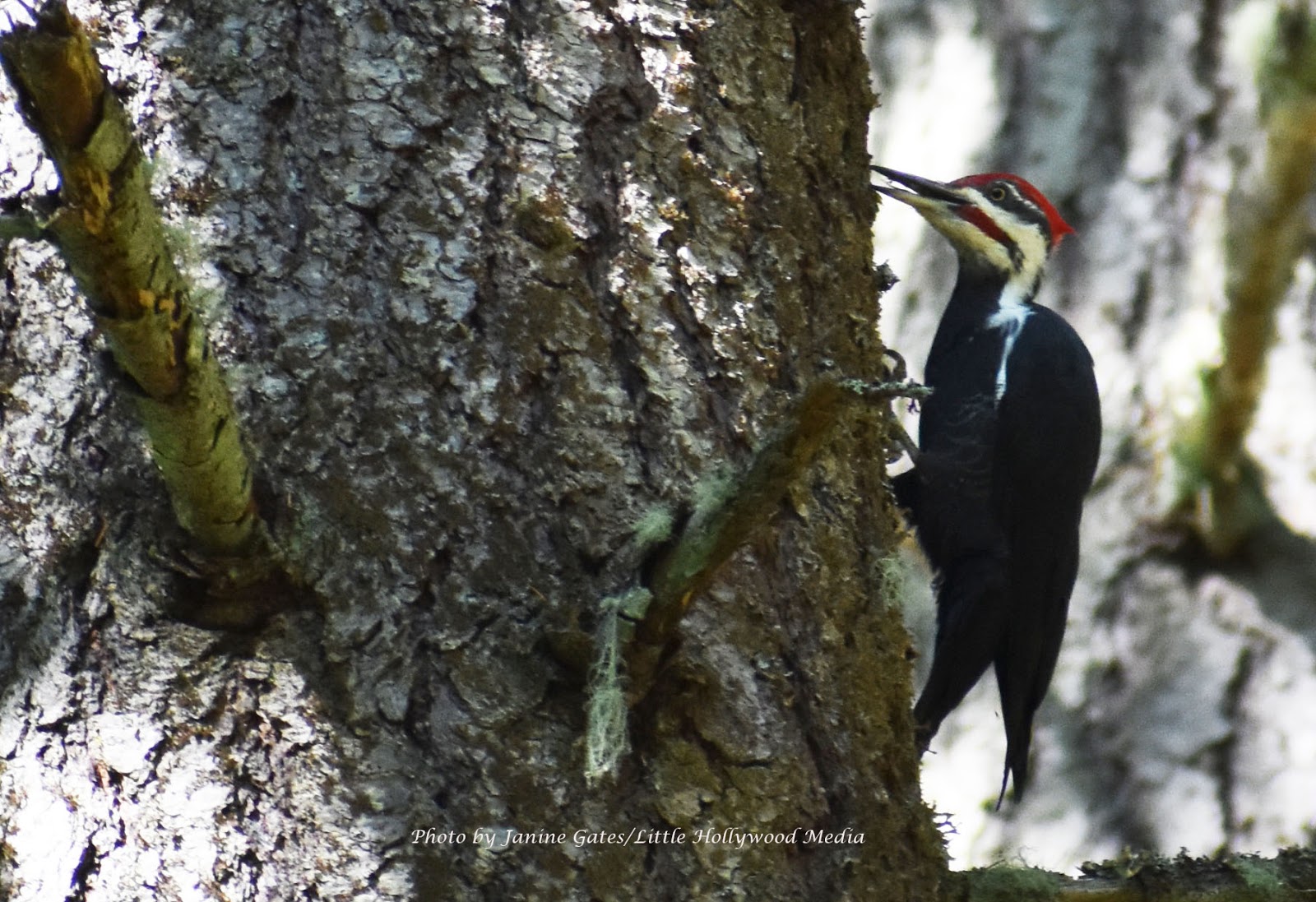
Above: Several pileated woodpeckers were heard boring
into snags and trees well before they were seen along the peaceful Sequalitchew
Creek trail in DuPont last week. Two industrial warehouses and related
facilities are proposed to be built 100 feet from the creek.
Public
Hearing Tentatively Set for October 24
Public Comments Highlight Area’s Historic
Significance, 9th Cavalry Buffalo Soldiers Held Maneuvers, Camped at Sequalitchew
By
Janine Gates
Little
Hollywood
A public hearing for
an industrial development proposal near Sequalitchew Creek in the City of
DuPont, Pierce County, is tentatively set for October 24, 1:00 p.m., at DuPont
City Hall, 1700 Civic Drive, DuPont.
The public is invited to attend and present oral and written testimony to a city hearing examiner on the proposed project.
DuPont Industrial Partners, LLC is proposing to
build two warehouses totaling 258,400 square feet on a vacant, 21 acre
wooded parcel near Sequalitchew Creek and the Sequalitchew Creek trail in
DuPont.
Based on the applicant’s materials:
Based on the applicant’s materials:
· The
buffer between the proposed project and Sequalitchew Creek is 100 feet.
· Nearly
400 healthy trees will be removed from the site, called “Lot Y.” Of that
number, 76 landmark trees are in the area, 49 of which will be removed.
Landmark trees are described in ordinances as significant. One of
the 49 landmark trees is a large Oregon white oak tree.
· Over
70 percent of the property is expected to become impervious surface.
· Approximately
444 total daily trips are expected to be generated on a typical weekday. Noise
from vehicular traffic to and from the site would be present with possible
operating hours of 24 hours a day, seven days a week.
· The
current comprehensive plan designation for the area is Sequalitchew Village
Planning Area. The current zoning designation for the site is Manufacturing
Research Park (MRP) and buildings on site may be as high as 70 feet.
The first comment deadline for state agencies, tribes, and the public to weigh in on the project
was September 12.
Jeff Wilson, community development director for the
City of DuPont, has compiled the comments and will likely issue a Mitigated
Determination of Non-Significance (MDNS) for the project.

Above: Mothers and children walk along the Sequalitchew
Creek trail. The trail leads
directly to Puget Sound and is popular with families, photographers, and bird
watchers.
History of Buffalo
Soldiers at Sequalitchew, American Lake
Most letters highlighted the historic significance of the area and called for its preservation. Others requested increased buffers from the creek and noted other environmental considerations.
Jackie Jones-Hook, executive director of the non-profit Buffalo
Soldiers Museum in Tacoma, is opposed to the proposed development.
She provided the City of DuPont historical information about the Buffalo Soldiers and intends to testify at the public hearing on October 24.
She provided the City of DuPont historical information about the Buffalo Soldiers and intends to testify at the public hearing on October 24.
In an interview with Little Hollywood, Jones-Hook says the area is part of a proposed
Nisqually-Sequalitchew Historic District and lies in the cradle of U.S. military history in the Puget Sound region.
In 1866, Congress established six all-black
regiments, each with about 1,000 soldiers.
Known as “Buffalo Soldiers,” the regiments were
comprised of former slaves, free men and Civil War soldiers. They helped rebuild
the country, patrolled the remote western frontier, protected settlers, built
forts and roads, and mapped the wilderness in the West.
The first stewards of our national parks were these Army
cavalry troops before there was a National Park Service. The last Buffalo
Soldier units were disbanded in 1944.
Of local significance, over 4,000 troops from the
regular U.S. Army and National Guard units from Washington, Oregon, and Idaho
were organized into opposing armies around American Lake and engaged in mock
battles and skirmishes.
Members of the 9th U.S. Cavalry Regiment served in
the 1904 maneuvers at American Lake, the first in a series of large scale
military maneuvers. The success of those maneuvers led to additional maneuvers in 1906, 1908, 1910, and 1912.
Jones-Hook said she is in the process of implementing a federal grant her museum just received to educate at-risk, under-served and under-represented children about the Buffalo Soldiers.
Field trips for the children will include the areas of
Fort Lawton, now Discovery Park, in Seattle and Sequalitchew Creek, where the
soldiers camped. Stables for the horses were also located there.
“Our curriculum will talk about the Buffalo Soldiers’ lifestyles and survival skills, and how they were able to live off the land by eating berries and drinking water out of the creek. It will also provide the children an opportunity to visit the actual sites where the Buffalo Soldiers served. You can talk about it, but actually being there puts you in a totally different mindset.
“For so long we were denied the ability to read and write, so it’s a story that’s not well told, but the story of the Buffalo Soldiers is the greatest tribute in the world to the dedication, strength, and pride of black men,” she said.

“For so long we were denied the ability to read and write, so it’s a story that’s not well told, but the story of the Buffalo Soldiers is the greatest tribute in the world to the dedication, strength, and pride of black men,” she said.

Above: A display at the Buffalo Soldiers Museum in Tacoma describes the 9th and 10th Cavalry also known as the Buffalo Soldiers, and their military maneuvers at American Lake in 1904, 1908, 1910 and 1912.
Archaeological
Investigations
Although artifacts have been found on the site proposed to be developed,
the area has been extensively disturbed over the years.
There is currently no marker or mention of the Buffalo Soldiers anywhere along Sequalitchew Creek.
The agency also wondered if the project proponent
has plans to retain the section of narrow gauge railroad that was recorded
during a cultural resource survey a few years ago.
Operation of the DuPont Powder Works in the early to
mid-1900s included use of part of the property as a burning ground dump from
the 1930s until 1945.
More disturbances occurred during archaeological
investigations and related artifact collection between 1989 and 2005, and environmental
remediation activities in 1999 and 2000.
Regarding the 9th U.S. Cavalry site archaeological investigations in 1989 and 1991, archaeologist Guy Moura and his team recovered over 800
artifacts.
Washington State archaeologist Robert Whitlam indicated in a 1998 letter to noted archaeologist Richard Daugherty that the
site was potentially eligible for listing on the National Register of Historic Places. He also recommended further work to define the boundaries of the Native American
and Buffalo Soldier occupations.
The Nisqually Indian Tribe expressed no concerns
about the development except in the event human remains or cultural and
historic resources were found.

Above: A marker indicates the likely location of the Methodist Episcopal Mission, the first non-permanent, Euro-American settlement on Puget Sound. Built in 1839, the Mission burned down in 1842. The location lies in the location of Warehouse B of the proposed project.
A September 5 story by Little Hollywood, “Sequalitchew Threatened by DuPont Warehouses,” is at http://janineslittlehollywood.blogspot.com/2018/09/sequalitchew-threatened-by-dupont.html
For more information about the property and to stay up to date on possible public hearing meeting changes, contact Jeff Wilson, City of DuPont Community Development Director and City SEPA Official, at jwilson@dupontwa.gov or (253) 912-5393, or go to www.dupontwa.gov.
For more information about the property and to stay up to date on possible public hearing meeting changes, contact Jeff Wilson, City of DuPont Community Development Director and City SEPA Official, at jwilson@dupontwa.gov or (253) 912-5393, or go to www.dupontwa.gov.
For more information about the Ninth and Tenth Cavalry Buffalo Soldiers Museum in Tacoma, go to www.buffalosoldierstacoma.org or email soldiersmuseum@aol.com. The museum is located at 1940 South Wilkeson Street, Tacoma, Washington 98405.


