Thursday, November 10, 2016

Post-Election Reconciliation: Signs of the Times


Above: In the spirit of peace, Glen Anderson, left, and Bob Zeigler each hold handmade signs at the northwest corner of Sylvester Park at Legion Way and Capitol Way on Wednesday afternoon in downtown Olympia.

By Janine Gates

Glen Anderson of Lacey, a retired state employee and local community organizer with the Olympia Fellowship of Reconciliation, has dedicated himself to stand or sit every Wednesday during the noon hour at the corner of Sylvester Park in downtown Olympia with hand-made signs since March 5, 1980 – that’s 36 ½  years. 

If ever there was a presidential post-election thought expressing Glen Anderson's feelings on what continued for many to be a gut-wrenching, emotionally wild day, his message, “Be gentle with one another,” summed it up. 

Those powerful, few words, written on a handmade sign, offered passersby an ever-so-brief suggestion of how to treat each other, while adding a calming, implied reminder, perhaps, to breathe.

Between waving to pedestrians and drivers, some who honk in apparent appreciation or agreement, Anderson said he specifically chose this sign to hold, one day after the election of president-elect Donald J. Trump.

“The political system and political culture is full of blame, full of shame, and trauma. This year, it has lifted up stuff that was already there so vigorously – anti-gay, anti-Muslim and racist sentiments – that it caught people by surprise,” said Anderson.

Anderson said both major party presidential campaigns were based on fear.

“Both parties are quite broken. The remedy for blame, shame, and trauma is not through the electoral option. If you want change, you have to work at the grassroots. That means sitting on street corners and talking to people. It means connecting….”

At that point, Bob Zeigler, another retired state employee and local community activist who is concerned about the climate crisis and the activities of the Port of Olympia, arrived to hold a sign. 

The sign he chose amongst an inventory of pre-prepared signs: “Act from love, not fear.”

Anderson also hosts and produces a monthly show related to peace, social justice, economics, the environment, and nonviolence on Thurston Community Media (formerly Thurston Community Television).

Anderson said his December program, which will be taped next week, will feature four community guests who will speak about the theme of healing from political blame, shame and trauma.

His guests will be Liv Monroe, a certified communications specialist in nonviolence and compassion, Robert Lovitt, a local Buddhist, Keylee Martineau, a mental health counselor who works with at-risk young adults at Community Youth Services, and the Reverend John Van Eeewyk, a local priest and clinical psychologist.

The Olympia Fellowship of Reconciliation is also co-sponsoring the Western Washington Fellowship of Reconciliation’s 2016 Fall Retreat on Saturday, November 12, from 9:00 a.m. to 5:00 p.m. at the Gwinwood Conference Center in Lacey. 

The theme will be “Interracial and Intergenerational Movement Building: Weaving Activism into Our Lives.”

The Fellowship of Reconciliation is a 100 year old pacifist organization founded at the beginning of World War I. 

For more information about the Fellowship of Reconciliation show, times, and how to access it through your computer, go to www.olympiafor.org/tv_programs.htm. For informtion about the 2016 Fall Retreat, or the organization's many activities, go to www.olympiafor.org or www.wwfor.org or contact Glen Anderson at (360) 491-9093 or glen@olympiafor.org

Above: Glen Anderson sits with his sign, “Create peaceful foreign policy,” at Percival Landing in downtown Olympia by The Kiss statue in October. Wind, rain, sleet, or snow, every Friday from 4:30 p.m. to 6:00 p.m.Anderson is there with many others, including the Artesian Rumble Arkestra street band. Anderson has many signs to choose from, and encourages individuals to participate. “Just dress for the weather and show up!” laughed Anderson.  

Wednesday, November 9, 2016

Future Uncertain for State Capital Museum


Above: The historic Lord Mansion, located in the South Capitol neighborhood in Olympia, has served as the State Capital Museum since 1942. Staff of the Washington State Historical Society informed the public on Monday that it cannot afford to keep the mansion as the state Capital Museum due to financial reasons. The mansion is currently closed to the public.

By Janine Gates

There is new uncertainty as to the future of the State Capital Museum at the historic Lord Mansion in Olympia.

At a public meeting at the mansion on Monday evening, Washington State Historical Society (WSHS) staff said that it cannot keep the mansion as a museum due to financial reasons. About 50 were in attendance, many of them from the South Capitol neighborhood association. 


The Lord Mansion, located in the historic South Capitol Neighborhood at 211 21st Street, seven blocks south of the Capitol Building, was built in 1923 for banker Clarence J. Lord and his wife, Elizabeth. The building was designed by Olympia architect Joseph Wohleb. 

Lord was a powerful figure in the history of Washington State banking, served as Olympia's mayor in 1902-03, and was a staunch opponent of any attempt to move the state capital. After Lord's death in 1937, the mansion was donated to the state by Elizabeth Lord, to be used as a museum. It opened as such in 1942, and was closed in 2014.

Jennifer Kilmer, director of the Washington State Historical Society, told the group that the Lord Mansion will continue to be renovated and a leasing tenant will be sought whose mission profile fits well with their occupancy of the historic structure. The mansion is owned by the Society.

Kilmer was hired after the 2008 recession, and the Society's budget had just been cut 44 percent. Ever since, the Society has struggled to keep the museum open, and the Governor's budget writers have told her not to ask for more money because she will not get it.

Despite obtaining past capital project funding to upgrade wiring and plumbing, replace the roof, and make repairs, the Society can no longer afford to operate the mansion.

In consultation with the state Department of Archaeology and Historic Preservation, renovations include repairing and repainting the interior and installation of new carpeting. The renovations are ongoing

Kilmer said it would take several million dollars to bring the building to certified climate control standards for the storage and display of historic documents, pictures, and artifacts. Renting the mansion out, she said, would be the worst option, because the wear and tear would be significant. 

The Coach House, located behind the State Museum, will continue to be available for public rental.

“We heard the biggest concerns were the impact to traffic in the neighborhood, continued care and preservation of the historic structure (and surrounding landscaping), and the perceived absence of a local history center that will be created by this decision,” Erich R. Ebel, Washington State Historical Society marketing and communications director, told Little Hollywood on Tuesday. 

“Basically, we want someone in there who appreciates and cares for the building and whose business fits well with the neighborhood. The meeting (on Monday night) was the beginning of this community conversation, not the end…there will be additional information and outreach in the future,” said Ebel.

The Washington State Historical Society will use funding from the building’s lease to fund programs and displays on the Capitol Campus, either in the Legislative Building itself or another building nearby, such as the Pritchard Building.

Asked about future tenants, Ebel said the Society is not yet ready to begin the search for a new tenant as renovations are currently underway. The building is currently occupied by an employee who oversees the structure and handles public rental of the Coach House.

A change to the relevant Revised Code of Washington, substituting “Historic Lord Mansion, for State Capital Museum, will be proposed for the next Legislative session to broaden the mansion's use beyond a museum. 

The Washington State Historical Society will continue to oversee maintenance of the structure and surrounding landscaping, including the native species garden named in honor of the late Delbert McBride, the museum's curator emeritus and an ethnobotanical expert of Cowlitz/Quinault descent. It features more than 30 species of native plants.

“The Washington State Historical Society takes its responsibility of being good stewards of state history very seriously,” said Ebel.

Above: As seen in May 2016, an inviting stone table and benches provide a place to rest and admire spectacular rhododendrons, native plants, and a pioneer herb garden at the historic Lord Mansion.


Editor’s Note, November 10: Clarifications made to this story, based on an email to Little Hollywood from Erich R. Ebel, Washington State Historical Society marketing and communications director: 

The meeting was in the mansion itself, not the Coach House. Also, the proposed legislation would change the name “State Capital Museum” to “Historic Lord Mansion.”

Also, Ebel comments: "There is a misconception that the mansion was donated explicitly for use as a museum. This is not the case. We’ve reviewed the transaction paperwork that was done at the time, and it only specifies that the mansion be used for the public good, possibly as a museum."

Little Hollywood appreciates the clarifications.

Saturday, November 5, 2016

Black Alliance of Thurston County Celebrates Work, Progress


Above: Dr. Karen Johnson, center, acknowledged the collective power of many individuals at the second annual founding celebration of the Black Alliance of Thurston County at Risen Faith Fellowship Church on Saturday afternoon. Left to right: Nat Jackson, Dr. Thelma Jackson, Barbara Clarkson (hidden behind Johnson), Rev. Charlotte Petty, Clinton Petty, Crystal Chaplin, Andre Thompson, and, standing with the assistance of a walker, Bryson Chaplin.

By Janine Gates

Community singing, thoughtful commentary, powerful testimony, and good food was plentiful at the second annual Black Alliance of Thurston County founding celebration at Risen Faith Fellowship Church on Saturday afternoon.

“It doesn’t take an awful lot of people to get a lot of work accomplished, but it does take a lot of heart,” said Dr. Karen Johnson, chair of the Alliance, who served as mistress of ceremonies for the event.

While the westside shooting of two, young African Americans, Andre Thompson and Bryson Chaplin, by an Olympia police officer in May 2015 was the catalyst for the group's formation, their work with law enforcement and the community has taken on a life of its own with a lot of effort and hard work by many individuals.

Special awards were given to Kathy Baros Friedt and Leslie Cushman, for their efforts organizing the Olympia Coalition for the Reform of Deadly Force Laws, the YWCA of Olympia’s Stand Against Racism efforts, Senator Karen Fraser and Olympia Police Chief Ronnie Roberts, and Olympia High School’s African American Alliance, which has held several conversational meetings about race.

Lacey Police Chief Dusty Pierpoint, who was not in uniform, addressed community questions and concerns about the crisis training and psychological testing of police officers, progress regarding fair and impartial policing, and how training about implicit bias can be effectively measured.

In law enforcement for over 30 years, Pierpoint acknowledged that police officers are dealing with difficult, community issues.

“We, as law enforcement, are being tasked with things we should not be. We are not mental health professionals, we’re not drug addiction professionals, we’re not marital counselors, we’re not homelessness experts, but that is who gets called. We are being tasked with things that the community should be dealing with, and it’s not happening. That’s why 30 percent of our jails hold those with mental illness who do not belong there,” Pierpoint said to a round of applause. 

Pierpoint also gave recent examples in which officers have used de-escalation techniques when responding to a call, but described how those incidents don’t get recognized or acknowledged in the media.

Office of Superintendent of Public Instruction candidate Erin Jones gave a powerful, personal talk about education and her first experiences with racism, and Thurston County Auditor Mary Hall spoke about voting and the importance of civic engagement. 

Hall assured the audience that vote tabulation is a safe and transparent process in Thurston County and across the country. She said there are nearly 175,000 registered voters in Thurston County, a record high. She also expects an 80 to 85 percent turnout rate in Thurston County. Ballots will start to be scanned on Monday. 

Part of the work of the Black Alliance resulted in the eventual passage of a bill that created the Joint Legislative Task Force on the Use of Deadly Force in Community Policing. That group's final meeting, which will include proposed recommendations to the governor, is November 21, 9:30 a.m. – 4:30 p.m., John L. O’Brien Building, House Hearing Room A, at the Capitol Campus.

Among other activities, beginning in February 2017, the Black Alliance will collaborate with The Olympia Unitarian Universalist Congregation (OUUC) and The United Churches of Olympia to host a monthly film series and conversations about race. Films will be held the third Thursday of each month, 6:30 p.m. – 9:00 p.m., at the OUUC Sanctuary, 2315 Division St. NW, Olympia.

Perhaps the most poignant part of the afternoon, moving some to tears, was witnessing Bryson Chaplin standing, and then walking to the stage with the assistance of a walker, to be recognized with his family. Bryson still has the officer’s bullet lodged near his spine.

“This is a celebration of what faith and love and hope and determination can do,” said Johnson.

“I just want to say he came in a wheelchair, I prayed for him after church….Oh, give thanks up to the Lord for He is good,” praised Rev. Charlotte Petty.

For more photos and information about the Black Alliance of Thurston County, Karen Johnson, the Joint Legislative Task Force on the Use of Deadly Force in Community Policing, the Ad Hoc Committee on Police and Community Relations, Andre Thompson, Bryson Chaplin, and local groups working for racial justice, go to Little Hollywood, www.janineslittlehollywood.blogspot.com and type key words into the search engine.

For more information about the Black Alliance of Thurston County, go to www.blackalliancethurston.org.

Above: Office of Superintendent of Public Instruction candidate Erin Jones greets Drs. Sherman and Eve Beverly of Olympia at the second annual founding celebration of the Black Alliance of Thurston County on Saturday afternoon, where Jones gave a powerful, personal talk about education and her first experiences with racism.

Friday, November 4, 2016

Chambers Prairie Grange Rezone Passes Tumwater City Council


Above: Long shadows are cast across the Chambers Prairie Grange No. 191 on Thursday morning. The Tumwater City Council passed a rezone for the property, which stands at the crossroads of Yelm Highway and Henderson Boulevard. Owner Tom Schrader is now looking for a suitable local business that will honor the spirit of the rezone, and accommodate a community service in the 106 year old building.

By Janine Gates

“Within Grangers, ideas are born, and in the Grange, they become a reality,” reads a slogan in a vintage Washington State Granger’s guide. 

That slogan takes on special meaning now as Tom Schrader moves closer to his dream of converting the vacant 106 year old building into a vibrant place of community once again. 

Schrader and his wife, Tiffany, purchased the property last year and have worked with neighbors to address their concerns regarding its future use and traffic.

City of Tumwater council members passed a comprehensive plan amendment at their October 25 meeting, changing the zoning of the Chamber Prairie Grange, located at 1301 Yelm Highway SE, from single family low density (SFL) to community service (CS).

Under the SFL zoning, the former Grange could have been torn down to build four to seven homes or duplexes, among other uses. The zoning change to community service limits how commercial the site could be developed and protects the property from becoming a gas station, a mini-mart, or a five story commercial building.

Several spoke in support of the rezone, including Dave Nugent, president of The Farm homeowners association, an adjacent subdivision.

Nugent addressed the council, saying The Farm board is so confident in Schrader’s dedication to the Grange’s future that a developer agreement is no longer needed. To determine the project’s impact, Nugent asked for the city's assistance in monitoring traffic patterns before and after completion of the project.

Lloyd Flem of Olympia, a retired professional planner who served on Olympia’s planning committee in the 1990s, said the rezone was a perfect example of adaptive reuse to preserve an important piece of the community’s history.

Schrader announced at the meeting that he and his wife would most likely not sell the property as planned, but select and help manage the business that ends up there.

“We are really happy for everyone - neighbors, friends, family, and community - that we can now do something on that corner that will be a place for the community!” said Schrader after the meeting.

Schrader has tried to garner the interest of local businesses in his idea to convert the building, while retaining its historic character, into a coffee and sandwich shop and meeting place, but has found it to be a tough sell without knowing whether the rezone would pass.

“I have spoken with a lot of local businesses - Batdorf & Bronson, Meconi's, Vic's Pizza, Olympia Coffee Roasters, Budd Bay Cafe, Dancing Goats, Starbucks, Cutter's Point, and Royal Bean Coffee. I have also been contacted by Wendy's, Carl's Jr., Taco Time, and Chipotle too,” says Schrader, who quickly added that he is not interested in those latter fast food businesses.

“There wasn’t much teeth in my sales pitch or delivery before, but now I can move forward,” he said.

Before any further physical change to the building can take place, such as putting on a cedar shake roof, Schrader needs to have a tenant in place, so that changes are made to fit the specific requirements of the new business.

“In the next few weeks, my wife and I will decide the best fit for the property and our community. It's an important corner, and I want to be known as a responsible and sensible person. I want to see people there, and have it be a happy place!”

The Washington State Grange came into existence Sept. 10, 1889 as a protest by farmers against intolerable conditions – against poverty, extortionate taxes, freight rates and mortgage interest, and government control of state government by selfish interests.

The Chambers Prairie Grange, No. 191 Patrons of Husbandry principal place of business was the hall, located on what was then called Route #2 in Thurston County.

According to its nonprofit articles of incorporation, the Grange’s purpose was to “educate along the lines of social, moral, and educational betterment,” and “to inculcate into the minds of the membership the benefits of cooperation.”

Little did Grangers know that decades later, Tom Schrader, with his infectious energy and enthusiasm, would be saving their most treasured asset - their building - to become a place of community, cooperation, and commerce once again.

For more photos, history, and current information about the Chambers Prairie Grange, Tom Schrader, the rezone effort, go to Little Hollywood, www.janineslittlehollywood.blogspot.com and type key words into the search engine. Previous stories are dated November 29, 2015 and May 28, 2016.

Above: Tom Schrader holds a Grange piece of history: an old Olympia Federal Savings and Loan Association check register, found in the Chambers Prairie Grange building after he took ownership of it last year.


Saturday, October 29, 2016

Olympians Stand with Standing Rock Water Protectors

Above: Benjamin Sitting Bull, Oglala Lakota Sioux, a sixth generation grandson of Sitting Bull, spoke to Olympians in solidarity with Standing Rock Water Protectors on Saturday afternoon in downtown Olympia.

Clothing Donations Accepted in Olympia for Water Protectors

By Janine Gates

At the southernmost tip of Puget Sound, the direct descendent and grandson of Sitting Bull, Benjamin Sitting Bull, Oglala Lakota Sioux, spoke to Olympians on Saturday afternoon in downtown Olympia.

About 65 people gathered in solidarity with the water protectors blocking the Dakota Access Pipeline route at Standing Rock, North Dakota.

A harbor seal in Budd Inlet approached Percival Landing beneath The Kiss statue near Sitting Bull, also wanting to listen.

Sitting Bull lives in Olympia, and said that he is choosing to raise his two year old daughter, Josephine, here because it is safe and warm. As she sat on a little scooter wearing a monarch butterfly costume, he acknowledged the wide range of emotions community members are feeling about the tense situation at Standing Rock. 

....Those feelings are valid…. That’s why we’re standing up as indigenous people, because we’re called upon. Our grandparents that are no longer living - our elders - have tapped on us and come to us in our dreams and are saying, ‘Get up and say something to the people around you. These songs and these ways that are given to you – put them out in the public right now....’

As her father spoke, Josephine listened. When he began singing a prayer song, she closed her eyes, put her head back, and started bouncing to the beat of his drum.  

Although the protest in Standing Rock continues to be ignored by corporate media, a wide variety of social media sources and Native news sites feed constant, live streaming videos and disturbing updates. Reports of police brutality, including reports of intrusive bodily searches of the protesters, called water protectors, are rising.

The proposed 1,172 mile long pipeline would move 470,000 barrels of domestic crude oil a day through four states and run through the Standing Rock Sioux reservation, threatening water, the environment, and Native American burial and prayer sites.

Law enforcement has escalated their response and have arrested at least 141 protesters. Efforts by journalists to document what is happening is being hampered and criminalized.

A local prosecutor had charged Amy Goodman of Democracy Now! with rioting after her crew filmed an assault on protesters on September 3. A judge threw out the charges against Goodman on October 17.

Documentary producer Deia Schlosberg was arrested for filming protesters who broke into a pipeline valve station near Walhalla, North Dakota on October 11. She was charged with three felony conspiracy counts, and could face as much as 45 years in jail.

The Society of Environmental Journalists wrote law enforcement officials at the state and federal levels on October 19, objecting to the prosecution of journalists who have been covering the protests.

Recent visits by the Reverend Jesse Jackson and actor Mark Ruffalo and others have helped raise awareness of what is transpiring, and several Olympians have traveled there, will travel there, or are there now, experiencing police brutality.

Caro Gonzales of Olympia has been at Standing Rock since August as an organizer for the International Indigenous Youth Council, and was arrested and released on Friday. All her gear has been impounded.

“They snatched me while I was praying…then dragged me to the burial grounds to handcuff me and stomped on my arms till I dropped the tobacco offering and sage. They kept us in dog kennels. We were put in solitary and refused medical attention,” she wrote on social media.

She reports that she was charged with a felony and released. She is currently seeking anyone who may have video of her arrest to prove she was praying while taken away by law enforcement.

Amnesty International USA issued a press release on Friday saying they have sent a delegation of human rights observers to the Standing Rock Sioux Reservation, to monitor the response of law enforcement to protests by indigenous communities.

AIUSA also has sent a letter to the Morton County Sheriff’s Department expressing concern about the degree of force used against the protesters. The organization will also call on the Department of Justice to investigate police practices. 

Sitting Bull continued:

“....Don’t hold hatred in your heart for those officers (at Standing Rock) because that’s not what we do in the Sun Dance way. I want to say, turn that around on them, just hope that they start looking at their human consciousness that’s been stolen from them…that they may have a spiritual awakening, a personal experience. They might say, ‘What am I doing? What am I doing to this person, this human being that I’m pulling out of prayer, pulling his naked body out of the womb. What am I doing? What am I doing? I can’t do this anymore, for money….’ In that way, he might transition back to those birds, those trees. All the natural things around him might start talking to him again. The birds might say, ‘Hey, come back, come back and talk to us, stop what you’re doing. Let’s live together in hope....

Above: As rain clouds loom, Rebecca Cesspooch, Northern Ute, Nakota, of Olympia addressed the group gathered in Olympia on Saturday.

Lydia Drescher, California Band of Mission Indians, Tongva, of Olympia, has already been to Standing Rock and said she will leave again on November 20 to deliver much needed community donations gathered in Olympia.

There are three locations where individuals can make clothing donations. Although there was an initial abundance of clothing sent to Standing Rock, those items, including tents and teepees, have recently been taken away by law enforcement.

The request is being made now to donate earplugs, goggles, heavy socks, long underwear, gloves, and other warm items that are not too bulky.

A donation box is located at the Westside Co-op at 921 Rogers St. NW, but donations can also be taken to the Eastside Coop at 3111 Pacific Avenue SE. Other donation box locations are at The Longhouse at The Evergreen State College, and Traditions Fair Trade, 300 5th Avenue, in downtown Olympia.

Financial donations made at either branch of the Olympia Food Co-op will be matched, dollar for dollar, up to $1,000. In addition, the Co-op is asking patrons to “round up” their grocery bill to the nearest dollar or more to donate to the Standing Rock water protectors.  

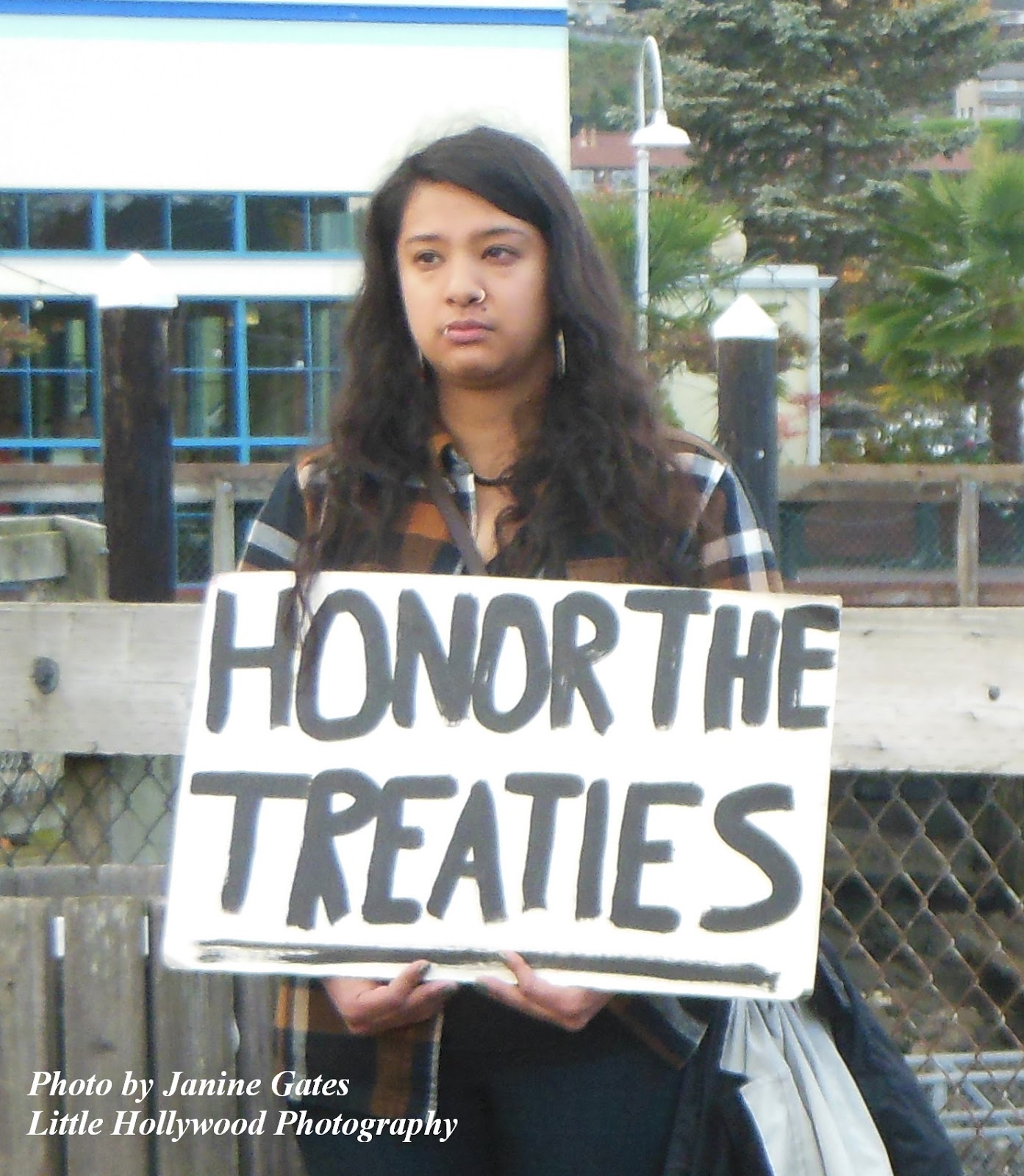
Above: Rebecca Cesspooch, Northern Ute, Nakota, of Olympia, held an Honor Treaty Rights sign, addressed the group gathered in Olympia on Saturday.

“This is a long fight that has been happening. This fight is old. It never stopped. It’s been going on forever…It’s our turn now to be strong in the way our ancestors have been strong…It is our time to go back to the old ways. Now is the time to reclaim them because the Mother Earth needs you. Your ancestors are singing to you. Now is the time to unite and remember our ways….It will be hard…but we have to be strong. Talk to the land, talk to each other….Pray for accountability, pray for healing, justice, and long term systemic change. Pray. Take the time to remember the sacredness in you and around you. Love yourself unconditionally and love those around you unconditionally, even though we may not agree….Hold compassion in your heart…because that’s the only thing that will keep us strong and get us through this. All my relations….” said Rebecca Cesspooch, Northern Ute, Nakota, of Olympia. 

For more information, the Standing Rock Sioux Tribe at www.standingrock.org and is accepting financial donations online that will go toward legal, sanitary, and emergency purposes.


Thursday, October 27, 2016

Owls Occupy Old Brewhouse Tower in Tumwater


Above: On a tour organized by the Old Brewhouse Foundation in October 2014, City of Tumwater councilmember Tom Oliva, in dark coat, stands on the sixth floor of the Old Brewhouse tower, and looks up at the photographer who is in an upper loft of the tower under the copper roof. Owl droppings litter the floor. It is anticipated that the owls will be relocated before the tower undergoes temporary repairs, window closures, and weatherization this winter.

By Janine Gates

Barn owls have occupied Tumwater’s vacant Old Brewhouse tower for years, but they will not rule the roost for much longer.

In a meeting last month of the Tumwater Historic Preservation Commission, commissioners approved, with conditions, a certificate of appropriateness so the city can begin temporary weatherization efforts of the tower.

The 110 year old Old Brewhouse is a historic landmark, and was placed on the National Register of Historic Places in 1978. It has been on a watch list by the Washington Trust for Historic Preservation, and is also in Tumwater's Historic Brewery District.

Obtaining a certificate of appropriateness by the commission ensures that any alteration, demolition, or new construction to the historic site is consistent with the property's character. The step is also necessary to move forward with permitting. 

The commissioners took their time at the September 8 meeting to express concern for the owls, ask extensive questions about the types of materials to be used in repairs and weatherization, the methodology for anchoring a temporary roof, and the appearance of the temporary fixes.

One of the conditions for approval was assurance from staff that they would learn more about the barn owls and figure out how to relocate them before installing a temporary roof and sealing up about 55 windows.

Barn owls are a protected species under the Migratory Bird Treaty Act.

After consulting with biologist Michelle Tirhi of the Washington State Department of Fish and Wildlife after the meeting, city staff learned that they must place owl boxes elsewhere on the property in hopes that the owls in the tower will be convinced that they should go elsewhere.

Contacted by Little Hollywood, Tirhi said barn owls often seek out older, seldom used outbuildings for nesting, like barns and old buildings. Barn owls are done nesting for the season and this is a great time to construct and place nest boxes, and then seal them out of their current location.   

The boxes should be installed as close to where the owls currently enter and exit the building. 

Tirhi said she is hopeful the city or volunteers will continue to monitor the boxes so that they can be protected, repaired, or replaced over time, as needed, for the sake of the owls.

The City of Tumwater acquired the tower in an agreement with owner George Heidgerken in May. Heidgerken and his company, Falls Development LLC, owns the 32 acre area around the Old Brewhouse property, roughly bounded by Custer Way to the south, the Deschutes River to the west, Capitol Lake to the north, and the railroad to the east. 

As of this week, there is still no update on the placement of the nesting boxes.

“We’re working with George (Heidgerken) to get permission to install them on site in a variety of locations that are appealing to owls. Then, it will be safe to seal up the Old Brewhouse,” said assistant city administrator and brewery property manager Heidi Behrends Cerniway.

In the meantime, the building continues to deteriorate. In a process called “spalling,” bricks literally fly off the tower, as moisture causes the mortar to expand and contract with weather temperatures, thus dislodging the bricks. 

Behrends Cerniwey told the seven member commission that whenever she visits the site, new bricks are laying on the ground around the tower.

The city hopes to have the temporary protections and weatherization efforts complete by the end of the year.

Above: The southeast corner of the Old Brewhouse tower of the fourth floor shows a dramatic decay of bricks and exposure to the elements.

Regarding the appearance of the repairs, there will be no unsightly blue tarps, but a temporary roof is expected to stay put for one to four years while funding is secured for a permanent roof and window materials.

The windows could be boarded up with plywood from the inside, and perhaps shaped to fit the window, but some windows may have a clear weather resistant material instead, to allow in light. Some may stay open to allow for minimal ventilation. There is no electrical power or heating inside the building.

The city’s consultant, Cardinal Architecture, produced a detailed tower protection and renovation report in May. It estimated that a temporary roof structure would cost about $97,750, and temporary windows and door panels would cost about $21,250.

Because they will be temporary - immediate protections meant to reduce the rate of decay - the city says it will not go through a formal bidding process, and the work will be done with volunteer labor and donated materials.

This was another aspect of significant discussion, as commissioners did not want to find themselves in a situation similar to that of the City of Olympia when it attempted to use the donated services of Joint Base Lewis-McChord soldiers to demolish two blighted buildings on the isthmus in downtown Olympia last year.

One of those organizations donating services is the nonprofit Old Brewhouse Foundation.

Rob Kirkwood, president of the nonprofit, has already built four owl boxes, donated an additional owl box, and provides informal input on how to approach the project and what is needed to be done in terms of professional services.

The City of Tumwater will begin permanent restoration efforts as soon as funds become available through grants, capital giving campaigns, and other sources. The project, when complete, is expected to cost about six million dollars.

So far, the only funding the City of Tumwater has on hand for the tower’s restoration is $14,500, an amount earned from the Conservation Futures fund for trail easements that will be donated back to the city. Another $288,000 is coming through the city’s lodging tax funds.

“We’ve been doing our homework about a capital campaign, and working on a funding strategy to raise private and foundation dollars as a match for state grants such as the Heritage Capital Project Fund (HCPF). We did apply for a HCPF grant of $500,000 for the 2017-2019 biennium, but it requires a match of two to one to begin the first phase of restoration,” said Behrends Cerniway.

Above: Local naturalist Nancy Partlow of Tumwater holds barn owl pellets on a tour of the Old Brewhouse property and the tower in October 2014. Partlow documents and contributes many of her observations on a local blog, Bees, Birds & Butterflies, at www.olypollinators.blogspot.com and has known about the owls in the tower for many years.

“It's a perfect setup for them, protected, but with open and easy access to prey. Their nests are simply scraped together regurgitated owl pellets, which are the fur and bones left over after the rest of its prey has been digested. Nature's recycling at work, but also an interesting way for owls to raise young, on the remains of their victims,” says Partlow. 

For more interior and exterior pictures and information about the Old Brewhouse, Tumwater, the planned action for the historic property, George Heidgerken, Falls Development LLC, stop work orders, groundwatering monitoring, and other issues related to the property, go to Little Hollywood, www.janineslittlehollywood.blogspot.com and type key words into the search engine.

For the benefits of owls in Washington and providing for them, go here: http://wdfw.wa.gov/living/owls.html


Cornell Lab of Ornithology has a page on installing barn owl nest boxes: