Tuesday, October 7, 2014

Heck and McDonald Debate 10th District Issues


By Janine Unsoeld
www.janineslittlehollywood.blogspot.com

A debate Monday night between the 10th Congressional District candidates, incumbent Democrat Denny Heck and Republican challenger Joyce McDonald, drew about 60 people. The event was held at the Washington Center for the Performing Arts in Olympia.
Cythnia Iyall, chairperson of the Nisqually Indian Tribe, moderated 11 pre-determined questions, and Allyson Brooks, vice president of the Olympia chapter of the League of Women Voters, asked several questions posed by audience members, written on index cards.

The debate was taped for broadcast on Thurston County Television (TCTV).

Heck mentioned the Seahawks game in progress as a possible reason for the sparse crowd and kept the audience up on the game score during the debate and announced its outcome at the debate’s end, which received the loudest cheer of the evening.

Heck answered each question with confidence while McDonald read some answers about national or international issues from prepared notecards.  She spoke most warmly and effectively about being a former foster parent and softball coach, and her time as a state legislator. McDonald also has several years of experience on the Pierce County council.
Questions covered standard election issues: the revenue disparity between rich and poor, federal legislation for curbing carbon emissions, the quality of the rail system with regard to safe fossil fuel transport, immigration, foreign policy, wounded veterans, jobs and more.
Questions posed by the South Sound audience were also wide ranging. McDonald was sometimes vague, as was Heck, who also liked to tell stories and use his allotted time to its fullest capacity.

In brief:

Should the Washington Redskins be compelled to change its name or face Congressional censure?

McDonald: …Public pressure should do the job for them…. the market tends to work quite well in these cases...I don’t think it’s the role of government….

Heck: Yes. Nobody has the right to engage in a racial slur….It's deeply insensitive to the First Peoples of this nation....

The Trans Pacific Partnership - How can we protect our local environment and jobs?
Heck: Well, I think you've touched upon two of the three criteria I think applies to any proposal for the Partnership...this is kind of a big deal - this is a proposal to enter into a trade agreement with 11 other nations…it is fraught with both danger and opportunity: Three criteria should include: 1) assurance that its adoption will not harm workers…2) Assurance that we are not just exporting low governmental standards… 3) assurances that it will protect our sovereignty….we ought not to delegate the right to set policy for America. 

McDonald:  …At the Congressional level, I would very clearly be working on it depending on what committee picked it up…this is a very important issue, a more important issue for Washington State than for some others so I’d be following this very closely….
The proposal to de-list the Great Wolf from the protection of the Endangered Species Act:

McDonald: I wouldn’t support that...I don’t think they’ve come back with enough population to warrant that…
Heck: …Science ought to dictate this…it ought not to be a political decision, it ought to be based on science. It just seems to me that it shouldn’t be that difficult to determine whether or not the base of that population is sufficient….

What to do about the high incarceration rate in the United States:
Heck: …I think it’s more than worrisome when America has the highest incarceration rate in the world…This is a very expensive way to deal with problems in our society...it’s a lot cheaper to invest up front…in a strong education system so they can see the future of hope….

McDonald: …In Pierce County, we put in place other alternatives to incarceration and allow… alternatives to court such as drug court and veteran’s court…and put people into pathways…rather than just put them in jail and throw away the key…As a former foster parent, I understand that some people have to play the hand they are dealt, but we need to bring people alongside so they can get the help and encouragement and modeling that they need to become productive citizens….
Funding priorities and if you would increase funding for the National Park Service:

McDonald: I’d love to but… my priority will be getting on board with a plan that will reduce the federal debt so we don’t continue to burden our future generations….so I won’t be going there to increase funding. I’ll be going there to see if we can’t find a way to maintain…what we have….
Heck: The fact of the matter is that we get to the point that the funding for providing for some of these facilities and services is so low that it will end up costing us more in the long term… our national parks have been degraded over the last several years…The bigger threat is sequestration….

If Shelton were to receive 400 new immigrants who are meeting their families in Mason County, who should pay for the bi-lingual teachers and the load on the schools and the community?
Heck: It is the paramount duty of the state to make ample provisions for the education of all children….It is unequivocal….

McDonald: Unfortunately, the state of Washington would have to pick up the bill for those children… but this is just another example of …where the federal government has…failed to do its job….to enforce existing law. In my perspective, this is something that should be picked up, at the very least, by the federal government….
Should President Obama ask for a declaration of war against the Islamic State? How would you vote and why:

McDonald: Well, I think it’s evident that the Islamic State has made a declaration of war against the United States and its citizens by beheading American citizens and other citizens of allies of the United States…I think it’s definitely something that should be debated in Congress. It’s not that simple, an act of declaring war and then we run into a country, and start bombing and put troops on the ground…. War is a very serious matter and people’s lives, people we love, who put their lives on the line….Our military is the best in the world….so I’m just not sure this is the right time to be making a declaration of war….but when the time comes, the President should go with Congress, and with one voice, we should take care of the business that must be taken care of.
Heck: …Not once has war been formally declared since WWII….think back to all our conflicts we’ve been involved with in the last seven years – not once, except WWII, did we formally declare war. What’s happening now at least is that the President is operating under…the Authorized Use for Military Force, AUMF, it is called. It was adopted by Congress in 2002, and that’s what he’s using… as his justification… What I do think is appropriate…and it’s past due, is for Congress to at least try…to… make it more reflective of our times… new conditions and/or limitations, new instructions to the President and our Armed Forces with respect to our involvement there….I think it’s a Congressional responsibility… to at least attempt it.

For more information on Representative Denny Heck’s positions, see an article dated January 8, 2014 titled, “One Year in Congress: Is Congressman Heck Giving ‘Em Heck?” go to www.janineslittlehollywood.blogspot.com and type key words into the search engine.  

Sunday, October 5, 2014

Olympia Mural Gets A Makeover


Above: Joslyn Rose Trivett paints over graffiti on the mural she created in 2012. The mural is located between the two roundabouts on Olympic Way near downtown Olympia. The mural was tagged in mid-September.
 
By Janine Unsoeld
www.janineslittlehollywood.blogspot.com

In a story first reported by Little Hollywood in 2012, Joslyn Rose Trivett transformed an ugly wall into a beautiful mural.
 
Today, Trivett continued her dedication to remove stubborn graffiti that appeared several weeks ago. Despite the anti-graffiti coating, the graffiti could not be removed with a chemical recommended by the manufacturer.

“It was really, really nasty stuff,” said Trivett, as she painted. “It melted our gloves. I think I’ll just skip the anti-graffiti coating. If it happens again, I'll just wash the wall and repaint it.”
Above: This graffiti is not art. It is vandalism.

As Trivett worked, drivers honked their horns in approval, and bicyclists and moped riders shouted their thanks. Using some paint leftover from the project two years ago, she spent about $50 in paint today and about six hours of time in labor.

For Trivett, helping make Olympia a beautiful place is everyone’s business.
Trivett and her family, who live in Olympia’s northwest neighborhood, has continued to maintain the mural, prune the nearby vegetation, and sweep the sidewalk. The project was originally spearheaded by Trivett and the Southwest Neighborhood Association.

Trivett says she has put out the offer for a couple of years to paint a mural on the lower section of the wall, which abuts another residence. Located in an area seen by thousands of drivers per day, it is another high-maintenance area with unsightly grime and is a frequent target for graffiti. In particular, she says she would need help maintaining the vegetation.
For now, passersby are grateful for the time and effort she’s putting into the mural to make a difference.

“Hey, it looks good!” shouted a bicyclist riding up Olympic Avenue.
 
For more information about the mural, go to www.janineslittlehollywood.blogspot.com and use the search button to type in key words. Little Hollywood posted a story, Mural Transforms Ugly Wall into a Piece of Art,” on August 12, 2012.

Arts Walk and Arab Festival Offer Culture


By Janine Unsoeld
www.janineslittlehollywood.blogspot.com

The weather cooperated all weekend, and Arts Walk continued on Saturday in downtown Olympia, with some exhibits scheduled to be on display throughout the month. The pace on Saturday was quieter, and allowed more time to see art and speak with artists about their work.
 
Above: Pianist Luke Davis, 16, played outside Browser’s Bookstore on Capitol Way for Arts Walk. Davis said he’s been playing for eight years and has participated at Arts Walk for six years. He attends Black Hills High School. He says donations are going toward his college fund, and parts for his car. “My window isn’t staying up,” he said.

Above: Members of Shahrazad dance Ensemble of Seattle perform at the Olympia Arab Festival yesterday at The Olympia Center.

The Olympia Arab Festival

Coinciding with Arts Walk was the Olympia Arab Festival, sponsored by the Rachel Corrie Foundation for Peace & Justice.

The theme of its second annual event was “Shuruq II,” which means sunrise. In a celebration of Arab culture, the event featured food, performances, speakers, and children’s activities.

Rachel Corrie, Olympia, was killed in the Gaza Strip in 2003 as she tried to prevent the demolition of the home of two Palestinian families.
The Rachel Corrie Foundation was established by Rachel’s family to continue the work that she hoped to accomplish. The Foundation conducts and supports programs that foster connections between people that build understanding, respect and appreciation for differences.
Above: Laith Amireh, 20, of Amman, Jordan, attends Bellevue College and is taking courses in computer science and programming. He says he enjoys being part of the Arabic Culture Student Association, which has 138 members. For more information about the club, go to www.learnarabicculture.org. This is the club’s first visit to Olympia.

Above: The Olympia-Rafah Sister City Mural Project on Capitol Way and State Street in downtown Olympia. For taped recorded information about the wall and the artists, call (360) 252-9779.

Above: Omar demonstrates the fine art of Arabic coffee making at the Olympia-Rafah Mural today. The smell was irresistible. The result of just one cup made for a very productive afternoon and evening! The site at the mural featured a hookah lounge at last night’s Arts Walk.
For more information about the Rachel Corrie Foundation for Peace & Justice, go to www.rachelcorriefoundation.org.

Arts Walk is sponsored by the City of Olympia Arts Commission and the Department of Parks, Arts & Recreation with plenty of support by local businesses and artists. For more information about Arts Walk, go to www.olympiawa.gov/parks.

Saturday, October 4, 2014

City, Tribal Partnership Creates a New Water Source for Olympia


Above: Tribal elder Bob Sison holds a commemorative glass given to participants of today’s dedication of the McAllister Wellfield, the site of Olympia's new water supply.
 
By Janine Unsoeld
www.janineslittlehollywood.blogspot.com

“This is the beginning of a new journey. Father, Grandfather, hear me, Spirit of our People, hear me. We thank you, thank you for joining hands with another world. We thank you for the mountain, for it brings us the water, the water that we will share. May the mountain never run dry, or if it does, so will our lands, so will our people. Watch over and guide and protect everyone who is here. Give them your physical, mental and spiritual strength…show them the way….You’ve brought our people a long ways, you’ve left us the gift of water. Let the rivers never run dry…the pumps…keep them strong. Keep the water flowing, for this is an honor to join hands with Olympia, their people. We pray that the water will give them strength, especially to the children. Help them to remember, teach them, teach them the way, the way it was. The pure of the water, the pure of the land. We ask this, we thank you Grandfather, Creator of Heaven and Earth….Masi…masi…” Tribal Elder, chaplain Bob Sison, offering the blessing at today’s dedication of the McAllister Wellfield.

And so began an emotional ceremony today as local city and state officials and tribal representatives spoke at the dedication ceremony of Olympia's new water source at the McAllister Wellfield today.
Words such as ‘commitment,’ ‘visionary,’ and ‘challenging,’ were also used to describe the efforts that led to today’s event, which marked a unique partnership between the City of Olympia and the Nisqually Tribe.

The city’s new wellfield replaces McAllister Springs, which is located on Nisqually tribal land, as the city’s primary water source. Located about a mile away from the Springs on 20 acres of city-owned property on St. Claire Cut Off Road SE, the new site includes over 160 surrounding acres that are protected from future development.
The McAllister Wellfield water supply will provide high quality, protected drinking water to the regional community over the next 50 years and beyond.

Putting that figure into perspective, the Nisqually Tribe has been using McAllister Springs, which they call Medicine Springs, for 10,000 years.
Living in peace and prosperity in their original homeland of over two million acres, Nisqually land encompassed the present towns of Olympia, Tenino, Dupont, Yelm, Roy, and Eatonville, and extended to the top of Mount Rainier.
In her remarks, Nisqually Tribal Chairperson Cynthia Iyall said, “….Looking around, you see fir trees, you see cedar, you see cottonwoods, you see oak trees…all these different trees are living together, harmoniously, and they share the same water. I was told when I was younger that cedar loves to be near the water, near the river because they loved to dig their roots in, to get their toes wet. And that was so important to the Nisqually tribe because it was such a mainstay in our lives. It’s used for clothing, for protection, for housing, all kinds of things, so we’re glad to be a part of your forest, and you’re a part of our forest and we are so glad that all these seedlings…coming up for the next generation will have safe water….”

Iyall thanked her mentor, tribal elder and former Nisqually tribal councilmember, Larry Sanchez, for creating much of the early framework and shared vision for the project.
She later said that the Nisqually Tribe will develop a water supply at the wellfield in a future phase.
Above: Lacey Mayor Andy Ryder and Lacey Mayor Pro-Tem Cynthia Pratt cautiously peer into the drain after the Wellhouse 1 pump is turned on for show and tell. The pump uses a 700 horsepower motor, the same as a NASCAR race engine, and pumps 6,000 gallons of water per minute. The well is at a depth of 425 feet.


Rich Hoey, public works director for the City of Olympia, explained the project as a steady stream of elected officials, city staff, and those associated with the project walked through Wellhouse 1.

Seeing the infrastructure first-hand helped to visualize the process of how water from the ground manages to travel the eight and a half miles to the city of Olympia.

There are three wells, each ranging from 370 to 425 feet deep, with an initial pumping capacity of 15 million gallons of water per day. The wellfield project cost $13.7 million to design and construct, paid largely with low-interest loans from the Washington Drinking Water State Revolving Fund.
Partnerships  
Aside from physical pipes and plumbing, today’s ceremony was also about partnerships. In a process that began nearly 22 years ago, the Olympia-Yelm-Lacey water supply project has involved a collaborative effort assisted by the state Department of Ecology, the state Department of Health, the cities, and the Nisqually Indian Tribe.

“It’s a spectacular piece of property,” said Hoey before the ceremony. “It’s an amazing accomplishment, knowing it’s high quality water – we’re in good shape. It’s a remarkable thing to have this level of confidence in our water….”
Ecology Water Resources Program Manager Tom Loranger was the most specific in detailing the lengthy legal process it took to get this point.

“It took persistence and partnerships and risk taking. There were discussions about mitigation and offsets. What does the law say? How do we develop projects? There were tough times and discussions….There was no template for doing it. New court decisions changed what we had to do….” Loranger credited the Smith Farm acquisition several years ago as a critical piece of the project.
According to City of Olympia records, the cities of Olympia, Lacey and Yelm jointly purchased about 200 acres of the farm because it was a critical cold water spring source. Ceasing intensive agricultural activities on the land combined with habitat restoration directly improved the summer flows to large portions of the Deschutes River.

“….It was huge…a mile of riparian habitat restored gave it the final legs that could get it done. We have not seen anything like this. I talk about it all the time around the state. There were so many partners, and a number of pieces in play. It’s the gold standard of mitigation to improve the environment….(The state department of) Fish and Wildlife has testified to that…the amount of persistence…you made the choice to take some risks and get this done.”
After the ceremony, Lacey Mayor Andy Ryder said, “The fact that all these communities came together is historic and something to be proud of…it should be used as a model for more accomplishments, like clean air. This project was a new trail, it took time. It was true regionalism.”

Andy Haub, public works planning and engineering manager for the City of Olympia, said that the city will start tapping the McAllister Wellfield in about a month.

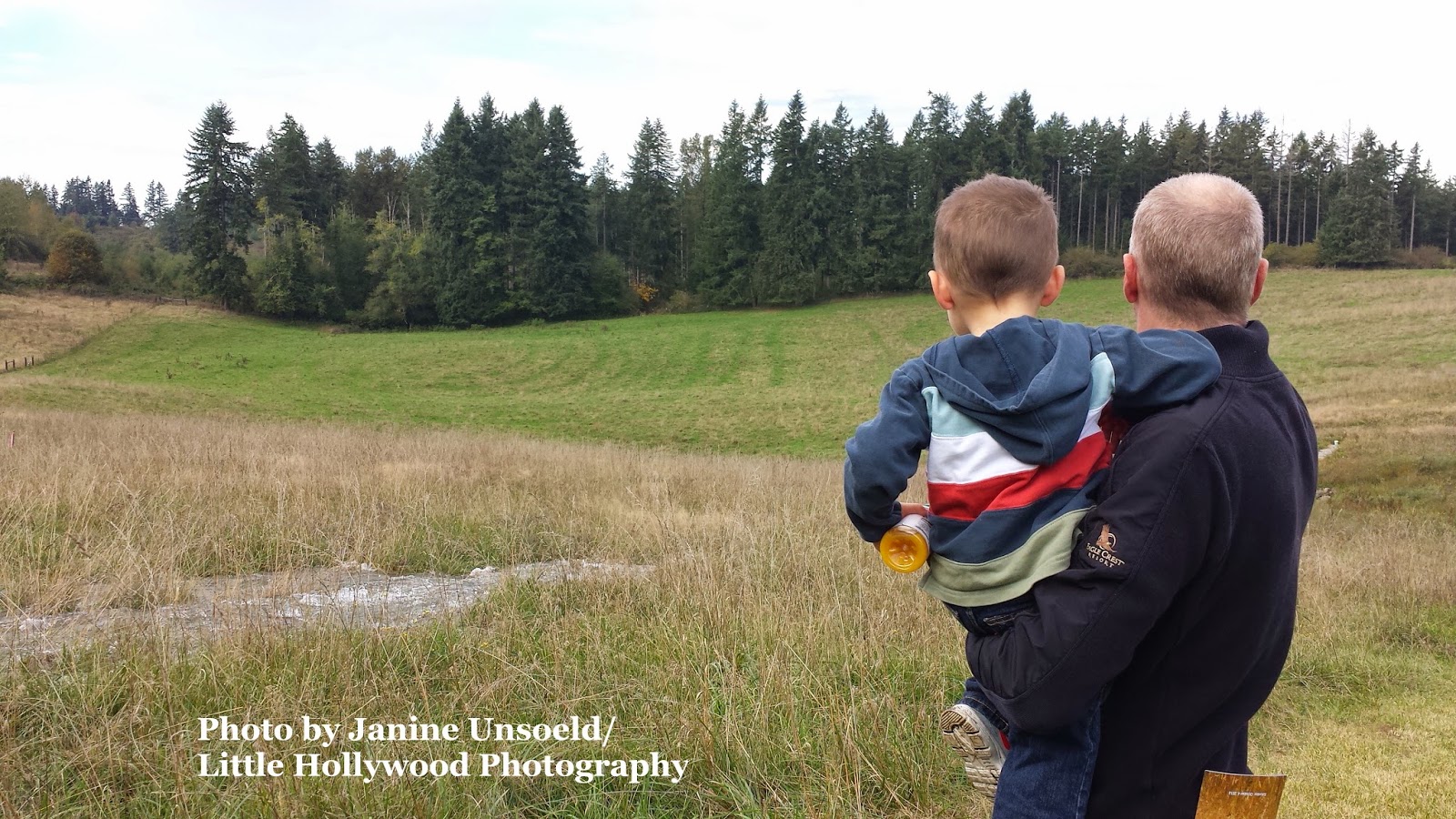
 Above: Reese Gaer,3, and his father Ken Gaer, look over the McAllister Wellfield area after today’s ceremony. Reese's mother, Shari Gaer, is employed with the wellfield 's design consultant, Gray & Osborne, Inc.
Editor’s Note: Several Native words were used in the remarks by tribal elder Bob Sison and Nisqually Chair Cynthia Iyall. Little Hollywood apologizes for not knowing how to write those words. Asked later what “….Masi…masi….” meant, Sison said, “It means thank you. It’s a very thankful word….”
A Brief History
McAllister Springs has supplied most of Olympia’s drinking water since 1949. Studies indicated that the springs are susceptible to land use impacts, which could diminish water quality during periods of heavy demand and drought. To address these concerns, the City of Olympia decided to replace its supply source with high-capacity wells.

In the 1990s, the city identified and purchased 20 acres for a wellfield. Studies of the site showed that the wellfield site taps a large sustainable aquifer with high quality water.
In May 2008, the City of Olympia and the Nisqually Indian Tribe entered into a historic agreement - the first such agreement between a tribe and a municipality in the country - to jointly develop the new regional water source at McAllister Wellfield.

In 2012, after working together for many years to gather data, refine computer models and predict potential impacts, the state Department of Ecology presented the Olympia City Council with the final approval for transferring water rights to the new wellfield.
Subsequent construction projects included a nearly one mile of 36-inch diameter pipeline to connect the new wellfield to the city’s existing water transmission main at McAllister Springs.

Above: Participants of today’s celebration and dedication of the McAllister Wellfield include, left, public works director for the City of Olympia, Rich Hoey, local elected officials including Olympia and Lacey city council members, Nisqually Tribal members and staff, and members of the public. Olympia Mayor Stephen Buxbaum, in brown suit with blue shirt, is standing next to Nisqually Tribal Council Chairperson Cynthia Iyall.
 

Thursday, October 2, 2014

Crazy Faith Pastor Ben Charles Fined For Using Downtown Parking Lot; Hearing Today


Above: Crazy Faith Outreach pastor Ben Charles, right, meets with his wife, Denise, and his attorney, David Roland, before his civil infraction hearing this morning at the Lee Creighton Justice Center in Olympia. Charles was cited and fined on June 19 in violation of a city code for using a downtown parking lot without a permit to serve food to street people.
 
By Janine Unsoeld
www.janineslittlehollywood.blogspot.com

The City of Olympia came prepared for battle this morning at a civil infraction hearing against Crazy Faith Outreach pastor Ben Charles.
Charles was cited on June 19 by the City of Olympia and the Olympia Police Department for using a downtown parking lot without a permit. Crazy Faith was using the lot to feed street people, an activity they have done for about four years. The city owned lot in question is on the corner of Washington and State streets, located across from the Intercity Transit station.
Charles was fined $103. The citation was not given to Charles directly, but mailed to a reservation address. Charles is a member of the Lower Elwha Klallam Tribe.
The city was represented by attorney Jeffrey Myers with assistance by deputy city attorney Darren Nienaber. Presenting multiple exhibits over the objections of Charles’ attorney, Myers worked to illustrate that the city has informed Charles and Crazy Faith Outreach that they are in violation of city code OMC 10.16.140, as passed by the Olympia city council in December 2013. The city stated that it has offered alternative locations for Crazy Faith to conduct its mission of feeding street people.
The city ordinance states, in part, that lots may only be used for parking, unless an activity is authorized by a city issued permit, lease or unless the activity is conducted by the city. Crazy Faith uses the parking lot for its service to feed those who come on Thursday and Saturday evenings.
Charles is being represented by former Olympia based Freedom Foundation constitutional rights attorney David Roland, who is now with the Freedom of Missouri.  Roland requested that the case be dismissed, challenged the amount fined, and found inconsistencies in Officer Paul Lower’s report.

Given 20 minutes notice, Municipal Judge Christopher Coker presided over the case, replacing Judge Scott Ahlf, after Ahlf revealed a possible conflict of interest.
The non-traffic civil infraction hearing often felt like a criminal trial, and lasted one and a half hours.
While Myers produced maps, email exchanges, and letters, Roland raised multiple objections that the city was trying to call into question matters that were beyond the scope of the citation. At one point, after Myers asked Charles if he had a permit through the state department of health, and whether or not he believed in the Bible, even Judge Coker asked where Meyers was going in his line of questioning. 
Roland also pointed out inconsistencies in Olympia Police Department Lieutenant Paul Lower’s report. Lower, who has been with the department for about 18 years, is assigned to walking patrols and specialty operations with a focus on downtown.
Although Lower checked the box on the citation indicating that he had checked Charles’ identification, Lt. Lower testified on the stand that in fact he did not check Charles’ identification on that evening, but had on a prior occasion.

In his report, Lower wrote that, “he (Charles) arrived with a large white van…from this van he and other members of his group unloaded large tents and multiple tables and merchandise….” Roland questioned the use of the word “merchandise,”  and Lower admitted that he didn’t know what word to use, but the “merchandise” was in fact food, and there was no buying or selling observed.

Lower also said that he had spoken with City Manager Steve Hall and city attorneys prior to issuing the citation, and that Hall and city attorneys knew that he was going to issue a citation that evening.

Crazy Faith Continues Its Mission
 

Crazy Faith has continued to serve food and beverages to street people since the citation was issued.
“It gets busy toward the end of each month,” said Charles outside the courtroom before the hearing.
“A lot of folks are now telling me that their hours, if they work, are being cut to 25 hours a week. We’re feeding 4,400 servings of food per month. There’s still a great need. Not only is the physical food a benefit, but I believe we are providing emotional and spiritual support as well.”
Crazy Faith supporters Amy and Shea Renecker joined Charles and his wife Denise before the hearing. They said they have been helping serve food with Crazy Faith for almost a year. They said that Papa John's Pizza on the Westside has been especially generous in providing food.
“It’s a service that’s desperately needed in our community – we bring our daughter down and she serves the drinks,” said Shea Renecker.
“The Crazy Faith feed is a safe place, a neutral area. We’re feeding people. It’s a peaceful gathering where people get fellowship. If you need to pray for something, come….” The Reneckers dispute reports that the feeds have posed any problem to downtown businesses.
We have contact with the Olympia Police Department all the time. They walk on through just to see if everything is o.k. There’s never been an arrest at one of our feeds. We’re being part of the solution to downtown crime. The Harlequin Theater manager even says there’s less crime on the nights we’re here….” said Renecker.
After the hearing, attorney David Roland said that he suspects the city is using Charles as a test case, and that the city hasn’t taken further action against Charles because it wants to see what their next step should be.

“I find it appalling that (the city) wants to reserve this space for a 'better class' citizen. Not everyone can afford cars. The city can’t condition a constitutional right to gather as long as they are peaceful and that’s the definition of what Crazy Faith has been doing – they are doing this for a laudable purpose.”

Judge Coker said he would issue a decision in the case in about a week.
For more information about Ben Charles and the mission of Crazy Faith Outreach, go to www.janineslittlehollywood.blogspot.com and use the search button for past stories.

Monday, September 29, 2014

Local Chiropractor Makes An Appeal Regarding Proposed Development


Above: Local chiropractor John Tanasse stands near the vacant lot he purchased on State Street near downtown Olympia. The nearby historic Bigelow Neighborhood Association is upset with his building’s proposed design on the long vacant lot at 924 State Avenue, saying it is not in keeping with the historic nature of the area. The Association has retained an attorney in the case.

 
By Janine Unsoeld

Summer has come and gone, the prime season for construction projects in the South Sound. But one project that didn’t happen as planned was the groundbreaking of a business on State Avenue near downtown Olympia.
 
In a classic case of competing visions for what constitutes smart land use and acceptable urban design strategy, local chiropractor John Tanasse finds himself at odds with those he had hoped would welcome him to the neighborhood.
 
In an unusually frank, open letter to the community, Tanasse strives to explain the difficulty a recent land use process has had on his family and his business. After sending the letter to the Bigelow Neighborhood Association, Tanasee was informed by the neighborhood’s attorney, Allen Miller, that direct communication with the neighborhood was “unethical.”
 
Tanasse expressed his ongoing frustration to Little Hollywood, saying, “There’s no way to communicate or continue the conversation with neighbors except through the legal process.”

The city of Olympia will hold an administrative appeal of his case on October 8 at 6:30 p.m., City Hall, 601 4th Avenue East, Room 207. The hearing is open to the public, however, only those who are already parties in the case may speak.
On State Street near Quince and Pear streets, the proposed three story mixed use building would have a 2,931 square foot footprint, which includes the garage, and a 6,970 square foot total with shared parking in the alley and on the north side. The business would be located on the first and half of the second floor, with two residences on the second and third floors.

Tanasse says his proposed building is of a larger scale than the adjacent buildings, but it is modulated into smaller parts that are in proportion to its older, smaller neighbors.


Bigelow neighborhood residents have been upset with the building’s proposed design on the long vacant lot at 924 State Avenue, saying it is not in keeping with standards or the historic nature of the area. Neighbors say that most surrounding buildings were built before 1925, and are gabled, have porches, and have clapboard or shake siding.
State Street, however, is not part of the historic Bigelow neighborhood boundary. It is considered to be a high density corridor by both the City of Olympia and the Thurston Regional Planning Council.

Businesses within view of the Tanasse property include Thurston First Bank, Frost and Company, East Olympia Healing Arts, and the Washington State Lottery. Two businesses, Muffler and Brake Service and the R.L. Ray Violin Shop are located directly across the street from Tanasse’s proposed mixed use home and business. Some of these businesses are in former homes converted to businesses.
The historic Bigelow neighborhood has an eclectic mix of businesses and residences, with a variety in the ages, sizes, and character of the buildings. The building next to the proposed business is about 100 years old, according to the project proposal submitted to the city by Tanasse. While residential in character, it has been transformed into a triplex. A building to the east is a former residence about 70 years old that is also now a business, Morgan James, PLLC Personal Injury Lawyers.

Both buildings are well maintained, but neither has landmark status or is of known significant importance. Some buildings on Olympia Avenue to the north are on historic registers or significant to the history of the Bigelow neighborhood. The closest historically recognized buildings are at Olympia and Pear and at Olympia and Quince Streets.

Olympia's Comprehensive Plan

Olympia's Comprehensive Plan expresses the community's vision and goals and sets policy direction for the next 20 years. An update to the current plan is in its final steps.

Tanasse believes he is talking the talk and, quite literally, Tanasse wants to walk the walk when it comes to the implementation of the current draft of the land use and urban design chapter of the city's plan.

The Plan states what Olympia values: “Olympians value neighborhoods with distinct identities; historic buildings and places; a walkable and comfortable downtown; increased urban green space; locally produced food; and public spaces for citizens in neighborhoods, downtown, and along our shorelines.”
It also states our vision for the future: “a walkable, vibrant city.”

In our conversation about accommodating the future growth of the community, protecting our environment, and increasing urban density to minimize suburban sprawl, Tanasse says these kinds of challenges are not unique to downtown Olympia.


“Our close neighbors in Portland’s Pearl District, Seattle’s Belltown, and Tacoma’s downtown have all met these challenges in similar ways and have effectively revitalized their urban areas....People moved in, not out. They work, reside, play, eat, entertain, bank, and shop within the city. Vancouver B.C. sets the standard in this regard. This is what makes for thriving cities and towns.”

“I care about the city….Putting my vision of the community’s Comprehensive Plan is the direction we need to be moving. I want a robust, thriving downtown. Any thriving municipality has to have high density, especially along busy corridors. I wanted to have a small lot and maximize the footprint intentionally. As a minimalist project, it’s a mixed use building. I want to be part of the solution….”

Tanasse, who grew up in Seattle and is one of nine children, has lived in the South Sound area for 46 years. Tanasse and his wife have three children aged 11, 13, and 18, all of whom anticipate living in the mixed use building along with his elderly parents.
“….The building will be eco-friendly, reduce our energy usage to a fraction of the current three separate locations that we now occupy. We will cut our family living area in half, and total roof area by three….I want to downsize now. And why wouldn’t I want an elevator in my house? I have disabled friends and my father has Parkinson’s and is in a wheelchair….I want to stay here until I crumble, but no one wants to live where their ideas or projects aren’t welcome. It’s hard to stick around, pull up your sleeves and do something….”

Neighbors Saw Red

Tanasse admits he jumped into the project underestimating the extent of the neighborhood backlash. He also expressed frustration with the City of Olympia’s development process.
“My first several trips to the city were about what I planned on doing. I had an idea of what I wanted to do and I was very clear about my square foot needs…I said, ‘Is this possible in this lot?’ I’m not a developer, but I carefully reviewed the codes myself and I was continually reassured that what I intended was possible….now, they want me to put gables on it. That means space that has intended use goes away.”

Under “New Construction-Infill Buildings” for historic buildings, guidelines state that new buildings should be compatible with adjacent buildings in terms of height, materials, set back, width, scale and proportions, and roof form.


While Tanasse’s original vision for the modern building would have it painted bright red, Tanasse has responded to the recommendations of the city’s Design Review board which governs standards.

Now, portions of the building on the east and west sides that bump out will have cedar siding, the same material as on the recessed front of the building. Each of these elevations will have a large portion that is cedar. The primary color of the flat panels will be "cool marine green" and the cedar siding will have a light "cape cod" finish.

“The project touches the intersection of commercial and residential. I get everyone’s frustration – I admire that they are passionate about their neighborhood and want to shape it as they see fit – that’s to be commended….It’s about a big difference in vision….” says Tanasse.

Above: Tanasse Chiropractic is currently at 1303 4th Avenue East, directly across the street from the offices of The Olympian newspaper, in a former home built in 1889. Upon purchase of the building 14 years ago, John Tanasse says his family invested in its restoration efforts including rot removal, jacking the south end up six inches, restoration and repair of the original fir floors which were covered by liquid nails and industrial carpet, and tilted up the original concrete retaining wall along 4th Avenue. The building is also sporting a fresh new paint job and garage roof rebuild.

An Appeal to Drop the Appeal
Tanasse’s open letter, titled An Appeal to Drop the Appeal, is below:

Dear Bigelow Neighborhood,
We are writing to reiterate the awkward position in which we find ourselves. From the outset of this project, we have been open with the City of Olympia Community Planning and Development, the governing body for construction and development within the City of Olympia, about our intentions, project scope, and design for this location to accomplish what we set out to create, to remain consistent with the city’s mission, and to avoid issues that would cause potential obstacles during the process. Because we are a family and a small business, and not developers, we counted on the city's process, perhaps naively, to help guide the way. Not once during the process were we told we would need to go through a Bigelow building application process, nor a Bigelow Neighborhood design review. We also were not informed that gables would be required for project approval. If that had been the case and we were able to understand the level of neighborhood disapproval we could have and would have chosen NOT to purchase the property nor initiate the process.  We would simply have chosen to move on.

Unfortunately, this was not the case, and we find ourselves heaps of resources into this, not wanting to be here, feeling trapped by the city, and held hostage by the neighborhood with no way out but to walk away with missed opportunity for all parties involved. We scratch our heads trying to understand how we got here, and why it is possible that a neighborhood could, and would hijack such a lengthy, painful, and costly process for a family, in the name of sameness on an avenue of divergent architectural character. We find difficulty identifying the relevance of this position at this critical juncture of civic need.
We never expected much of a welcome from an avenue scarce of permanent residents. We also didn't expect to be blasted by the residents to the north. We were disheartened by private and public attacks in neighborhood meetings, editorials, and letters to the city. We were again saddened by the neighborhood's decision to appeal our project despite our efforts to make meaningful design changes. This sadness was further deepened by an invitation to attend a neighborhood block party, with two fresh pies in hand, only to meet a frosty welcome by some and a table of Tanasse Legal Fund envelopes and paraphernalia. Clearly, welcome is not in the cards as we oddly find ourselves begging to move our family to State Avenue.

Mr. Elder stated at the first public meeting, “The Tanasses will do what’s best for the Tanasses.”  I can only respond to him and the entire neighborhood that moving to State Ave. isn't entirely self-serving. Ask our children who had no interest in leaving Holliday Hills. Ask our friends who think we’re nuts! It has taken thoughtful consideration and a fair amount of courage to consider moving our family to State Avenue given the current condition of downtown.  I ask Mr. Elder the same. “Given your action of appealing our project, are you acting in the best interest of this town? “ You also mentioned at the first meeting that the Bigelow Neighborhood was a little like Disneyland. You feel transported to a different place. As we recall, Disney’s motto is that it is the friendliest place on Earth. With the exception of few kind and supportive souls (thank you), this has eluded us in your neighborhood, as you confirmed this in conversation as identifying yourself and members of your neighborhood as being “prickly.” Do you feel this is an identity that must be upheld at the cost of good, healthy city development? Who does this serve?
By deciding to build on State, we felt we could accomplish goals individually and collectively. We wanted to create a more appropriate space for our family business not far away. We wanted to participate in a new direction of development for family, multi-generational, and multi-use living that seemed intelligent, efficient, cost effective, and important for municipal vitality, preservation of open spaces, and prevention of sprawl. We wished to use our creative, financial, and human resources to participate in improving Olympia by being a part of downtown in all of the ways that this implies. We have felt an ongoing responsibility to contribute to solutions of problems our community faces. Ironically, we find ourselves the problem of this community. We are sleepless and tired which we assume is a strategic goal shared by the legal team in the absence of substantive legal grounds for this action.

This has brought forth a whole host of additional questions we have for Bigelow Neighborhood residents. We hope you will consider them thoughtfully.
What are you afraid of? Why has this lot been vacant for so long? Why has it been for sale on many occasions for long periods of time?  Why, if you covet the character of your neighborhood would you not secure it to protect your interests? Are we not the first family who has been held hostage? Why do you feel all the houses in the area need to look the same? Given there is so much architectural variety and flat roofs within a stone’s throw, why is it our building you insist have gables? What is so wrong with a town whose vision is to develop along commercial corridors, especially along a road that sees 25,000 cars per day? Do you feel justified in obstructing any development that fails to meet your aesthetic taste and opinion when there are no legal encumbrances that provide provisions for doing so? If so, do you believe this to be good for this city, or, good only for this neighborhood? If our building was two stories with a gable roof, would it not be just as tall with wasted attic space, blocking views from the same sections of sidewalk? Do you feel you are entitled to views of the Capitol building through vacant lots and commercial corridors? Do you not care more about the character of your neighbor than their difference in taste? If you are so adamant about our building looking the same, are you as adamant that we are the same, politically, religiously, and ideologically?  Do you believe that someone more foolish than us will want to build a single family residence on 924 State Ave. when permitting, studies, design, engineering, and impact fees cost well over 100K before a single shovel breaks ground? If so, do you believe this person would want to spend the 100K to develop on 924 State Ave. with the constant barrage of graffiti, hypodermic needles, human feces, and vandalism (all of which we have endured at 1303 4th Ave.)? Do you believe they will want you to design it? Why do you have such an ax to grind with the city? Are you really going to use us as a wedge between the city and the 20 year comprehensive plan that intelligently has the health of the entire city in mind and is based on thousands of man hours of study, thoughtful consideration, debate, and success elsewhere? Did you really mean to hire legal counsel to dump enough mud on our project in the hopes of making us go away?  Do you really take pride in being “prickly”? Do you understand that there were no permanent residents of State Ave. present at any of the public meetings regarding this project? Do you recall that we are a family, with children, parents, and grandparents, like you? Do you recall, we are already fellow neighbors from three blocks away, choosing to become permanent residents on State Ave, in a time of dire city need for more residents willing to shop, eat, play, and help out? Did you know there is a heroin epidemic in this town?  Did you know that violent crime is up many fold in this town over the last ten years?  Are you really going to make us beg to move to State Avenue? Do you realize that we already feel a bit vulnerable?

We have admired and appreciated the Bigelow Neighborhood and all of the care that has gone into it by those who live there. We have wrongly assumed by the eclectic appearance of State Ave. that our activity would have minimal impact on Bigelow Neighborhood residents. We apologize the process, as it is, excludes early public input. We did consult Heritage Commission members regarding the historical significance of properties on either side, and did ask for guidance regarding our modern intentions. The response we received from multiple members was that one honored historical design and character.
MORE by building a distinctly modern structure than by constructing a new building that mimics historical design. 

We have heard you during the public meetings and we have attempted to make meaningful changes and concessions including color change, additional modulation, privacy railing and screening along the alley side, and additional cedar siding to soften the contrast. Clearly, we have divergent visions for OUR project, and perhaps for city direction. We would like to remind you, we rolled the dice after careful feasibility review and purchased the parcel, which sat for years. Therefore, we will ultimately decide its size, appearance, and spirit, within the code requirements and zoning allowed. We have sincerely considered your input in ways that would maintain minimum project demands.
As such, we are asking you to immediately stop harassing our family. We ask you also to stop bullying our project. And, we kindly request that you withdraw the appeal so that we can all move on and participate in more meaningful ways.

Sincerely,
John and Tiffany Tanasse