Thursday, August 4, 2016

Thurston County Fair 2016


Above: Elizabeth Ware, 16, of Rochester, relaxes with her pigs, Cinnamon, who weighs 248 pounds, and Spice, (not shown), who weighs 275 pounds, at the Thurston County Fair on opening day Wednesday. They are about seven months old. Youth exhibiting their animals at the fair are eager to share their knowledge - ask them questions! The fair runs August 3 - 7.

By Janine Gates

The Thurston County Fair, which runs from August 3 – 7, is a microcosm of just some of the tremendous talents, interests, politics, businesses, food, and music the county has to offer. 

The first Thurston County Fair was held in 1871 at Columbia Hall, now the Fourth Ave Tav, in downtown Olympia, and was called the Mutual Aid Fair, aimed to help farmers and agriculture, and to aid the development of our area by encouraging immigration.

It moved around, and later, was held in Tumwater on Cleveland Avenue, (where the Safeway is today), Chehalis, Lacey, (where the post office is today), Tenino, (where the elementary school is today), and the South Bay Grange. Finally, it settled in 1958 at 3054 Carpenter Road SE in Lacey, near Long Lake, where it is located today.

Elizabeth Ware, 16, of Rochester, will show the beauty and health of her pigs, Cinnamon and Spice, before judges on Friday, aa three year member of the National FFA Organization, a youth leadership organization better known by its former name, Future Farmers of America. 

She'll wear clean, neat clothes, and demonstrate her ability to follow the orders of the judge and control her animals, gently guiding them with a stick. 

There's a lot of responsibility and work involved in raising farm animals. Besides feeding and mucking out the pen every day, you must always think of your animals before yourself and provide accurate recordkeeping for an animal that is going to auction. 

For Ware, this includes tracking the animal's initial cost, its purchase weight, current weight, pounds gained per day, pounds of grain fed, cost of the grain and hay, including bedding, and miscellaneous costs such as veterinary bills. 

Total all that up, and hopefully, you'll make a profit when you sell the animal. Then, you'll reinvest your money and start all over again. 

“I love it…I have a bond with my animals,” said Ware. That bond also extends to the butchering of her animals for consumption, as she did last week. 

A few pig facts: Pigs are excellent swimmers, very intelligent and social, have a good sense of direction, have over 20 vocalizations, and run up to 11 miles per hour. Pigs have been used to sniff out landmines.

Contrary to myth, pigs eat slowly, are very clean, and do not like to sit in mud. They do not have sweat glands and roll in mud to cool off. 

Above: You know you want them - warm, slightly crunchy, deep fried, caramel drenched apple rings.

On the food front, warm, slightly crunchy, deep fried, caramel drenched apple rings were served up Wednesday at the Thurston County Republican food booth by 19 year old political newcomer Donald Austin, who is running with the Republican Party for State Representative Position #1.

Austin, a student at South Puget Sound Community College who is taking prerequisite classes toward a computer science degree, said it was hard to sleep after beating out three other Democratic candidates in the primary election last night. 

He will now face Democrat Laurie Dolan for the position. He said his goals are to promote the economy, create a fair and balanced education plan, and keep the Legislature from passing a state income tax. 

Asked if he supports Republican presidential nominee Donald Trump, Austin said he has a lot of problems with Trump. 

“I won’t support a lot of things about Trump – he has a history of supporting the Democratic Party, he’s friends with Hillary Clinton, and runs a strip club. That concerns me. Every Republican should be concerned,” said Austin.

Food and politics aside, there are plenty of ongoing, live demonstrations and activities related to the showing of animals, commercial vendors, carnival rides, and educational exhibits by local organizations like the Olympia Beekeepers Association.

It takes a lot of work to pull off the Thurston County Fair. Some exhibits and activities stay the same, and other features are definitely new. And if you don’t like what you see, or have fresh ideas, there are four vacant positions on the Thurston County Fair board, so get involved and help make a difference!

Above: Thurston County’s Tactical Response Vehicle (TRV) is on display just as you enter the fair. Weighing 50,000 pounds, the vehicle gets three to five miles per gallon, ...and that’s on a good day, going downhill, joked a volunteer with the Thurston County Sheriff’s Department. Thurston County procured the vehicle a couple of years ago through the nation’s military surplus program. It was used in Afghanistan and has been used in Thurston County during several incidents. 

Above: For good natured fun during the fair’s welcoming ceremony, local elected officials blew a lot of hot air to competitively move little duckies down two water gutters. After several rounds, Thurston County Commissioner Bud Blake ultimately won. Blake demonstrated a very distinctive, winning strategy of blowing in short, powerful bursts that allowed him to beat Lacey Mayor Andy Ryder and finally, as seen above, Olympia Mayor Cheryl Selby.

For a full schedule of events, hours, cost of admission, parking, and free shuttle parking details, go to www.thurstoncountyfair.org. Music by the popular Oly Mountain Boys is on Friday night!

Monday, August 1, 2016

Olympia’s Green Cove Basin Watershed Threatened by Possible Rezone


BranBar, LLC is seeking a rezone near Cooper Crest Neighborhood

Above: Sal Munoz, president of the Cooper Crest Neighborhood Association, walks on the sidewalk of Cooper Crest Drive NW, a narrow street that leads to property owned by BranBar, LLC. He was one of several individuals who testified at a hearing last week  against a proposal to rezone BranBar property for a housing development. The BranBar development would be using Cooper Crest roads, as there is no other way in or out of the neighborhood.

By Janine Gates

The slow death by a thousand subdivisions of the environmentally critical Green Cove Basin watershed continues in west Olympia with the possibility of a land use rezone, and with it, the possibility of yet another housing development.

A request to change the zoning of about five acres at the west end of Crestwood Place NW from residential one unit per five acres to another category called residential low impact (RLI), would allow up to 20 single family dwellings on the property.

There is no actual land use application for the property pending before the city, so it is difficult to ascertain the full impact of the proposed rezone, but neighbors of the adjacent Cooper Crest neighborhood are upset.

The undeveloped, heavily wooded property, owned by BranBar, LLC, of Covington, is represented by Brandon Anderson, and was annexed in 2006 from Thurston County into the City of Olympia, along with the Sundberg property off Cooper Point Road.

These annexed areas contain the only areas of the city zoned residential one unit per five acres, which was a remnant land use designation prior to annexation.

The RLI designation is intended, the city says, to protect sensitive drainage basins.

The RLI definition states that it accommodates some residential development within sensitive drainage basins at densities averaging from two to four units per acre, provided that the development configuration avoids stormwater and aquatic habitat impacts.

The actual density for this parcel would range from 10 to 20 units. Lacking an actual application, the city settled on assuming the maximum would be desired.

The site lies in the Eld Inlet watershed within the 2,626 acre Green Cove Drainage Basin, considered to be critical aquifer habitat. The Green Cove Creek basin has its own comprehensive plan, adopted by Thurston County in 1998.

For more information about this watershed, see Little Hollywood’s story, “Housing Development Threatens West Olympia’s Green Cove Basin,” May 9, 2016, which focuses on Parkside, a preliminary plat application currently before the city that proposes to subdivide 30 acres near Cooper Point and 20th Avenue into 65 to 75 single family lots.

Above: Cooper Crest Drive NW, currently a dead end labeled as a future neighborhood collector, leads to the BranBar, LLC property. The street is surrounded by wetlands, which are labeled as protected by the City of Olympia.

BranBar

The City of Olympia is supporting the BranBar rezone and issued a state environmental policy act determination of non-significance on June 22 for the proposed project. The comment deadline was July 6 and the appeal deadline was July 13.

The determination was not appealed, but several residents of the Cooper Crest Neighborhood Association showed up in force at a public hearing in front of Hearing Examiner Mark Scheibmeir on July 25 at Olympia city hall to express their opposition to the rezone. The hearing lasted three and a half hours.

Scheibmeir, who said he made a site visit to the neighborhood and the property earlier that afternoon, said he would issue a decision in a timely manner and has up to 14 calendar days from the date of the hearing to do so.

Several speakers mentioned the Green Cove Basin Comprehensive Plan in their testimony, but it was only after Lisa Reiner, president of the nearby Burbank/Elliott neighborhood association, asked him directly if he had read the plan, that he responded that he had not, and in fact, no one had provided him a copy. He requested that city staff provide him with a copy of the document.

Residents brought up issues primarily related to traffic.

“….Although I’ve known and appreciated the environmental sensitivity of this area for years, it was not until I began reading, viewing maps, and comprehending the cumulative developments in the basin over the last 20 years that I became alarmed. My original testimony plan focused almost exclusively on traffic with only a brief mention of environmental issues,” said Russell “Rusty” Horton, an original resident of the Cooper Crest neighborhood, in an interview with Little Hollywood after the hearing.

Horton says the Green Cove Creek and Basin are special areas worthy of protection.

“In Cooper Crest, only a few hundred feet from the BranBar parcel, I have personally seen nesting Bald Eagles fledging their young in multiple years, coyotes, owls, hawks, long and short-tailed weasels, deer, cougar, pileated wood peckers, rough-skin newts, and salamanders. The water from BranBar drains directly to Green Cove Creek where the sensitive mudminnow and salmon and trout species spawn. I realize these are not all threatened species, but they are all indicative of the balanced ecosystem we want to see,” said Horton.

Little Hollywood asked Cooper Crest Neighborhood Association president Sal Munoz why the neighborhood did not appeal the state environmental policy act (SEPA) determination.

He said the $1000 appeal fee for the SEPA determination was difficult to pull together in a short period of time.

“We don’t spend that kind of money casually and we don’t know what the hell we’re doing – we just don’t know land use. We assume it would have required the hiring of a land use attorney, and that would have required a significant expenditure of money,” said Munoz.

Horton echoed that thought, and said he is looking ahead to the next step in the process.

“While extremely frustrated that the SEPA document defers all study until the rezone is approved and a development proposal is submitted, I thought that any appeal effort might be better focused on an actual development proposal SEPA - to try and force an environmental impact statement.

“Personally, I find it incomprehensible that we cannot use our imaginations and study theoretical densities that would be allowed by a rezone prior to the development proposal being submitted. We should have a right to not give away a greater density designation without first understanding its potential effects,” said Horton.

Above: Cooper Crest Neighborhood Homeowners Association president Sal Munoz discusses the history of the neighborhood near the BranBar LLC property. Here, Munoz describes how the streets were damaged by past BranBar, LLC activity to access their property. The road shows visible gouges. 

Cooper Crest History

“In my opinion, it is not wise or safe to add additional burdens to our streets…it’s not just volume, it’s about the character of daily life…this is a spot rezone to aid one owner at the expense of others,” testified Sal Munoz, an original, 11 year resident of the Cooper Crest Neighborhood Homeowners Association, at the public hearing on July 25.

Developed by Tri Vo of Triway Enterprises, the Cooper Crest neighborhood has had a long and torturous history. 

Touted as Olympia’s first so-called low impact residential development, the neighborhood features 138 homes built close together and narrow streets with multiple bulb-out curbs that constrict traffic. 

Residents are tight-knit and appreciate the family friendliness of the neighborhood, but also struggle with the challenges and realities of the development.

Residents immediately complained of shoddy workmanship and the area’s high water table, resulting in poor soil drainage, causing extreme flooding issues. Most of those issues have been corrected, but stormwater issues are constant, as most of the development features varying elevations.

Most important to the neighborhood right now is the fact that the BranBar development would be using Cooper Crest roads, as there is no other way in or out.

A city traffic impact study by the city states that the BranBar development would put the neighborhood at its fullest capacity.

Neighbors say the count conducted on March 8 by the city was low by 40 – 60 vehicle trips, and did not take several factors into consideration, such as several vacant homes, an extended vacation by a resident, and cars accessing the mailboxes on Cooper Point Place.

In general, the narrow streets are usually clogged with resident and guest vehicles, which, when parked in driveways, spill over onto sidewalks. Parking enforcement issues are constant.

Traffic is bad enough when residents need routine homeowner maintenance or other professional services, but they cannot imagine construction crews for BranBar moving through their streets.

Currently, with cars parked on one side of the road, each main access road is essentially a one way street.

Children routinely play in the street at Cooper Crest. Neighbors, who govern themselves through a private homeowner’s association, know to crawl through the neighborhood at 5 to 10 miles per hour. Many are worried that residents and guests of the proposed BranBar neighborhood will not be so careful.

Prabakar Manoharan, a 10 year resident of Cooper Crest, testified at the hearing and remarked that he has never seen such narrow streets anywhere in Washington State.
He said residents and their guests routinely use a fire lane, originally meant to be gated and used only in case of emergency by the fire department.

“Especially while entering the community, it is inviting to use the fire lane as a short-cut for more than 60 percent of the homes in the community,” said Manoharan. He said that he is sure that if the BranBar property is rezoned, residents who live there would do the same.

“The fire lane was funded and created specifically for Cooper Crest home owners and we maintain it. Has the city given a thought on how to control excess traffic in the fire lane or does the city have any future plans for the fire lane?” he asked.

He and others urged the city to create a separate access point from 20th Avenue to BranBar, identified as Road 65 NW, near Julia Butler Hansen Elementary School. The road would connect Cooper Crest Drive and Crestwood Place to the corner of 20th and Road 65 NW.

“The only benefit in the whole rezoning process is to the developer in saving some money from constructing an access road. Approving such a project increases the burden for existing and new homeowners, increasing the accident risks in the neighborhood. Please don’t be a part of it,” urged Manoharan.

Rusty Horton, who lives on Cooper Crest Place, a relatively minor street, says his street has become a de facto neighborhood collector for the lower half of the neighborhood.

“It was designed for a maximum of 500 vehicle trips per day…even now I have to deal with the speeding, safety, and access concerns of a street that is functioning like an avenue. I especially worry about the safety of my very active five year old and his young friends…Even without the new 20 homes from BranBar, Cooper Crest Place is nearly at its design value and will become a failing road if as few as eight new homes are built in BranBar,” he said.

Sunday, July 17, 2016

Lakefair Parade Float Denied Entry by Organizers


Above:  A float created by members of the Olympia Confronting the Climate Crisis group was not allowed to enter the Lakefair Parade. Instead, the group parked it on Percival Landing and educated the public about fossil fuels, recent oil train derailments, and provided a more sustainable, alternative vision of the future.

By Janine Gates

The carnival rides and games, food, parade, and fireworks are all highlights of Capital Lakefair, a five day festival which began 59 years ago in downtown Olympia. 

It's gone through a lot of changes over the years, but maybe there’s room for just a little more change.

About 100 entries from around the Northwest for the parade on Saturday night were submitted, including flashy, motorized floats from Northwest area community festivals, school marching bands, drill teams, and a few groups advertising their for-profit businesses, but a modest, homemade, two piece float was not allowed to participate.

Designed by members of the Olympia Confronting the Climate Crisis group, an oil train derailment is depicted under the section titled, “CO2 = Climate Chaos, which features a lot of of black paint, train wheels that really move and flames made out of cardboard. 

The other section depicts a happy scene with children and families playing near clean water, raised garden beds, and a solar powered house under a rainbow.

After organizers could not get an explanation for the denial from Lakefair executive director Dennis Williams, group members reached out to local media to make their case.

King 5 News contacted Williams, who told that news organization that the floats were political in nature. Williams did not respond to an emailed request for information from Little Hollywood.

“The floats were made specifically for the Lakefair Parade - all stated limitations regarding the parade were related to politician limitations as stated on the Lakefair website,” Rod Tharp told Little Hollywood

In response to the denial to participate, members of the group quickly organized to place the float on Percival Landing near The Kiss statue, and staff it during Lakefair hours of operation. They explained the scene and climate change issues to passersby.

Tharp, a member of the climate crisis group, and a former small residential contractor and carpenter, designed the floats and worked with several others to create the two piece, educational, multi-media float. He has lived in Thurston County since 1975.

“If we don't solve the climate change issue, all the other issues - social justice, equality of all people, and peace, will become more serious. All these are related so we are working on all of them, but climate change is our top item,” he said of the group.

The theme for this year's Capital Lakefair is Community Hearts Fly! 

“We are an accepting community – that doesn’t make sense. We’re so progressive here. We line Fourth Avenue and Capitol Way with rainbow flags showing our pride and we can’t have a rainbow float in our Lakefair parade to show community spirit?” said one woman who saw the float and was told it wasn’t allowed in the parade.

Above: A passerby ponders the portion of the float depicting an oil train derailment.

“Hey, at least you get to be out here showing people this longer than being in the parade,” said a young man.

Above: Todd Davison is a new member of the Olympia Confronting the Climate Crisis group. He helped create the float scenes, and educated passersby about climate change issues on Friday.

“I’ve been concerned about pollution and the destruction of the environment for about 30 to 40 years and my parents built a solar powered house in the '80s in Maine. I used to work for Homes First! but now I’m retired and have the time and resources to help out,” said Todd Davison, as he staffed the float on Friday.

The group is part of the Olympia Fellowship of Reconciliation and has been active in Olympia for almost six years. It meets every third Wednesday, 6:30 p.m. at the Olympia Center, and is known for its colorful signs and props at peaceful protests and events.

Bourtai Hargrove, a member of the group who staffed the floats on Friday and Saturday, said the floats took about three weeks to make. She and other members of the group have also testified for divestment of state retirement funds in fossil fuels at meetings of the Washington State Investment Board.

“This float is about protecting future families,” said Sue Langhans, who was also helping to staff the float on Friday and Saturday.

Capital Lakefair is a non-profit, volunteer organization. It takes a tremendous amount of effort to pull it off, and many local organizations rely on the proceeds from their Lakefair food booths to fund their year-round community activities. To find out more information, go to www.lakefair.org.

Above: Using an oil train tanker look-alike semi, CrimeStoppers volunteers inexplicably threw toilet paper rolls featuring an advertisement for a local plumbing company to parade watchers, which was a real hit with the kids. 

Speaking of fossil fuels, Olympia Mayor Cheryl Selby rode in the parade in a 1950 Buick. Tumwater Mayor Pete Kmet rode in a 1957 T-Bird Convertible. There were also several cars with the Corvettes of Olympia club, several entries for the Horseless Carriage Club and the ever-popular fire trucks. Near the end of the parade, Olympia city councilmembers Clark Gilman and Julie Hankins were seen on foot, along with city manager Steve Hall and a solid waste recycling team, ready to collect recyclables from parade watchers. 

For more information about the Olympia Confronting the Climate Crisis group, the Washington State Investment Board, sea level rise, and other climate change issues of particular concern to downtown Olympia and the community, go to Little Hollywood, www.janineslittlehollywood.blogspot.com, and type key words into the search button.

Tuesday, July 12, 2016

Police Use of Deadly Force Study Underway


Legislative Committee Examines Use of Deadly Force Law, Issues

Above: Fe Lopez, representing OneAmerica, an immigrant advocacy organization, speaks at the first meeting of the Joint Legislative Task Force on the Use of Deadly Force in Community Policing in Olympia. She is also the executive director of the Community Police Commission in Seattle. The 26 member legislative task force met for three hours on June 28.

By Janine Gates

“I do believe that this issue is not an either-or…you can be a complete advocate and supporter of law enforcement as I am, and you can also be an advocate for community safety. I think the common ground we all share is to have a safe community. Everyone wants to go home to their families at the end of the day and I think if we keep that in mind as we go through this process, it would be very helpful,” said Gloria Ochoa-Bruck, Washington Commission on Hispanic Affairs.

Ochoa-Bruck’s words at the first meeting of a joint legislative task force on the use of deadly force in community policing on June 28 takes on new meaning as feelings of insecurity, tension, grief and outrage increased and challenged Americans this week.

Later in the meeting, Ochoa-Bruck said, “If you take away the badges, what does that look like? There are apparently two very different standards....

In response to the five police officers killed in Dallas and for the recent police shootings of Alton Sterling in Louisiana and Philando Castile in Minnesota, the work of the joint legislative task force should be made all that much more urgent.

Task Force on Use of Deadly Force in Community Policing

A bill signed into law by Governor Jay Inslee in April, ESHB 2908, created the 26 member task force on the use of deadly force in community policing.

Above: Getting a bill through the Legislature and signed is sometimes only half the battle. Now the real work begins. Governor Jay Inslee signs ESHB 2908, surrounded by prime sponsor Representative Cindy Ryu (D-32) and a few bill advocates in April 2016.

The 26 member task force buckled down June 28 for their first meeting, which lasted three hours without a scheduled break, in a hearing room at the state Capitol Campus in Olympia.

About 35 people observed the proceedings, including members of Olympia area community groups such as the Faith Action Network, Interfaith Works, Unity in the Community, and the League of Women Voters. Local law enforcement observers included Thurston County Prosecutor Jon Tunheim and staff members of the City of Olympia police department.

The task force will review the history of Washington State’s law, best practices used by state and national law enforcement agencies, examine the wide range of reporting requirements, and current training curriculum and practices and use of force policies. 

Staff briefly reviewed ESHB 2908 and explained when police use of deadly force is justifiable under state law.

Goodman confirmed that one of the main reasons the task force convened is to examine the use of deadly force by law enforcement and whether or not the law needs to be changed and to look at ways in which law enforcement establishes relations with communities.

“….I’m here because our community depends on law enforcement and we’re all here interested in keeping the peace. We recognize that police officers have a difficult job and we all have a stake in law and order….This effort here today is not about good cop, bad cop, or placing blame, it’s about coming together to build and strengthen trust within our communities and within the law enforcement community….I’m here to listen and learn and come to a solution that works for everybody,” said Timothy Reynon, a member of the Puyallup Tribal Council, representing the Governor’s Office on Indian Affairs.

Conversation around the issues echoed their representative positions and issues discussed nationwide, leading one task force member, Gabriel Portugal, representing the Latino Civic Alliance, to be ready within an hour’s time to start making motions and move forward.

But task force chair Roger Goodman (D-45) was not to be rushed, wanting to hear thorough introductions and lay the issues on the table, making sure all were heard.

Goodman said the task force will be inclusive, respectful, and deliberate, for “as long as it takes.”

The committee has until December 31 to meet at least four times to discuss a wide range of issues related to the statewide use of deadly force in community policing and produce a report of their findings.

Despite the tight timeline in which to conclude their efforts, the group was not split up into subcommittees, nor expectations provided or requests made to committee members.

Future task force meetings will be held July 26, 9:00 a.m. – 12:00 p.m. and September 13 at 1:00 p.m. – 4:00 p.m. at the Washington State Criminal Justice Training Commission in Burien.  Details for another meeting, scheduled for November, are to be announced. 

“I want Washington State to lead the nation in the process to help build trust and reciprocity between communities that feels underserved and the law enforcement that serves them,” said Goodman.

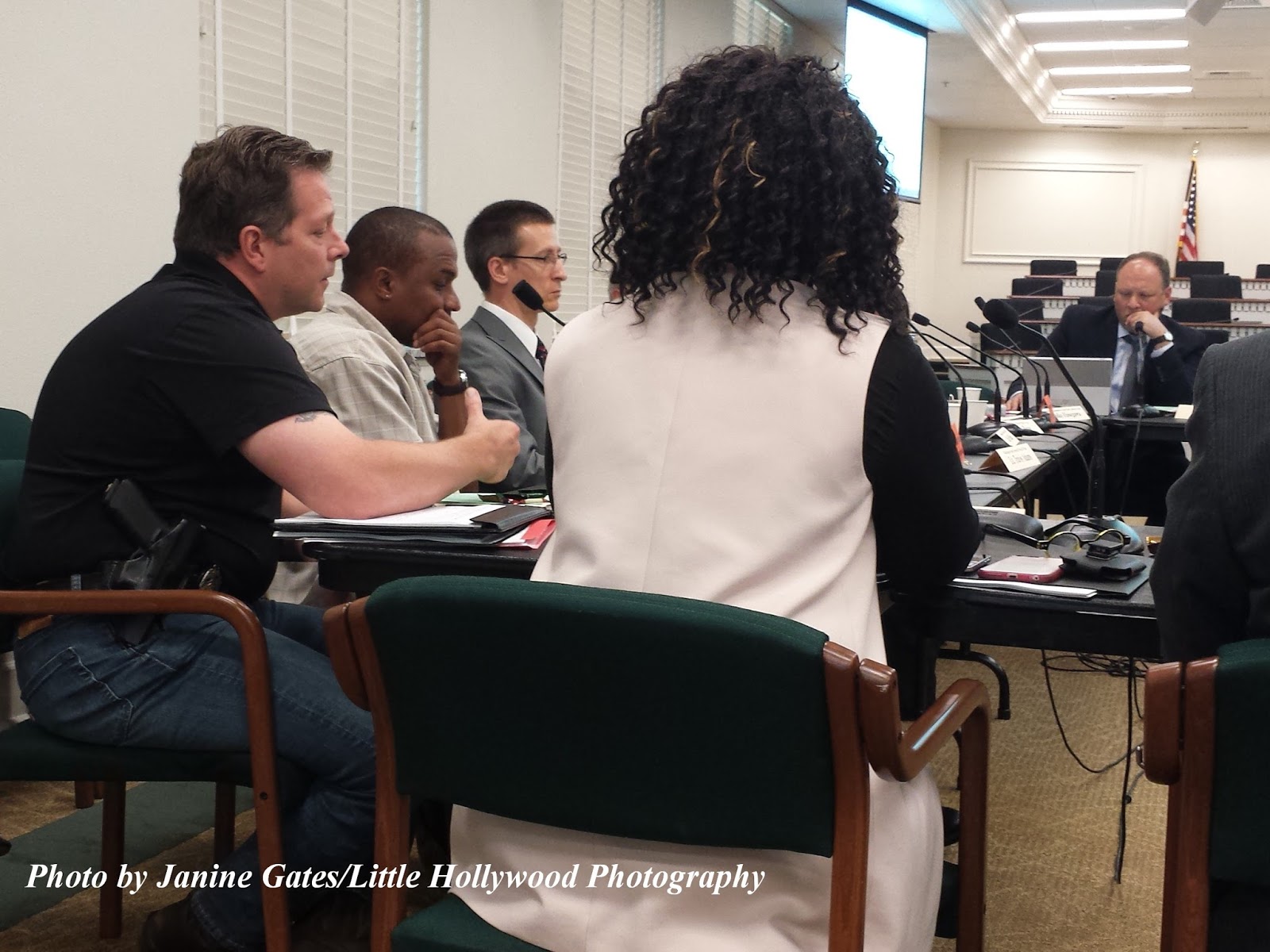
Above: Twenty-six year veteran Seattle police officer Kerry Zieger, representing the Council of Metropolitan Police and Sheriffs, speaks to task force members. Sitting to his left is Gerald Hankerson, representing the National Association for the Advancement of Colored People (NAACP).

Zieger said he was recently involved in an incident on May 1st in Seattle. He and a couple of bicycle officers were surrounded by 50 – 70 individuals wearing masks and throwing objects. He said he was hit by a piece of cement or a rock and injured.

“At the time I was struck, that entire city block was unprotected because now it became a violent situation…all the officers could do was protect themselves and wait for others to come in and rescue the officers. A rock can be a deadly weapon. Another inch lower and I would have lost my eye….”

Zieger said he was out of work for six weeks and still suffers pain and headaches as a result. Use of deadly force against the protesters would have been justified in that incident, he said.

Only Washington State law provides a defense against prosecution when a police officer acts “without malice and with a good faith belief that such act is justifiable.” 
Malice is defined in law as “evil intent.”

Another police related bill heard during the 2016 Legislative Session, HB 2907, would have removed language from RCW 9A.16.040, which states that an officer who acts without malice cannot be held criminally liable. It did not pass out of committee. That bill, sponsored by Representative Luis Moscoso, (D-1) was spearheaded by members of the Black Alliance of Thurston County.

Amnesty International calls Washington State’s law regarding use of deadly force as the “most egregious” in the nation.

The United States has failed to track how many people are killed by law enforcement officers. No one knows exactly how many people are killed each year, but estimates range from 400 to over 1,000.

According to The Counted, an ongoing investigation by the Guardian into the use of deadly force by police, African American males between the ages of 15 and 34 comprised more than 15 percent of all deaths logged this year. Their rate of police-involved deaths was five times higher than for white men of the same age.

Paired with official government mortality data, this new finding indicates that about one in every 65 deaths of a young African American man in the U.S. is a killing by police.

Also according to the Guardian, 12 individuals in Washington State have been killed by law enforcement so far this year.

Task Force Conversations

Representative Goodman encouraged an open, freewheeling conversation between members. Feedback moved swiftly as participants articulated their viewpoints.

While Representative Goodman asked the group several questions that helped frame the conversation, some were quick to not allow him too much freedom in making assumptions.

Starting with law enforcement recruitment, retention, training, and disciplinary methods, and taking a critical look at data collection, Goodman said he wanted to learn more about how Washington State’s statute came about, and that as a result of their conversation, their “to-do” list will get longer.

“….Do law enforcement agencies have the diversity and reflect the community that they serve? You have to collect the dots before you can connect the dots….The use of force reports would help provide that information,” said Goodman. Goodman said that he heard that fewer than two percent of public interactions with law enforcement involve of use of force.

“That’s really a small percentage…they are really very rare,” said Goodman.

“That depends on the validity of the reporting,” responded Laura Daugaard, representing the Public Defender Association of Seattle. Daugaard explained how reporting systems vary widely.

Che Taylor and Zambrano-Montes Cases

Task force members also challenged Goodman’s direction when exploring their scope of work.

After the shooting deaths of Che Taylor of Seattle on February 21  and Antonio Zambrano-Montes of Pasco in February 2015 had been mentioned by committee members several times, Goodman said he didn’t want to hear those cases retried.

Several committee members responded, saying that the lessons of those officer involved killings must be discussed and analyzed and that there is much for the committee to learn by doing just that.

Zambrano-Montes, a farm laborer with a history of mental illness, was shot by police in February 2015.

“….Within five minutes and 15 seconds, he was shot 17 times with 45 caliber bullets. Eight of those bullets killed him. The prosecutor declined to bring charges…it’s real difficult for a prosecutor to take a case like that…Yes, there are times officers need to use deadly force, there’s no question about that. The concern we have as a community is accountability and so prosecutors don’t have their hands tied by language in the statute,” said Gabriel Portugal, Latino Civic Alliance.

Che Taylor was killed by Seattle police in February and the case is still under investigation.

“To the data issue, we have to look at those cases…and the case in Olympia....because that's where we can learn statewide what's going on. We have to look at them critically...to see what's going on within those communities and what happened with those prosecutors and why they made those decisions,” said Fe Lopez, representing OneAmerica, an immigrant advocacy group.

“There’s a lot of passion in this room. If you don’t have a knot in your stomach, we’re not doing it right…I want to use the Che Taylor and Antonio Zambrano-Montes cases as a springboard to learn from each other,” agreed Cynthia Softli of the Black Law Enforcement Association of Washington.

Law enforcement representatives were often coaxed by Goodman to enter the conversation, but when they did, they represented their agencies well.

Snohomish County prosecutor Mark Roe, representing the Washington Association of Prosecuting Attorneys, said he has never felt like his hands were tied to not prosecute an officer if the facts warranted it.

“…I understand angst about “malice.” There is a huge continuum about use of force…between hands on them and everything in between.”

He described the procedures used by a multi-agency response team and their protocol for a major incident. He said a lot of the task force’s work will be about public perception and confidence.

“There have got to be better ways to avoid altercations,” he said.

Mason County Lieutenant Travis Adams, representing the Washington State Fraternal Order of Police, responded that law enforcement is specifically called to go to the incident.

“We are thrust into a situation that a civilian is not….”

Showing that law enforcement protocols have changed, Rich Phillips, representing the Washington Council of Police and Sheriffs, said that the science of memory, recall, action, and reaction is evolving very rapidly.

In the old days, the standard law enforcement reaction after a critical incident was, “no comment.” Now, they are out ahead of the curve to help with perceptions and provide what they know, but it is not an exact science.

Captain Monica Alexander, representing the Washington State Patrol, said it was important to establish trust before an incident happens.

“After an incident, everyone goes to their corners – let’s have that relationship before the incident.”

Jorge Baron of the Northwest Immigrant Rights Project, responded by saying there is a racial disparity as to the subject and use of deadly force.

“How do we avoid those situations?” he asked. Baron said he took a test and discovered that he held an implicit bias against African Americans.

The conversation was flowing at a pretty good clip until a comment by Senator Kirk Pearson (R-39), saying that as a man of faith, he did not have any bias against anyone.

The comment seemed to set the committee back two and a half hours and 200 years, as some members of the committee and many audience members audibly groaned.

Above: Andre Taylor greets members of the task force after the meeting. Left to right, nearest the camera, Gloria Ochoa-Bruck, Washington Commission on Hispanic Affairs, Fe Lopez, OneAmerica, Karen Johnson, Black Alliance of Thurston County, and Taylor. 

I-873 – Not This Time

Andre Taylor, the brother of Che Taylor, the man killed in February by Seattle Police officers, was present in audience, as well as Che Taylor's wife, Brenda. 

Andre Taylor moved to Tacoma four months ago from Los Angeles and is now working on Initiative 873 - Not This Time, which concerns the use of deadly force by law enforcement, public officers, or peace officers.

The initiative petitions to remove the “without malice and with a good faith belief” clause in state statute. Several state legislators have endorsed it and United States Congressman Adam Smith (D-9) endorsed the initiative in June.

After the death of his brother, Taylor said he didn’t believe in shutting down and now has a good relationship with Seattle Police Chief Kathleen O’Toole. Taylor says he thinks it’s a problem if there are those on the committee who don’t think we have a problem.

“….What is our primary intent for being here? I think there is a lack of leadership within our police forces that allow certain things to go on where an officer can treat our citizens worse than a military treats our alleged enemies and that’s power....If we don’t recognize there is an issue in this country as Americans, then we have a problem. We have to fix it…. I believe that we have an opportunity in Seattle, Washington to do something and create a blueprint for the rest of the country…The more we inform people about the way our law is written, they are in shock. My job is to bring the information to the people. And I would hope, as we get this law changed, that this group we have here (the task force) is not being left behind because we’re moving forward and it’s going to get done,” said Taylor.

The 26 member committee is composed of Representative Roger Goodman (D-45) and Senator Kirk Pearson (R-39), who will take turns chairing the meetings, Representative Dave Hayes (R-10) and Senator David Frockt (D-46) and representatives of  the Washington State Fraternal Order of Police, Washington State Patrol, The Tenth Amendment Center, Northwest Immigrant Rights Project, Public Defender Association, National Association for the Advancement of Colored People (NAACP), Association of Washington Cities, Washington State Commission on Asian Pacific American Affairs, Washington Association of Sheriffs and Police Chiefs, Black Alliance of Thurston County, OneAmerica, Disability Rights Washington, Washington Commission on Hispanic Affairs, Washington Council of Police and Sheriffs, Latino Civic Alliance, Washington Commission on African-American Affairs, Criminal Justice Training Commission, Governor's Office on Indian Affairs, Washington Association of Prosecuting Attorneys,  Black Law Enforcement Association of Washington, Washington State Association of Counties, and the Council of Metropolitan Police and Sheriffs.

For more information about the task force, HB 2907, HB 2908, Amnesty International’s report, “Deadly Force: Police Use of Lethal Force in the United States,” City of Olympia police issues, community policing, Karen Johnson, the Black Alliance of Thurston County, race, bias, and related topics, go to Little Hollywood, www.janineslittlehollywood.blogspot.com and type key words into the search engine.

For more about the task force from the Washington State Legislative body, go to http://leg.wa.gov/JointCommittees/DFTF/Pages/Members.aspx

The event was taped by TVW and can be viewed at http://www.tvw.org/watch/?eventID=2016061155

Editor's Note, July 13: Caption for top photo is now correct. The person speaking is Fe Lopez, not Gloria Ochoa-Bruck. I also straightened out a couple quote attributions. Thank you TVW.