
"...this transition will provide yet another opportunity for the Partnership to evolve...." says Col. Anthony Wright in his farewell letter.
by Janine Unsoeld
www.janineslittlehollywood.blogspot.com
In what turned out to be one of his last Puget Sound Partnership meetings, the executive director, retired Col. Anthony Wright excused himself about 3:00 p.m. yesterday to meet with newly sworn-in Governor Jay Inslee and state agency directors.
At about 3:40 p.m., an assistant to Wright issued a press release from Wright saying that it was time for him to move on, and get back to his company, Normandeau Associates, thus ending his seven month tenure as head of the agency tasked with restoring the health of Puget Sound. Wright accepted the temporary appointment when Governor Gregoire asked him to take the job, and agency staff have known for about two weeks that he was leaving.
Explaining Wright's departure from the agency, the Partnership's public information director Alicia Lawver said this afternoon, "Tony had a personal commitment to former Governor Gregoire...he's been fantastic, and a champion for Puget Sound. He will continue on for the transition. He's committed to stay for a few weeks until a replacement is found...."
Governor Inslee's communications director, David Postman, said in a telephone interview this afternoon that a recruitment notice for a new director of the agency was posted and interviews for a new director may start as soon as next week.
"My understanding is that when Governor Gregoire asked him to serve, he always knew he was going to go back to his previous job, and he let Governor Inslee know that at least several weeks ago. It wasn't a surprise. A decision will be made with the Leadership Council of the Puget Sound Partnership and they think they have some great candidates," said Postman. Postman declined to name the candidates.
Says Wright in his farewell letter to the agency and Puget Sound partners,"While a change in leadership is never easy, this transition will provide yet another opportunity for the Partnership to evolve. Over the years, each of the Partnership’s executive directors has brought a different talent and provided enduring contributions that continue to propel the Partnership and its mission forward....The Partnership’s next leader inherits a solid foundation for action and I look forward to seeing this essential work continue to build momentum."
This reporter last spoke with Wright in November at a meeting of the Thurston County League of Women Voters, saying that when he interviewed with Governor Gregoire for the position, he eagerly told her he was going to "break some plates." She reportedly responded, dryly, "Well, how about you just chip them a little."
Whether Wright broke any plates, chipped them a little, or even had a chance to get them out of the cupboard is debatable, but his shoes yesterday, usually black and shiny, did exhibit quite a bit of mud.
The Partnership's Advisory Boards
Efforts to clean up Puget Sound has a long history. The Partnership group strives to work on an action agenda to prioritize Puget Sound cleanup and improvement projects, and work cooperatively to coordinate federal, state, local, tribal and private resources. The website says that they will base their decisions on science and focus on actions that have the biggest impact, and hold people and organizations accountable for the results.
Governor Gregoire's politically appointed seven member Leadership Council chose a science panel, composed of nine scientists, who report to the Council.
Another board, the Ecosystem Coordination Board, also advises the Council. This board is made up of 27 individuals representing the interests of federal government, tribal government, the state departments of Health, Fish and Wildlife, Natural Resources, Ecology, ports, cities, counties, and environmental and business. Environmental interests are represented by the Washington Environmental Council and the Nature Conservancy. Business interests are represented by the Master Builders and Taylor Shellfish.
In typical acronym laded, state agency-ese, upcoming work plans were outlined by several entities as they gave 20 minute presentations on how they propose spending their allocated budgets to benefit Puget Sound. Some participants questioned how some multi-year, multi-phase efforts can keep up with emerging issues and solve big, overall problems. Concern was also raised on how to communicate regional success stories to local governments and encourage restoration efforts in counties with low resources.
At Thursday's Ecosystem Coordination Board, Wright stayed most of the day, participating in conversations about the the struggle of convincing private property owners against the hard armoring of shorelines, despite their having properly issued permits that allow it, and the delicate tightrope the agency must walk when dealing with legislators.
With the legislative session and Governor Inslee's term now underway, the group discussed the legislative process and basic questions of how to stay in touch with each other and how often. With the infrequency of meetings (the last meeting was held in late October) and the time staff spent in rebuilding their website, the group sounded like it was behind the eight ball.
Potential conflicts of interest were also discussed as some board members may also serve as lobbyists for their interests or in the case of agency representatives, it is inappropriate for them to push the Partnership agenda.
"We all have lobbyists up there - I'd rather know where the third rail is before I touch it, whether to intervene or stay away from it. Knowing this on a real time basis would be helpful," said Sam Anderson, who represents the Master Builders Association of King and Snohomish Counties.
"Welcome to my world," responded Linda Owens, legislative assistant to Senator Christine Rolfes, (D-23rd, Bainbridge Island). "The word of the week is interesting....a lot of changes, new committee names, staff being shifted daily...it's very busy. I'm sort of optimistic, maybe this is a shake-up...be persistent and carry on. Be as persistent as you need to - we're here if you need us."
As the conversation continued about how to proceed with a proactive agenda, Wright said, as if to explain his limitations and soon-to-be departure, "You'll see us not say certain things because we're a state agency. The Governor told me to do this, and I went for it...but there are gaps that are relatively obvious, but we'll be concurrent with the Governor. We need to get in there, with everybody, and make sure they know who we are...."
How that happens, and with whom as executive director, remains to be seen. Let's hope he or she doesn't mind getting a little mud on their shoes as they hit the ground running.
The next meeting of the Ecosystem Coordination Board will be Thursday, March 21 in the General Administration Building on the Capitol Campus in Olympia. For more information about the Puget Sound Partnership, go to www.psp.wa.gov.
Friday, January 18, 2013


Tuesday, January 15, 2013
Tree Maintenance in Sylvester Park, Old Capitol Building Campus
 |
| Above: Workers remove damaged limbs from a mature beech tree in Sylvester Park yesterday. |
www.janineslittlehollywood.blogspot.com
Trees are being pruned, and some are slated for possible removal in Sylvester Park and the nearby campus of the Old Capitol Building.
Luke Colvin, owner of Arbor Care Tree Specialists, of Astoria, Oregon and his crew were spotted in the park yesterday taking care of some dangerous limbs. Colvin said that one tree, a Deodoria Cedar, had a "big fracture" in it as a result of last year's storm. The other tree they were pruning is a beech.
"These trees have some large crossing limbs in the upper canopy and some over weighted lower leaders...We've been honored to receive a two year contract with the state of Washington to maintain the trees in state parks and properties...now we're buried in work," said Colvin. He said the state has worked for two years on a progressive scope of work that includes an inventory and evaluation of trees throughout the Capitol Campus and state owned properties. Sylvester Park is owned and maintained by the state.
In late December, the company removed trees near the Insurance Building, and a nearly 35-foot-tall Western red cedar tree next to the Visitor Center at Capitol Way and Sid Snyder Avenue. That tree, which was adjacent to the pedestrian footbridge over Capitol Way, was diseased and posed a public safety hazard. Wood from the downed tree was offered to local tribes.
There are plans and a timeline of activities associated with the replanting of trees wherever possible. In the case of the four trees recently removed near the Insurance Building, replanting will not occur due to their proximity to the building. In three other campus locations where trees were removed, trees were replanted, with more replantings scheduled in the future.
Tree Inventory and Evaluation
Upon request of the state Department of Enterprise Services, Colvin's company evaluated the trees in Sylvester Park and the Old Capitol Building grounds. At both locations, Colvin says he did not see any major signs or symptoms of root rot or large decay pockets in the trunks of the trees. Because of the lack of outward signs of major structural defects caused by decay, he only performed visual evaluations of the trees from the ground.
According to the October 2012 report, his findings and recommendations mostly recommend proper pruning to repair storm damage, to establish proper structure and reduce tip weight on the lower leaders. This work will help insure long term preservation, help prevent future storm damage and reduce hazards.
Some trees, however, are slated for possible removal. Colvin's report includes the following description of his assessments:
Sylvester Park:
"Along the
south side of the park, there is a row of conifer trees made up of Common
juniper, False arborvitae, Western red cedar and Port Orford cedar. All of
these trees have grown up in very close proximity to each other and thus have
had a lot of competition for light and space. Due to this competition, the
trees have taller heights than they should...and are
over weighted in the upper canopies. Also, there are numerous included crotches
because of co-dominant tops, minor to major storm damage and some small decay
pockets. I recommend proper pruning and possible removal of a couple of the
trees to reduce the hazards they pose.
Other trees:
On the west side of the park there is a row of six mature Norway maple trees that appear to be in good over-all condition. All six sustained minor to major storm damage. I recommend proper pruning to repair storm damage...."
In the southeast corner of the park is a mature American elm tree. This tree sustained major storm damage and has some very over weighted lower leaders. In the lower canopy, this tree is pushing a lot of epicormic growth from the main trunk. This could be in response to the storm damage or be a sign of another underlying problem. Further in depth evaluation should be performed to determine the health and safety of this tree. If the tree is found reasonably safe to retain, I recommend proper pruning to repair storm damage...."
Old Capitol Building grounds:
Two trees are recommended for removal.
"On the southwest corner of the building is a
mature Western red cedar. This tree sustained major storm damage and has many very
over weighted lower leaders. I recommend proper pruning to repair storm damage...."
On the southeast corner and the east side of the property, there are ten semi-mature Sweet gum trees. All ten sustained minor storm damage and one sustained major storm damage. The one that had the entire top broken out, I recommend removal and replacement. For the other nine, I recommend proper pruning to repair storm damage...."
 |
| Above: New grass was recently planted where a 119 year old beech tree was removed last year after it sustained heavy damage in last year's winter storm. |
Monday, January 14, 2013
2013 Legislative Session Starts Amid Climate Change Concerns

by Janine Unsoeld
www.janineslittlehollywood.blogspot.com
Climate change activists bundled up early this morning to head down to Percival Landing to observe another high tide in downtown Olympia. This one, however, was nowhere near the level reached in December. Budd Inlet, was, in fact, quite calm due to a high atmospheric pressure.
"The event is a non-event," said Andy Haub, city of Olympia planning and engineering manager, arriving this morning by bicycle to the gathering on his way to work. Mayor Stephen Buxbaum briefly hung out with the few shivering die-hards by The Kiss statue, who all then headed to the Bread Peddler for morning treats.
Haub will explain sea-level rise issues at the city's third annual community update on climate change on Monday, February 4, 2013, 7:00 p.m. at the Olympia Center, 222 Columbia St. NW, Room B, in downtown Olympia. The event will also be hosted with Transition Olympia and a local group called Confronting the Climate Crisis.
This year’s discussion will focus on Olympia-specific implications and response to climate change and sea level rise. Haub will provide an update on the city’s ongoing sea level rise work and summarize a recently-released federal study of potential sea rise rates along the Pacific Coast including Washington. Rhonda Hunter, a former coordinator of climate change planning for the state Department of Ecology will discuss climate change action from the state to the individual level. Time will be provided for questions and answers.
2013 Legislative Session, Climate Action Rally Begins Amid Snow Flurries
Later in the afternoon, this first
day of the 2013 legislative session, a grassroots climate action rally was held
on the steps of the Capitol Building, featuring local speakers
and musicians, including Jim Page.
Glen Anderson, coordinator of the
Olympia Fellowship of Reconciliation, which created the Confronting the Climate
Crisis group, addressed the crowd.
"Climate scientists are
virtually unanimous that the climate crisis is real, is caused by humans, and
is getting worse very rapidly...on this first day of the Legislative session,
we affirm that the climate crisis is our first priority, and we call upon the
Washington State Legislature and Governor Inslee to act boldly to protect our
climate. We are all in this together!"
Gar Lipow, a local independent
journalist and author of "Cooling A Fevered Planet" and other books
related to the climate crisis, was also one of the speakers.
"Washington State is a center
of awareness about the climate crisis. Let's make it a center for action as
well when it comes to creating green jobs and reducing greenhouse gas
emissions....and let Washington State's citizen's push our national leaders for
national action too!"

Above: Glen Anderson speaks at today's climate action rally.
Stephanie Angeles, 26, of Seattle,
came to Olympia specifically to attend the climate action rally. A volunteer
with Puget Soundkeeper Alliance and a student at the University of Washington,
her senior project is coal exports. "I'm dealing with it as a violation of
the federal Clean Water Act and I spoke at the scoping hearing in December
in Seattle....It's so important to be down here!"
The Climate Crisis and a
Carbon Tax
In an interview later, Lipow said he
is watching a proposed carbon tax expected to be introduced this session by the Senate
Majority Assistant Whip, Senator Kevin Ranker (D- 40th District,
Orcas Island).
Although Ranker has not yet introduced the legislation, Lipow has read the description and says it is regressive. Ranker was interviewed by KUOW on January 7 on the value and advantages of introducing a tax on carbon in Washington state.
Although Ranker has not yet introduced the legislation, Lipow has read the description and says it is regressive. Ranker was interviewed by KUOW on January 7 on the value and advantages of introducing a tax on carbon in Washington state.
"By its very nature, a carbon
tax is limited...it hits the poor, and it's hard to structure. If you have a
carbon tax, it's a matter of justice and political reality for it to be
progressive. So, the way you make it progressive is you spend the revenue
in a way that benefits the majority of the people. Ranker's bill says it's
looking at relieving business and property taxes. It's not going to help....If
you pass a tax that's going to hurt the local plumber but not Bill Gates, how
much support do you think you're going to get in the future?" said Lipow.
Lipow says he supports a carbon tax,
but it's probably not going to be a high priority for him this session.
Instead, he has developed a position paper called N.O. F.E.A.R. (No Obligation
Funding of Efficiency and Renewables) that he hopes to promote with
legislators.
"If we deployed all mature efficiency and renewable technology
in Washington State where energy savings would pay back costs, we create tens
of thousands of jobs, and grow our state's economy," said Lipow.
Lipow says that utilities in six
states, including Oregon, finance insulation, solar hot water heaters, and
other forms of efficiency and renewables by adding monthly charges to utility
bills. Charges are tied to the meter, not the payer. A monthly fee becomes
another part of the utility bill. When the current occupant moves, the next
occupant is liable for it, just as the next tenant is liable for the rest of
the electric bill.
Lipow suggests that Washington State
can issue tax exempt bonds for purposes such as renewables and efficiency and
then lend the proceeds of the bond sales to non-profit groups that engage in installing such technology,
such as the Washington State Housing Finance Commission does.
"If we formed non-profit
Renewable and Efficiency Districts in each county, they could partner with
utilities to finance such programs on a large scale, funded by tax exempt bonds
issued by Washington State," said Lipow.
The result would be that funds could
be available to home owners, small business, and renters who would not need to
borrow money to take advantage of the opportunities, and funds would be
available to everyone, regardless of income level.
To learn more about progressive use of a carbon tax, Charles Komanoff will be speaking in Olympia on Wednesday, February 13, 7:00 p.m. at Traditions Fair Trade, 300 5th Avenue SW. Komanoff directs the Carbon Tax Center, a New York based clearinghouse for information, research and advocacy on behalf of revenue-neutral carbon taxes to address the climate crisis.
To learn more about progressive use of a carbon tax, Charles Komanoff will be speaking in Olympia on Wednesday, February 13, 7:00 p.m. at Traditions Fair Trade, 300 5th Avenue SW. Komanoff directs the Carbon Tax Center, a New York based clearinghouse for information, research and advocacy on behalf of revenue-neutral carbon taxes to address the climate crisis.
The Olympia Fellowship of
Reconciliation's climate action group meets at the Olympia Center, 222 Columbia
St. NW. The next meeting is Tuesday, January 22. For more information,
contact Bourtai Hargrove at climate@olympiafor.org for more information.
For more information about the City of Olympia sea-level rise discussion on February 4, contact Andy Haub at (360) 570-3795 or Barb Scavezze, Transition Olympia, a local organization focused on building community resilience and self-reliance, at (360) 878-9901.
 |
| Above: Stephanie Angeles of Seattle came to Olympia today to participate in the climate action rally on the steps of the Capitol Building. |
Friday, January 11, 2013
Hidden In Plain Sight: Elizabeth Smart Speaks About Hope, Survival
 |
| Above: Elizabeth Smart |
by Janine Unsoeld
www.janineslittlehollywood.blogspot.com
For Elizabeth Smart, the worst happened, but she is a survivor and now provides hope for other families whose lives are forever changed by the loss of a missing child.
Smart spoke Thursday afternoon at St. Martin's University to local Rotary groups and other community members. She was joined by Olympia resident Rani Hong, a United Nations spokesperson against human trafficking, and Thomas Nnour, 20, a student at Olympia High School who escaped war in his native Sudan.
The event was sponsored by the Rotary Clubs of Thurston County and many other local service and community organizations, state agencies, and businesses.
"None of us are perfect or have perfect lives...Many of us say, 'Please, let this day be over.' Every single one of us, we all have our trials in life...No one else can understand exactly how you feel...but no matter how bad life gets, it will get equally as good....The worst time in my life was a story you all know about...." she began.
Smart lead her listeners into the very difficult subject of her kidnapping from the safety of her home in 2002 at age 14. She endured rape and torture for nine months, until she was discovered walking on a street with her captors in Salt Lake City. Her discovery was based on a tip called into 911, and her captors were confronted and arrested by police officers.
"I'll never forget the morning I was kidnapped and taken up into the mountains...I was brought into a tent, and the man followed me inside, and zipped up the tent. I was crying....I screamed out...." The man said he would kill her if she screamed again. She did not scream again. "I knew I wasn't ready to die yet...." Describing what he did and her feelings, she wondered if her parents would want her back.
"I was a 14 year old girl...I didn't watch the news much, but while I was on the floor of the tent I thought of those stories, saying that 'they found her body' and thought, they are the lucky ones, because they don't have to feel like their souls have been crushed...I fell asleep to those thoughts. I was chained up...I felt like my life wasn't worth living anymore. I was sentenced to a life less than an animal....I was a junior high school student about to graduate. I thought about how much I had changed in a day, I thought of family, my mom in particular...I didn't want to forget my mom's voice...."
Smart smiled as she remembered her disgruntlement upon hearing her mother's voice as a child telling her to go practice (harp), and do the dishes. Sometimes her mother gave her a choice - do the dishes or go practice, but her mother also said, "'once you're done with the dishes, you'll still have to practice.'" Of particular irritation to Smart was the sound of her mother singing at the top of her voice, "Oh What A Beautiful Morning!" to wake up her and her siblings at 6:30 a.m. or 7:00 a.m. each morning to get ready for school.
But as Smart lay on the floor of the tent, raped and alone, she thought of her mother, and said, at that time, "I would have given anything to hear her at that moment...."
Her mother also always told her that 'nobody's opinions mattered except for God's and mine.' Her mother always told her that 'He loves you and will never turn your back on you', and 'I will always love you, you will always be my daughter.'"
"Those words stayed with me and I decided I would survive, no matter what. I knew one day I would walk home....That decision was a big turning point for me. The things I was forced to do, no one could make me do now...."
Smart said the first happiest day of her life was when she was married early last year, and the second is when she was reunited with her family. A 911 caller had called to say that she thought she saw Elizabeth Smart on the street with her captors.
Smart had been coached by her captors with a story if there were ever any questions by anyone, and was told that if she didn't stick with the script, she and her family would be killed. Smart stuck to the script even as police questioned her that day. Finally, one police officer decided to separate her from her captors and asked her point-blank, "Are you Elizabeth Smart?"
In her mind, she said 95% of her wanted to say, 'Yes! Save me!' but the other five percent wondered, 'what if they don't believe me?' She said the majority won out, and she admitted that she Elizabeth Smart.
Smart was reunited with her family. "When I saw my mom, if I ever wanted to know what heaven was like, it was seeing her..." Smart said the best advice her mother then gave her was that 'the best punishment you can give that man is to be happy'...so, I knew he would never steal another second from me again."
"We all have trials and rough spots, we can all come up here and tell our stories and we would all be amazed...I am grateful for what happened because of the opportunities and doors it has opened to me and what I'm able to do now - I wouldn't be able to speak for so many who can't speak out - right now there are so many children who are waiting for their miracle...for their chance to come back...people like you made a phone call. If you ever see anything suspicious, make the phone call. You never know whose life you'll be saving - best case scenario, there's nothing wrong. You could make a difference....Never hesitate...That phone call is what brought me home...." Smart concluded.
Rani Hong
Olympia resident Rani Hong spoke about her story of being kidnapped at age seven from her village in southern India. Near death by age eight, she became worthless to her kidnappers, and was illegally sold for international adoption and went to Canada. Eventually, she was brought to Olympia. She attended Garfield Elementary, Roosevelt, Reeves Middle School, and Olympia High School.
"I'm here to prove that, with love, we can heal," said Hong. Hong founded the Tronie Foundation and is a United Nations spokesperson against human trafficking. Another struggle at age 17 tested her emotional strength: her adoptive mother died of cancer when when she was a sophomore at Olympia High School. "I was alone and vulnerable again...at 17 years old I wanted to run away, I didn't know what to do. I didn't want to tell anyone of my circumstances. I was going to drop out...."
Hong said she chose to live for tomorrow and because Rotary gave her a scholarship for her education to South Puget Sound Community College, she felt her community cared about her. Addressing the membership of several South Sound Rotary groups, she said, "It saved my life...never forget that...."
At age 28, in 1999, she was reunited with her birth mother, who had slept with her picture under her pillow every night. "I found her in a tourist hotel in India...my mom cried and cried....don't ever lose hope...."
Thomas Nnour
Hong introduced Thomas Nnour, a 20 year old Olympia High School senior, who addressed the group. Hong said it was his first time speaking publicly about his story as a Sudanese escaping war and his journey to Olympia.
His story, too, was a story of hope and survival.
"I left my homeland, war happened, so when the war starting, shooting, bombing, I see people dying, running around, airplanes bombing. We ran, ran, kept running. We walked nighttime and daytime. During our travel, many people, old people and kids (dying) on the way because they tired, there's no food or water...our enemy keep coming, fighting us. I was going to Ethiopia. On my way, we walk daytime and nighttime. From there, there were sick people who give up. We end up in Ethiopia. From there, we settled down. The Sudanese army coming and collecting little kids, kids. I didn't want to fight. The army came looking for kids. We escaped. I saw them but I ran away from them because I didn't want them to take me....From there, in refugee camp I live there as a minor so I have no mom. The UN (United Nations) - but we in a group - give me food and blanket at nighttime. Three years after what happened...they ask me, they find a better place. They would help me learn and find education. They did - they will take me to U.S. They want me to do interview and medical exam. Finally, they brought me to Washington State, put me in apartment. I learned to read and write and pay the bills every month. A lady comes and helps me. This is what I have...." Nnour continued his story saying he would like to go to college in the future. "It costs a lot...you have to pay for things, books, everything costs money when you go to college."
Matthew Grant, principal of Olympia High School, was clearly proud of Nnour, listening to Nnour and taking pictures of him greeting Smart and other well-wishers. About Nnour, Grant said, "He's one of the most loved students I've ever met at Oly, and he's one of the hardest working on so many levels...He's friendly, he's in tutoring...his work ethic is outstanding. He's a shining star at our school."
 |
| Above: Thomas Nnour and Rani Hong |
A resource and information fair involving over 40 local organizations and agencies was held throughout the afternoon. Speakers from various groups gave brief presentations about their work.
Grays Harbor Police Chief Rick Scott is involved with the investigation of Lindsey Baum, last seen June 26, 2009 in McCleary, Washington. He said that almost from the beginning, with his 30 years of law enforcement experience, "this didn't feel like a missing child." His agency quickly mobilized 30 FBI agents and over 100 officers within two days of her disappearance just blocks from home.
"You can never activate enough resources too soon when a child is missing....The case is active. We have investigated 4000 different tips and have continued to maintain a task force with the FBI, the Washington State Patrol, and other law enforcement. We continue to believe in our hearts that we'll bring Lindsay home."
Later, in an interview with Lindsey Baum's mother, Melissa, she said she was overwhelmed by Smart's talk. "The part where she said she wondered if her mother could ever love her again (after being raped), and how worthless she felt, got to me. I don't often cry in public, but that got to me....We're all so worried about minding our own business - I'm guilty of that too - but kids need to know that they will always be loved, no matter what...."
The Grays Harbor police department is currently thinking about issuing an age progression picture of Baum. It's been four years and her appearance has likely changed. Kyron Horman, age seven, disappeared from Skyline Elementary in Portland, Oregon on June 4th, 2010. Oregon authorities have already issued age progression pictures of him, with and without his glasses.
Human Trafficking and the Statistics
Human trafficking is the use of force, fraud, or coercion to compel a person to work. Human trafficking is modern day slavery. According to the National Coalition Against Domestic Violence, 80% involves sexual exploitation, and 19% involves labor exploitation.
Human trafficking is the use of force, fraud, or coercion to compel a person to work. Human trafficking is modern day slavery. According to the National Coalition Against Domestic Violence, 80% involves sexual exploitation, and 19% involves labor exploitation.
Human trafficking has been reported in all 50 states. Eighty percent of trafficking victims are female. Human trafficking is the third most profitable criminal activity, following drugs and arms dealing.
The U.S. Department for Health and Human Services estimate there are 300,000 teenagers who become involved in prostitution across the United States. According to the U.S. Department of State, 50% of trafficking victims internationally are under age 18.
In Washington State, around 80% of trafficked victims are forced into the labor maket. The 2010 Trafficking In Persons Report released by the U.S. Department of State reports that trafficking occurs primarily for labor in construction, manufacturing, health care and elder care, janitorial service, hotel services, domestic servitude, and agriculture. Due to its proximity to the border and waterways, the Seattle area is ranked in the top six places in the world to sexually exploit young boys and girls.

Anyone having information regarding Lindsey Baum's whereabouts are asked to contact 1-866-915-8299 or go to www.FindLindseyBaum.com. Anyone having information regarding Kyron Horman's whereabouts are asked to contact (503) 261-2847 or go to www.BringKyronHome.org.
Established in 2006, the Tronie Foundation creates safe havens for women and children victimized by international slave organizations. For more information about the Tronie Foundation, go to www.TronieFoundation.org.
The Zonta Club of Olympia works to advance the status of women by improving their legal, political, economic, educational, health and professional status. For more information, go to www.zontaolympia.org.
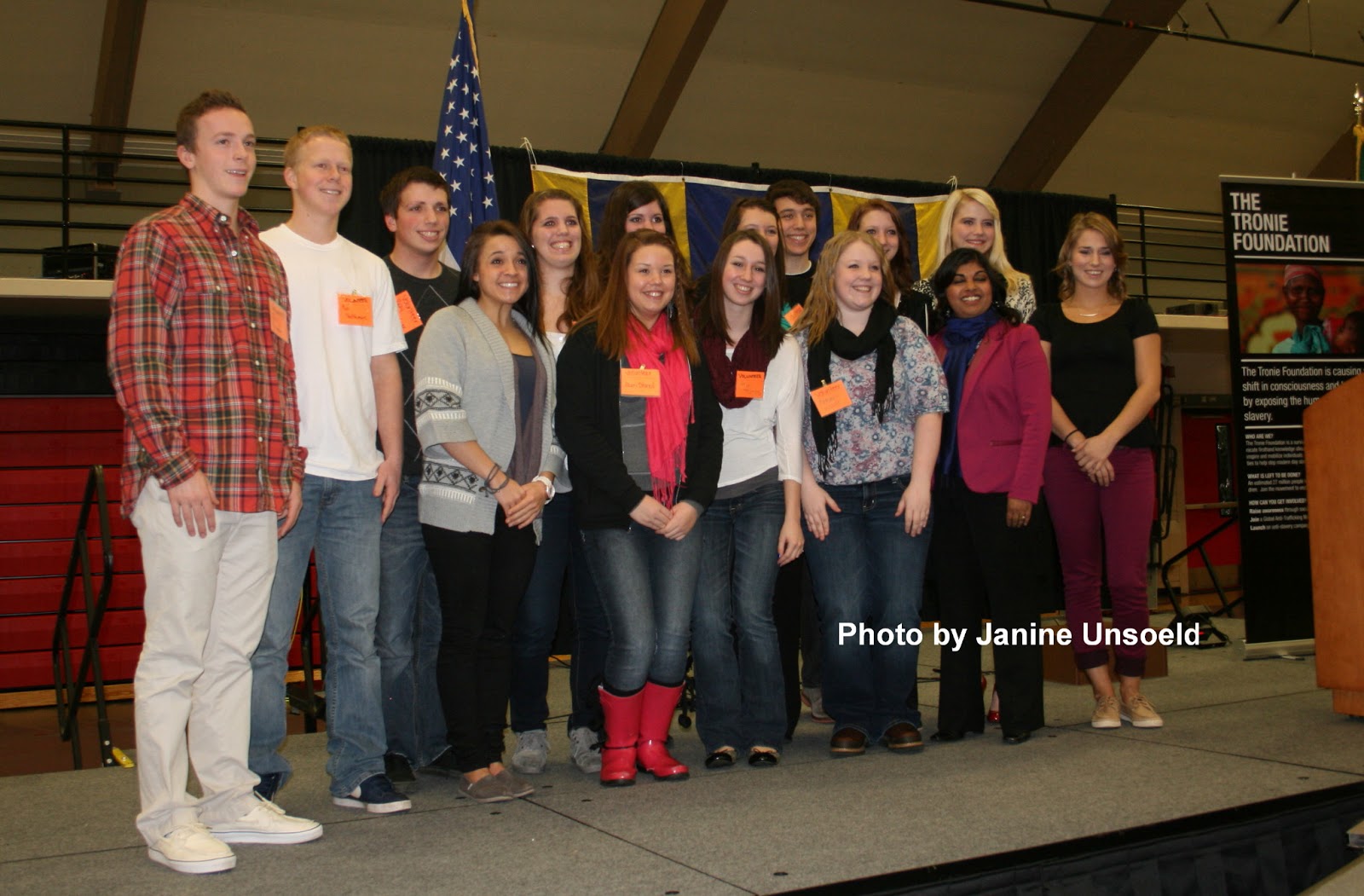 |
| Above: Rotary Interact student club members helped organize the event to bring Elizabeth Smart to the South Sound. Students from Rainier High School, Olympia High School, and Timberline High School pose with Rani Hong, second from right, first row, and Elizabeth Smart, back row, first from right. |
Tuesday, January 1, 2013

Thursday, December 27, 2012
2012: A Busy, Rough Year for Olympia's Police Department
"People don’t call the police because they are having a good day...."
by Janine Unsoeld
www.janineslittlehollywood.blogspot.com
On a daily basis, an on-duty police officer is potentially tasked with responding to reports of vehicle thefts, loitering, drug related offenses, suicides, traffic accidents, home and retail burglaries, disorderly conduct, domestic disturbances, and, in the summer particularly, loud parties.
Add to that public service calls such as welfare checks on the elderly or others in need. Add to that the responsibility of being put on the front lines of an increasingly deteriorating economic situation that puts more homeless and mentally ill on the streets, and officers also become required to be all-round social service workers.
Add five homicides to that, and you have a department that is strapped, both emotionally and financially.
It's been a busy, rough year for Olympia's police department.
Dealing with a diverse population with growing needs is challenging for officers in cities across the country, both in large cities, and smaller ones, such as Olympia.
Recently, when Olympia city manager Steve Hall urged the council to create an emergency ordinance to not allow camping on the grounds of city hall, it was an effort to better protect city staff and the public entering the building, and move a homeless population elsewhere. The council did not pass the ordinance and the homeless are still able to camp there - for now. The homeless are escorted away from the front of city hall by staff and sometimes police officers and the area is cleaned every morning with pressure washers at 6:00 a.m. City hall doors open to the public at 8:00 a.m.
As Mayor Stephen Buxbaum said during a recent city council meeting, "we have an outstanding (police) force - I think they do a good job. Unfortunately, police are too often on the front line of social issues and are forced to manage a situation with too little resources."
Referring to homelessness, he said, "This is not an Olympia problem, it's a national problem...Olympia is not alone...most are homeless out of other issues. It's not a problem of homelessness but health and safety...."
A Quick Profile of the Olympia Police Department
Creating a ever-growing laundry list of questions and concerns earlier this month, I met with Sergeant Paul Johnson and Laura Wohl, public information officer for the Olympia Police Department (OPD).
Based on those interviews, several clarifying, follow up emails, and other research, here is a quick profile of the department and other issues and challenges facing the Olympia Police Department.
- In 2011, OPD responded to about 50,500 calls for service and, as of six days ago, is on track to respond to 52,000 calls for service in 2012. That’s more than one call for service per capita.
- The Olympia police department is composed of 64 commissioned officers, including Chief Ronnie Roberts, a commander, four lieutenants, eight sergeants and 50 police officers and police recruits.The department also has nearly 29 civilian and limited commissioned employees. "Limited commissioned" employees are jail staff who have some, but not all, of the same authority as police officers.
- Officers are divided into four shifts: daytime, two swing shifts, and one graveyard. The number of officers on duty per day varies, with no lower than four. All shifts overlap in time. Right now, one or two officers work three days a week downtown. The city is divided into four sections: westside, downtown, northeast, and southeast. Scheduling is "incredibly complicated," says Wohl, due to the shifts, contracts with labor unions, vacation schedules, and sickness and other issues.
- The department is not fully staffed, and there's no "borrowing" of officers from other cities. Officers work overtime, providing the department with safety and financial concerns. The department has hired six new officers in 2012, with seven left to fill.
- Officers can retire at age 53, which puts them on the leading edge of the baby boomer age, causing real problems in recruiting and hiring. Officer tenure in Olympia is very long, and rarely has someone left the department. It takes one year to fully train an officer so that he or she is able to operate as a solo officer.
- There are no African American police officers in the department. There is one Asian American officer. Wohl did not know the answer about the number of Hispanic officers, because she said she is not sure which officers meet that category.
- There are seven women officers in the department, and two currently in the police academy.
- There are two Spanish speaking officers, one of whom is from Spain and speaks Basque. Wohl did not know what dialect of Spanish the other officer speaks. The department has one Russian speaking officer, and one certified American Sign Language speaker.
Johnson said an interpreter of some sort is needed "once every couple of weeks." Officers are needed who speak Spanish and Asian languages, particularly Vietnamese and Cambodian, to meet the needs of an increasingly diverse population in the area. When needed, out of area interpreters are contacted through a national commununications center and patched in on a telephone. "There's a cost to it...and the defendent speaks to him or her. It's OK for certain things but it can't be used as evidence, so if we have a crime, we need a certified interpreter to testify," says Johnson.
- Officers are paid an average of $61 an hour in overtime (time and a half). Sergeants receive more per hour. When asked how much overtime has been expended by OPD in Thurston County's pursuance of their case against Scott Yoos, Wohl says the department has no way of tracking regular hours or overtime related to a specific case. (For more information about the Scott Yoos case, see other articles by Janine Unsoeld at www.janineslittlehollywood.blogspot.com and type in key words into the search button.)
- There are gangs in Olympia, with an uptick in their presence in the last two years. They come primarily from Pierce County.
- Residential burglaries are "huge," says Wohl, much larger than in previous years, mainly in the northeast and westside, and a recent rash in the southeast neighborhoods. The department is not clear why, but a large percentage are drug related. Olympia has a huge heroin and methamphetamine problem. Sixty-nine percent of residential burglaries this past summer were due to unsecured homes and garages. Vehicle prowls are also rising.
The best advice the department can give residents, Wohl says, is to "secure your homes and cars." Neighbors looking out for other neighbor's homes and property is also key.
The department receives hundreds of calls a day. "People will call the police for everything, even to ask for directions on how to get to Best Buy. We do our best to direct people, because they are used to calling the police department for everything," says Wohl.
Wohl said dealing with the mentally ill is one of the biggest responsibilities currently facing the police department.
"They are disruptive, scary, and threatening...the police are caught between a rock and a hard place," says Wohl. "There doesn't seem to be a single social service agency that can deal with them...these are often people known to us, and they've been declared incompetent. Then, they end up in jail. That's not the place for them."
She said the police chief is trying to build a net for the mentally ill by working with the city prosecuting attorney.
"It's necessary to find solutions....for example, we have not one, but two individuals who are paranoid, and call 911 hundreds of times a day. Not only does this tie up 911 resources, but it ties up officer's time," said Wohl.
How Does One Find Out About An Incident Involving the Police?
Wohl said that the department has two databases. One is a computer-aided dispatch log, called a CAD log, which documents every call responded to by the department. For example, following a public records request, I looked at a CAD log summary from June 1 - July 1, 2012. It was 168 pages, with about 27 listings on each page. That's about 4,536 calls in the month of June. If a call becomes a case, then it is assigned a case number.
Meeting with Wohl a couple weeks ago, I inquired about a situation I had heard about and had done a public records request based on the information I knew: a big, deaf man was Tasered by Olympia police on Percival Landing in July. You'd think that would have garnered the necessary report, but since I did not know a case number, I was given a massive file of calls reported in July. I could not find the actual case.
After our interview, Wohl provided me the report.
Deaf Man Tased On Percival Landing - Mentally Ill or Just Singing and Dancing?
The case I specifically requested information about seems to illustrate many challenging issues facing the Olympia police department. Although the case is a matter of public record, Little Hollywood is choosing not to identify the individual or the officers. Whether the man involved in this case is actually mentally ill was not determined.
In a case the police classified as a "mental problem," Olympia police were dispatched to Percival Landing for a report of a disorderly adult male on July 4th. The caller who reported the man said that the person was running around yelling and screaming, appearing to be under the influence of something.
According to the officer's report, the man was large. The report says the man was 6'4 and 242 pounds. The officer says he made "several attempts to draw his attention to me, before I was immediately upon him. I yelled to get his attention, but he did not respond....He looked away from me, walked about 15' to the base of a tree, where he knelt down and started digging in the dirt with his hands...." The officer again attempted to get his attention, to no avail. The officer attempted to secure the man. The officer says, "(I) drew my Taser CED, pointed it at (his) upper back" and directed (the other officer) to handcuff him. The man resisted, and (the first officer) again Tasered the man. The CED produced the desired affect, in that (the man) immediately stopped resisting and rolled to his back. He did remain tense...there was no further use of force, and no injury, other than 2 CED probe wounds."
"(The man) had now stopped screaming, but took a seated position on the ground and kept trying to scoot away from us. He still ignored all attempts to try to communicate with him. One citizen approached and told us she believes (the man) is deaf. That does appear to be the case. Medics responded to the scene and attempted to evaluate (his) condition. He was transported to St. Peter Hospital by private carrier. Upon medical clearance, (he) will be committed to Crisis Services for a psychological evaluation."
The report goes on to say that a supervisor was called to the scene, and conducted several interviews of people who witnessed the incident. A woman on the scene felt the officers used inappropriate force. The woman said that the man was "just singing and dancing on the grass, and said she didn't know why officers were called or what they were told, but did not feel that the male deserved the actions she had witnessed from the officers. She further stated she had not heard verbal commands given to the male."
Another woman interviewed said that she, her husband, and a friend did observe the male for about ten minutes and it did seem that his behavior was "odd."
Another person, the man who made the initial phone call to the police, said that it wasn't his intention to get the man in trouble, but that he thought the situation should be "checked out".
Another man approached the police officers and the supervisor and said he knew the man was deaf because he had witnessed an incident involving the man at the Salvation Army the day before.
In closing, the report by the supervisor, the acting sergeant of that shift, states, "The actions of both officers were within policy and met with the reasonable officer standard based on the totality of the circumstances."
According to Wohl, the case was also reviewed by the patrol lieutenant for the team involved, the professional standards lieutenant, the commander and the chief.
Wohl said the department does track the number of Taser uses by the department, and that information will be provided to Little Hollywood in January.
Police Oversight: Citizen Review or Police Auditor...or Neither?
According to Wohl, the Olympia police department does not have a police auditor - the position was cut for budgetary reasons in 2009. The department has never had a citizen review panel, although there has been discussion about it.
"It is very unusual for a department of our size to have a citizen review panel. If a citizen makes a complaint, a professional standards lieutenant does a complete investigation into policy and law. For some complaints, a dispute mediator is used, for example, if a complainant feels an officer was rude....it's different than any other employment situation. It's a full investigation when a complaint is made of any kind," says Wohl.
"After the professional standards lieutenant makes his or her findings, it is reviewed by the commander and chief of police. If it is sustained, disciplinary action is taken. If somebody doesn't like the determination, and feels they have been harmed, they can make a claim with the city, or file a civil liability tort, and sue us."
In the past, a police auditor reported directly to the city council. The auditor, hired on an annual contract, reported on a quarterly basis, and conducted an internal affairs investigation, looking into use of force and other complaints.
It is not clear from the July police report regarding the incident on Percival Landing how or whether training protocol designed to help police deal with the deaf and hard of hearing was followed. The report does not describe how the officers attempted to get the man's attention, how they missed the fact that he was deaf, nor does it say that the man attempted to use sign language or indicate to officers that he was hearing impaired.
Crisis Intervention Training for Police Officers
A 13 minute training video to help police deal with the deaf and hard of hearing has been viewed by all Olympia police department officers, says Sergeant Paul Johnson. The video and training course manual was reviewed by this reporter through a public records request in September.
The video is part of a 40 hour Crisis Intervention Training (CIT) course curriculum created in 2008. It is sponsored and prepared by several agencies including the National Alliance on Mental Illness, Providence St. Peter Hospital, Behavioral Health Resources, the Olympia Police Department, and United Way of Thurston/Mason County. The material is taught by guest instructors and adapted from Seattle, Portland, and Memphis police department curriculum.
Sergeant Paul Johnson says that "most officers" have been through the CIT course training. "My hope is that everyone can (take it). It's pretty expensive - it takes a week to put an individual through the class, and they have to be compensated by state law. So, getting off-duty officers to come in and take it is difficult," says Johnson.
Training Video to Deal With the Deaf and Hearing Impaired
According to the video, which outlines several scenarios and procedures for getting the attention of the deaf and hard of hearing, about 12% of the population has some form of hearing loss.
The video says that "when people have a hearing loss, they should let you know of their situation and how they will need to communicate...the individual may be very expressive with their hands and facial gestures. Be prepared for this as it is part of their communication. Also be aware that some persons who are hard of hearing may speak in a very loud voice. This has often been wrongly interpreted as someone who is angry and aggressive...by contrast, the person who is smiling at you and not responding may not be understanding you."
The video continues, "When giving instructions, keep in mind they cannot understand you if they cannot see your face. Explain procedure and demonstrate facing the person what you want them to do. This can also be a problem when applying handcuffs to the person. Again, first explain what you are going to do before you do it. Handcuffs will also not allow the person to use hand signals when trying to communicate."
The video also states that "just because they (those detained) are hard of hearing or deaf does not mean they cannot pose a threat," pointing out that there is a need to communicate differently without compromising one's safety.
Challenges and Future Conversations
Olympia compares itself to other cities based on city population, rather than department size. Some of our comparable cities are: Auburn, Bremerton, Federal Way, Lacey, Lakewood, Lynnwood, Marysville, Renton and Richland. However, Olympia is unique in several ways.
"For our size, we have a lot of activity - not necessarily criminal - but because we are the state capitol, we have an active citizenry. Other communities are not as active. One of our biggest challenges too, unlike other cities in the county, is that we have a downtown. It's a gathering place. We also have a traveling population, due to having a major transit station (Greyhound), and they don't necessarily have ties to the community," said Wohl.
Asked last week if there was anything else she'd like to add to help community members better understand the Olympia police department, Wohl said, "One thing that I don’t think most people understand is the nature and volume of work we have...people don’t call the police because they are having a good day – they call them when something has gone wrong. Officers often deal with people at emotional extremes and they do it calmly and effectively day in and day out."
For more information: The Olympia police chief meets with community groups, neighborhood associations, social service and civic groups upon invitation. If you would like to meet with Chief Ronnie Roberts, call Laura Wohl at lwohl@ci.olympia.wa.us or (360) 951-8889, or go to the police department webpage at www.olympiawa.gov.
Wednesday, December 19, 2012
Emergency Shelters for the Homeless Go Year Round
Emergency Shelters for the Homeless Go Year Round
by Janine Unsoeld
www.janineslittlehollywood.blogspot.com
Advocates for the homeless are a devoted, seemingly tireless, loose connection of social service organizations, faith communities and people concerned about homeless issues.
Recently, many have eloquently spoken up, some for the first time, at Olympia city council meetings in response to ordinances that move homeless campers away from city hall property and criminalize sitting or lying on sidewalks.
Much of their work is behind-the-scenes for most of us, but very much on the front lines for those who need it most.
In a spot of good news in what is a daunting, ongoing issue for the community, these advocates, along with area congregations, have now made it possible for emergency shelters to be open year round. Funding to take this new step came from Thurston County and United Way.
The new shelter coordinator, Laurian Weissner, coordinates locations and their schedules. His part time paid position with Interfaith Works is currently funded for one year.
"Traditionally, the shelters for homeless men and women have operated seasonally during the cold weather months, ending in February for men, and ending in March for women," said Weissner, in an interview today.
Weissner says that in order for the shelters to be operational year round, current participating churches host twice a year. He has the women's shelters tentatively scheduled through the beginning of May and is appealing for two or three more congregations to "step-up" and help host the shelter.
Weissner urged that anyone needing emergency shelter should call (360) 515-5620. He also emphasized that people will not be denied shelter for theological reasons, meaning, they will not be required to participate in any religious ceremonies sponsored by the host church.
The women's shelter provides 18 beds for the homeless women, while the men's shelter provides 12 beds. Unused beds at the women's shelter are also available to families when the Family Shelter is full.
Local churches shelter homeless women in two week rotation cycles. St. Michael Parish on Olympia's eastside and Sacred Heart Parish in Lacey shelter homeless men. Coordination and screening to house the men and women is done through Sidewalk, Olympia's homeless advocacy and support center, and Interfaith Works.
The women's shelter is currently at The Lutheran Church of Good Shephard, on North Street in Olympia.
Partnership Organizations
The women's emergency overflow shelter provided 1,786 bed-nights of shelter in winter 2011-12, hosted on a rotating basis by 12 different congregations. The shelter is now officially called the "Women's Interfaith Shelter."
"Usage of the shelter in November 2012 was about double the volume of the previous year," said Danny Kadden, executive director of Interfaith Works, in an email to Little Hollywood yesterday.
"After 22 years of operating various types of winter-only shelters, we heard a growing chorus of our faith community members seeking ways to serve the year-round needs of unsheltered people. With funding in hand from the County and United Way, Interfaith Works will begin in Spring 2013 operating the faith-based shelters for both men and women every night of the year. This will require significantly more volunteers and participating churches and temples than ever before, but we are all determined to fill this gap in our shelter system," said Kadden.
There are few alternatives for women without Interfaith Works' shelter involvement. The Salvation Army has only 14 beds for single women and has limitations on the length of their stays. Bread and Roses can only serve 12 women at a time and sometimes has a waiting list.
The system is complicated for all who are involved. Apart from the Salvation Army and Interfaith Works' shelter, youth 22 years or younger are served by Community Youth Services. Families are served by the Family Support Center, and women fleeing domestic violence are served by Safeplace.
When and if Olympia's Smith building on 8th Avenue is operational, it will have family transitional housing on top, and a family shelter on the bottom. That's the long-range vision. Funding for it is significant.
Advocate Christie Kruger
Christie Kruger, a longtime, trained volunteer advocate for the homeless, urges more churches to become involved in hosting the homeless.
"Churches do not have to be a member of Interfaith Works to participate in the rotation, but they preferrably need to be on a bus line."
Kruger serves the homeless in multiple roles as an in-take coordinator at Sidewalk, conducting brief interviews with people who walk-in needing housing or referrals to other resources. She also assigns clients to other volunteers for longer term advocacy. Sidewalk advocates help clients fill out applications, apply for state and federal benefits and find housing.
"There's layers and layers of work, depending on their situation. It can be overwhelming." Kruger does suffer from burn-out from time to time, but it doesn't last long.
She's also an overnight host at the women's shelter operated by Interfaith Works. Volunteer hosts check in the shelter guests, spend the night at the church with them, and do laundry. Two hosts sleep over each night. One of the hosts needs to be a woman. Shelter hours are from 7 p.m. to 7 a.m. with lights out at 10 p.m.
As if that's not enough, she also schedules volunteer hosts for Camp Quixote, the homeless "tent city" that rotates from church to church.
Kruger, who has an approachable, friendly style, spent several nights with the women when St. John's Episcopal Church hosted the women's shelter from November 30 to December 13.
"Reaching out to the poor is a basic tenant of almost every faith...it's in their ministry," says Kruger.
"One of the benefits of doing this type of work is breaking down stereotypes and stigmas. Participating congregations will find they create and enrich a sense of community in their hosts as well as for the guests who might otherwise be outcast or socially isolated."
"If the homeless don't get screened into a shelter, where can they sleep safely, or at all? That's what it comes down to...." says Kruger.
SideWalk will be having a volunteer training in January. Go to www.walkthurston.org and click "volunteer" to sign up for training or find out more information.
Sidewalk is currently looking for volunteers to serve as greeters, hospitality volunteers, volunteer support specialists, advocates, and intake specialists. Volunteers can give as much or as little as they are able, though most of Sidewalk's work is done during business hours, Monday- Thursday from 10 a.m.-2 p.m.
For more information, contact Emma Margraf, Community Outreach Manager at Sidewalk at (360) 515-5587 or emma@walkthurston.org.
Interfaith Works has comprehensive information, including a calendar of events and activities, on their website at www.oly-wa.us/interfaith.
Olympia City Council Moves Against Camping On City Property
Olympia City Council Moves Against Camping On City Property
by Janine Unsoeld
www.janineslittlehollywood.blogspot.com
Homeless campers can stay put for now on the grounds of city hall and other city properties, such as the Olympia Center. Upon hearing the news during the city council meeting, many started bedding down for the night near the doors of city hall about 10:00 p.m.
On first reading, the Olympia City Council passed a proposed ordinance Tuesday night against camping on city property, which means there is time to put to work several ideas addressing homelessness issues before the ordinance will be heard again on January 8, 2013.
Councilmember Cooper voted no against the ordinance.
After thanking city manager Steve Hall for his efforts, Cooper said, "I do think there are other ways to do it. When I ran for this office, I promised my wife I would use my power for good...I have a feeling in my gut that this doesn't reflect the community's values...." Cooper endorsed a Homeless Bill of Rights proposed by homeless advocate Rob Richards at last week's council meeting.
If the ordinance passes on second reading, the ordinance would become effective on February 8, and the homeless will have to find other places to sleep.
After an impassioned public comment period dominated by numerous advocates for the homeless, and discussion by council members, the resistance to not pass the ordinance tonight on first and final reading signaled a compromise in hopes that several ideas to address homelessness issues will have a chance to be put in place.
One such idea is a youth shelter tentatively called Rosie's At Night. Operated by Community Youth Services (CYS), Rosie's is a place in downtown Olympia where youth 21 years and younger can hang out, get food, obtain supplies and gain access to other community resources. Mayor Stephen Buxbaum said he has been in conversation with CYS executive director Charles Shelan about it for three months and thinks the shelter could be activated around January 23.
Buxbaum also said that additional council monies could be allocated to Interfaith Works for use by homeless outreach organizations like the Emma Goldman Youth Homeless Outreach Project (EGYHOP), and Partners in Prevention Education.
Buxbaum also said the Union Gospel Mission is exploring their own enterprise to create a shelter. He also said that there is a conversation with the Salvation Army to address a change in guest in-take procedures. "We need to find out what's wrong with the system that there are empty beds."
Meg Martin, an EGYHOP outreach worker, in her public remarks addressed the fact that the Salvation Army has vacancies at their shelter despite people being on the street because the organization has barriers that "take away people's respect, dignity, and choices."
She said that while she kept homeless people warm last night, offering them hot coffee, she spoke with 22 people who filled out questionnaires about their needs. In response to unmanaged camping, she presented the council a detailed proposal for a low-barrier emergency overnight shelter for those who do not utilize current shelters.
Another portion of the ordinance addressed a change in the use of sidewalks. It passed on first and final reading and restricts laying down on sidewalks between the hours of 7 a.m. and midnight. Again, Councilmember Cooper voted no, joined by Buxbaum, because it did not contain a sunset clause, which would allow it to expire in a year. The ordinance against busking was repealed.
This was the last city council meeting of the year. The next meeting will be Tuesday, January 8th. The proposed ordinance will be scheduled on the agenda under other business.
Land Use Committee Meeting
The minutes of the council's Land Use Committee meeting on Thursday, December 6 have still not been posted on line on the city's website or been made available to the public. The committee, chaired by Steve Langer, also includes councilmembers Julie Hankins and Jeannine Roe.
The December 6 meeting followed the contentious city council meeting of Tuesday, December 4. Councilmembers invited community members to come and provide input into what could be done about the many issues surrounding the proposed emergency ordinance to prohibit camping outside city hall and on city hall property. The meeting is said to have generated a great deal of input and a long list of creative ideas developed by homeless advocates. About 20 people were in attendance, including Meg Martin of EGYHOP, who proposed her outline for a low-barrier emergency overnight homeless shelter.
The meeting minutes, according to assistant city manager Jay Burney today, are said to still be in draft form and cannot be released until they have been approved by the committee. The committee cancelled its next scheduled meeting for Thursday, December 20. The meeting minutes are scheduled to be approved at their next meeting, January 24.
The meeting minutes could help other homeless advocates and community members not able to be in attendance stay informed and engaged in the current conversation. During tonight's council meeting, Jeannine Roe said the December 6th meeting was so good, she wished it could have been televised. However, it was not televised.
For more information about the proposed ordinance, go to www.janineslittlehollywood.blogspot.com and use the search button and use key words on this blog.
Monday, December 17, 2012
Witnesses To High Tide in Olympia

Above: Olympia experienced a 17.6 foot high tide event this morning. The Welcome to Percival Landing sign, barely seen above, is half underwater at about 8:30 a.m. The words were fully underwater just minutes later.
Witnesses To High Tide in Olympia
by Janine Unsoeld
www.janineslittlehollywood.blogspot.com
A group of about 30 community members met early this morning in Percival Landing's warm and cozy Harbor House for sweets, hot coffee, and conversation. Folks gathered not just to enjoy each other's company, but also to serve as climate change witnesses.
Olympia experienced a high tide this morning that literally threatened to lap at the walls and doors of at least one downtown business. Tides are everyday occurrences, of course, but their impacts are magnified when combined with sea-level rise and storm events.
While it wasn't the highest tide on record for downtown Olympia - Jim Lazar said he remembers an 18.1 foot tide in December of 1978 - the brief meeting prompted a renewed awareness and action in the face of climate disruptions and its causes.
"There was a predicted 16.6 feet high tide this morning, but it measured 17.6. It's the highest as I've ever seen it," said Andy Haub, city of Olympia's public works planning and engineering manager, as he walked along Percival Landing this morning.
"The barometric pressure was below 29 this morning - that's why we're seeing it this high. A low barometric pressure - that's what we've seen yesterday and today - can add a foot and a half, " he added.
Stephanie Johnson, city of Olympia's arts and events program manager, said the new portion of Percival Landing was designed at a height of 19 feet.

Above: Glen Anderson and TJ Johnson walk on the parking lot this morning behind the Oyster House restaurant, surrounded by the sea water of Puget Sound's Budd Inlet. On the far left is the Capitol Building.
Giving a whole new meaning to waterfront dining for downtown restaurants, the water elevation of Budd Inlet was higher than Olympia's street elevation, so Budd Inlet was flowing up into the stormwater pipes. Electrical outlets and wiring were visibly underwater near the Oyster House.
A truck driver with Food Services of America, delivering food to the Oyster House, attempted to maneuver his truck close enough to the business to avoid getting wet. He was not successful. His shoes and feet, up to his ankles, became fully soaked.

Stormwater and combined sewer drains were also seen backing up near Anthony's Restaurant and Budd Bay Cafe. Budd Inlet was also seen perilously close to Bayview Thriftway.


Above: Bayview Thriftway and Budd Inlet.
Buxbaum said that there is no doubt we are facing sea level rise "due to a lethal overheating of the planet Earth" and that it's time for a community conversation about the issue.
"We're dealing with antiquated planning systems...On a state and federal level, we need large scale infrastructure programs...it's really a challenge. Public awareness is critical...it's probably not going to be about one solution. We need to stick to the facts and not jump to conclusions. We need creative solutions and not assume that we have a solution, because we don't," said Buxbaum.
Former city councilmember TJ Johnson commented on the amount of money currently being proposed to rebuild the East coast areas recently hit by Hurricane Sandy. "There is not enough resources on the planet to retrofit all coastal based communities...we need place-based investments."
Commissioner Karen Valenzuela said she appreciated the conversation, saying it's one the community has not yet had. "Is a sea wall possible? Do we want to pay for it?"
Former mayor Bob Jacobs said that, in the past, the knee-jerk reaction was to say 'we're not going to abandon downtown' and protect downtown Olympia at all costs.
"But when the underlying factors change, it's time for all options to be on the table. It may be that some level of abandonment may be appropriate for some portions," said Jacobs.
For more information about confronting the climate crisis on a local level, go to the Olympia Fellowship of Reconciliation's website at: www.olyfor.org. The organization has started a new climate action group that meets every second and fourth Tuesday at the Olympia Center.

Above: Sherri Goulet braves the wind and rain this morning along Percival Landing. During the gathering this morning, Goulet said that peace and justice issues are part of the climate change discussion, and "we need to bring it to folks so it's on their radar."
Subscribe to:
Posts (Atom)